Best technique for pre-spawn perch
Oh, the joy (and sometimes the frustration!) of targeting those feisty yellow perch right before they get serious about spawning! It's that magical window when the water is just starting to shed its winter chill, or the ice is thinning, and those perch are looking to put on the feedbag to fuel up for their big event. Sometimes it feels like they're everywhere, and other times, you could swear they've vanished into thin air. This guide is all about honing in on those pre-spawn perch in New Hampshire, helping you understand their movements and the techniques that will put more of them on your line.
Understanding Pre-Spawn Perch Behavior: What Drives Them
Before you can catch them, you really need to understand what's going on in the minds (or, well, instincts) of these fish. Pre-spawn perch are driven by two primary things: feeding and staging. They're still somewhat in their winter patterns, but with a growing urgency to fuel up and move towards their eventual spawning grounds. This makes them predictable once you crack the code, but they demand a specific approach.
The Urge to Feed and Stage
As the water temperatures begin to slowly creep up from their winter lows, typically hovering in the high 30s to low 40s Fahrenheit, a biological switch flips in perch. They sense the coming spring and the need to reproduce. This means they'll start actively seeking out food sources to build up the energy reserves necessary for spawning. Unlike in the dead of winter where they might be sluggish, pre-spawn perch are often quite aggressive eaters. They're not necessarily "on the bite" all day, every day, but when you find an active school, they can be ravenous.
At the same time, they're beginning to "stage." This means they're moving out of their deepest winter holding areas and starting to migrate towards the shallower, weed-laden flats or woody debris where they'll eventually deposit their eggs. This staging might involve congregating in transition areas – think subtle depth changes, the edges of drop-offs, or underwater humps adjacent to those shallower spawning zones. They won't be fully committed to the shallows yet, but they're getting there. Your job is to intercept them in these transitional spots.
Depth and Structure Preferences
During the pre-spawn period, perch aren't usually in the extreme depths they might inhabit mid-winter, nor are they fully in the shallow weed beds where they'll spawn. Instead, they favor those "in-between" zones.
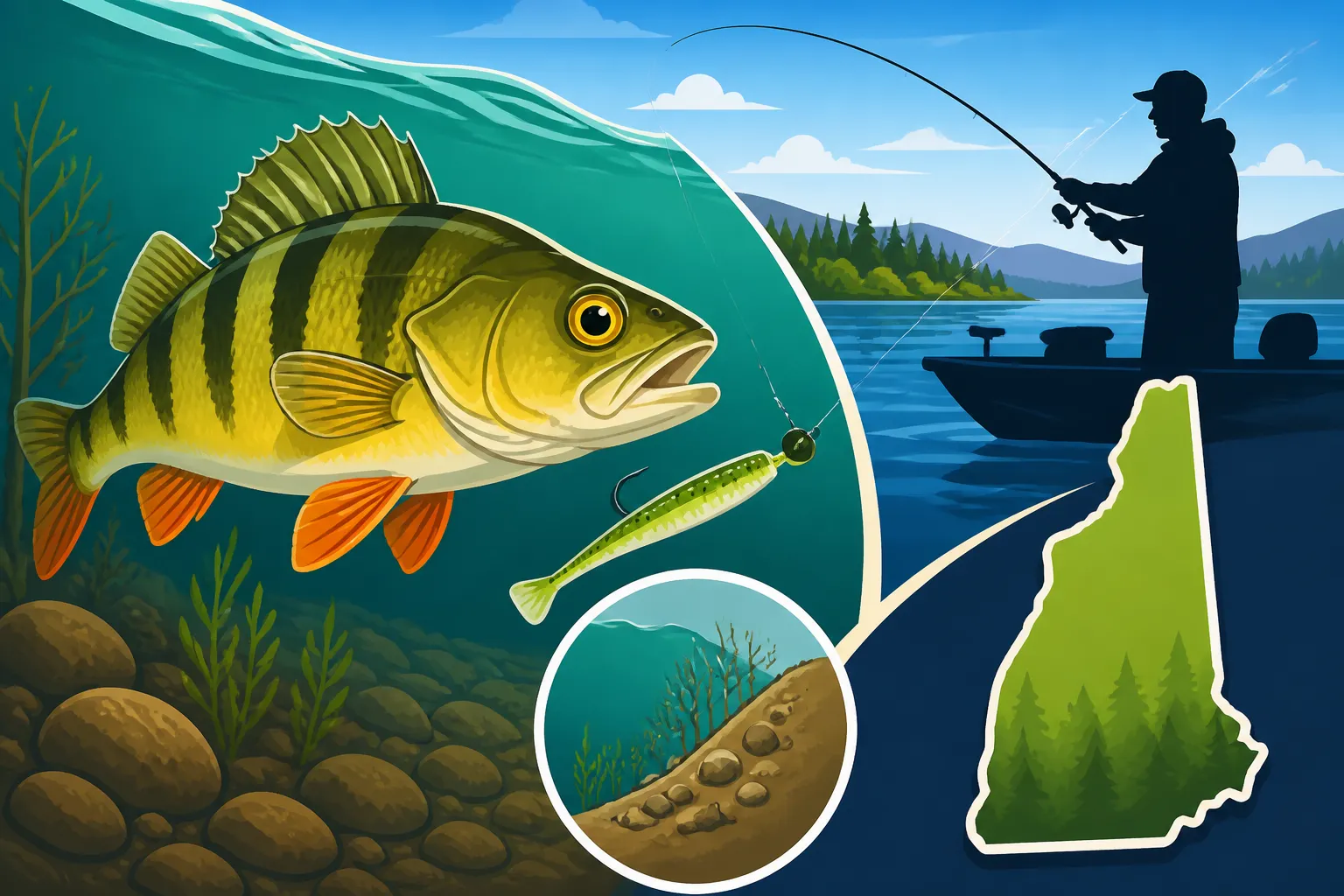
Look for them relating to structural elements that offer both cover and access to food, often in depths ranging from 15 to 30 feet, depending on the lake or pond. Submerged humps, the deep edges of points, channel swings, and areas where rock meets soft bottom are prime candidates. They often school up tightly in these spots, making them a fantastic target once you locate them. If you're fishing a lake with distinct contours, identifying these features on a good topographical map (or with your fish finder) is absolutely crucial. Think about a classic New Hampshire pond: where does a gentle slope suddenly drop into deeper water, or where is there a gravel bar extending out into a main basin? These are the kinds of spots that scream "pre-spawn perch!"
Locating Pre-Spawn Perch Hotspots in New Hampshire
Finding these staging areas is half the battle. Whether you're drilling through the last of the season's ice or casting from a boat on newly opened water, a systematic approach will save you a lot of time and frustration. The key is to cover water, understand the subtle cues the environment gives you, and leverage technology.
Reading the Water and Utilizing Electronics
When you're out on the water, whether it's iced over or open, observation is your first tool. For open water, watch for subtle currents, changes in bottom composition indicated by shorelines (rocky points often extend underwater), and areas where shallower flats give way to deeper basins. These transition zones are gold.
This is where your electronics truly shine. A good fish finder, whether it's a portable unit for ice fishing or a console-mounted one for your boat, is indispensable. You're looking for schools of fish, often tightly packed, hovering near the bottom or suspended slightly above it. Don't be afraid to drift or slowly motor over promising areas while constantly scanning your sonar. If you're on a budget, even a basic portable fish finder can make a huge difference in confirming the presence of fish. Checking out something like Best portable fish finder for kayak fishing can give you an idea of what to look for, even if you're not in a kayak.
Ice Fishing Considerations: The Last Ice Frontier
For those brave souls hitting the tail end of ice season, the pre-spawn period can be phenomenal. However, safety is paramount. The ice conditions can change rapidly in early spring. Always check the ice thickness with a spud bar as you go. For more details on ice safety, make sure to read How thick ice needs to be to fish safely in New Hampshire.
When ice fishing for pre-spawn perch, focus your efforts on the deeper edges of bays, points that jut out into deeper water, and underwater humps. Instead of drilling just one hole and waiting, drill a series of holes in a grid pattern or along a depth contour. This allows you to "walk" your way across a potential staging area until you pinpoint the active school. Once you find them, you'll often be able to stay on them for a while, pulling fish after fish. Remember, while you're out there, familiarize yourself with the specific rules for your chosen spot by consulting New Hampshire Ice Fishing Regulations by Water Body.
Open Water Scouting: Early Season Adventures
As the ice finally recedes, revealing the chilly open waters of New Hampshire's lakes and ponds, pre-spawn perch offer some of the first exciting fishing opportunities. Without the ice to guide you, your boat and sonar become even more critical.
Start by targeting areas adjacent to known spawning grounds – typically shallow, vegetated bays or flooded timber areas. Perch will stage on the deeper, open water side of these areas, moving in and out as water temperatures fluctuate and the spawn draws nearer. Use your boat's trolling motor to slowly cruise these deeper edges, constantly watching your fish finder for those tell-tale schools. Points, submerged humps, and even just subtle changes in bottom composition can hold big numbers of fish. Pay attention to how the wind is affecting the water; sometimes a gentle breeze pushing across a point can concentrate baitfish and, in turn, the perch.
Top Techniques and Lures for Pre-Spawn Perch
Once you've located those pre-spawn perch, the real fun begins! These fish, while often aggressive, can still be a bit finicky in colder water. You need techniques that are subtle enough to entice them but also offer enough flash or scent to grab their attention.
Jigging with Finesse
Finesse jigging is arguably the most effective technique for pre-spawn perch, especially when they're schooled up. The key is to use small lures and a very sensitive rod.
- Tungsten Jigs: These tiny jigs are dense, allowing them to get down to depth quickly and providing excellent feel. Tip them with a small piece of live bait (like a maggot or a wax worm) or a tiny soft plastic grub. The action is usually a subtle lift-and-drop, letting the jig flutter and settle. Often, the bite will be a barely perceptible tap or just a feeling of "weight" on your line.
- Small Spoons: Tiny jigging spoons, like those you might use for trout, can also be deadly. A 1/16 oz to 1/8 oz spoon in silver, gold, or a perch-pattern can be dropped down and jigged with short, sharp snaps. The flash and vibration can call in perch from a wider area.
- Best Practice: Whether you're ice fishing or on open water, watch your line carefully. Sometimes perch will hit on the fall, and your line will just go slack or twitch. A really good, sensitive rod is key here, and you can find a wide selection of them on Amazon. For more specific insights on jigging, check out Jigging for Perch Through the Ice.
The Power of Live Bait
Even with all the fancy lures out there, sometimes nothing beats a natural presentation. Live bait is a perennial winner for perch, particularly when they're still in that somewhat lethargic, cold-water pre-spawn state.
- Minnows: Small shiners or fathead minnows are often irresistible to perch. You can rig them in various ways:
- Under a Float: In open water, a small minnow hooked lightly through the back or lips, suspended under a slip bobber, can be incredibly effective. Let it drift over humps and along drop-offs.
- Drop-Shot Rig: For both ice and open water, a drop-shot rig keeps your minnow suspended just off the bottom. Hook the minnow through the back or nose. The weight on the bottom lets you maintain contact and feel subtle bites.
- Tipped Jigs: As mentioned, a small piece of minnow or a whole tiny minnow on a tungsten jig is a fantastic combination of attraction and natural appeal.
- Worms and Maggots: Earthworms (especially smaller pieces) and maggots (or their slightly larger cousins, wax worms) are fantastic for tipping jigs or fishing on tiny hooks. They emit natural scent that can draw in finicky perch.
- Scent Advantage: The natural scent and subtle movement of live bait can often trigger bites when artificial lures are ignored. Don't underestimate the power of a lively minnow during this period.
Spoons and Rattle Baits: Drawing Them In
When perch are scattered or you're trying to cover a larger area, or when they're in a more aggressive mood, spoons and rattle baits can be excellent tools to draw them in.
- Jigging Spoons: These are heavier spoons designed to be vertically jigged. Sizes from 1/8 oz to 1/4 oz are typically good. The fluttering action on the fall is what often triggers a strike. Experiment with different colors – silver and gold are classics, but bright colors like chartreuse or orange can also be effective, especially in stained water.
- Blade Baits: These are thin, metal lures with a lead belly that vibrate intensely when jigged. The vibration sends out strong pulsations that perch can detect from a distance. Again, a quick lift and a controlled fall are key.
- Rattle Baits (Lipless Crankbaits): While often associated with bass, smaller lipless crankbaits can be fantastic for perch, especially in open water. The internal rattles create noise and vibration, and the tight wiggle on the retrieve can be very appealing. Drop them down and rip them up, or use a steady retrieve near the bottom. These lures work well for attracting attention and can be found in various sizes and colors on sites like Amazon. For specific recommendations, you might want to look at Best Panfish Jig Colors for Winter.
Soft Plastics and Micro Baits: The Subtle Approach
Sometimes perch want a very subtle, lifelike presentation without the bulk or strong vibration of other lures. This is where soft plastics and micro baits come in.
- Small Grubs and Tubes: Tiny soft plastic grubs (1-2 inches) or tube jigs rigged on small jig heads (1/32 oz to 1/8 oz) can be incredibly effective. The soft plastic mimics small baitfish or aquatic insects, and the subtle tail action can be irresistible.
- Mimicking Natural Prey: Think about what perch eat: minnows, insect larvae, tiny crayfish. Choose soft plastic colors that mimic these natural food sources – greens, browns, clear with glitter, and white are often good starting points.
- Slow Presentation: The key with soft plastics is often a very slow, almost dead-stick presentation. Let the lure sit on the bottom, twitch it gently, let it fall again. Perch will often pick it up when it's barely moving. Berkley Gulp! baits, which combine the lifelike feel of soft plastic with a powerful scent, can be particularly effective when perch are being finicky. You can browse a wide selection of these versatile baits on Amazon.
Essential Gear for Pre-Spawn Perch Fishing
Having the right tools for the job can make a significant difference between a frustrating day and a successful outing. Pre-spawn perch require gear that prioritizes sensitivity and finesse, allowing you to detect those subtle cold-water bites.
Rods, Reels, and Line: The Feel Factor
Sensitivity is king when fishing for pre-spawn perch. They don't always hit like a freight train, especially in colder water.
- Rods: Look for light to ultra-light action spinning rods, typically 5 to 7 feet in length. Graphite rods are excellent because they transmit even the slightest tap up the line to your hand. A fast or extra-fast action tip will help you detect bites and set the hook quickly. This level of sensitivity is crucial. If you're ice fishing, a short, sensitive ice rod is essential. For open water, a good quality ultralight rod is worth the investment. Explore Best ultralight rod for panfish for more specific recommendations.
- Reels: Pair your sensitive rod with a small, lightweight spinning reel (sizes 500-1000). The smoother the drag, the better, as you'll be using light line.
- Line: Monofilament line in 2-4 pound test is a common choice for its stretch, which can act as a shock absorber. However, many anglers prefer fluorocarbon or braided line with a fluorocarbon leader for increased sensitivity and less stretch. Fluorocarbon is nearly invisible underwater, which can be an advantage in clear New Hampshire waters. Braided line offers incredible sensitivity, but its visibility means a fluorocarbon leader is almost always necessary.
Electronics: Your Underwater Eyes
In today's fishing world, electronics are no longer a luxury, especially for finding schooled fish like pre-spawn perch.
- Fish Finders/Sonar: A good fish finder is your best friend. For open water, a unit with down-imaging and side-imaging capabilities can help you scan large areas quickly and identify submerged structure and schools of fish. For ice fishing, a flasher unit or a small portable fish finder is invaluable. These devices show you exactly what's beneath your hole or boat, revealing depths, bottom composition, and most importantly, the presence of fish. They allow you to see your lure on the screen, letting you know how fish are reacting to your presentation.
- GPS/Mapping: If your unit has GPS and lake mapping capabilities, even better. This allows you to mark hotspots, navigate to specific structures, and track your drifts. Knowing the contours of the bottom without having to physically find them is a massive time-saver.
Ice Fishing Specifics: Beyond the Essentials
If you're hitting the hardwater for these early season perch, a few specialized items are absolutely critical.
- Ice Auger: A reliable ice auger is non-negotiable. Whether it's a hand auger, a propane-powered auger, or an electric auger, you need something that can make quick work of drilling multiple holes as you search for fish.
- Ice Shanty/Shelter: While not strictly necessary, an ice shanty can make a cold day much more comfortable, allowing you to fish longer and more effectively. It also provides a darker environment, which can sometimes make it easier to spot subtle line movements.
- Warm Clothing and Safety Gear: Always dress in layers, and never forget safety gear like ice picks, a spud bar (as mentioned for checking ice), and a throw rope. New Hampshire winters can be brutal, and spring ice can be unpredictable. You can find excellent quality outdoor gear and warm layers on Amazon.
- Tip-Ups: While not a "jigging" technique, setting out a few tip-ups with live minnows can complement your active jigging. Often, a fish will hit a stationary bait on a tip-up when they're not quite aggressive enough for a jig. Just be sure to adhere to New Hampshire Fishing Regulations Explained regarding the number of lines allowed.
| Technique/Lure Type | Best Conditions | Key Presentation | Pros | Cons |
|---|---|---|---|---|
| Tungsten Jigs | Cold water, schooled fish | Subtle lift-drop, twitch | High sensitivity, dense, precise | Small size can be hard to tie, light |
| Small Spoons | Active fish, wider area | Vertical jigging, flutter | Flash and vibration attracts fish | Less subtle than jigs, may snag |
| Live Minnows | Finicky fish, slow bite | Suspended, slow drift | Natural scent and action, very effective | Requires bait care, can be messy |
| Worms/Maggots | Finicky fish, tipping jigs | Tipped on jig, slow retrieve | Strong natural scent, affordable | Can be torn off easily, small |
| Soft Plastics | Subtle presentation | Slow crawl, dead-stick | Versatile, various shapes/colors | Less active movement than live bait |
| Blade Baits | Searching, aggressive fish | Ripping, sharp lifts | Strong vibration, covers water | Aggressive action might spook wary fish |
Remember, New Hampshire's fishing opportunities are vast, and the early season perch bite is a fantastic way to kick off the year. For general rules and permits, remember to check New Hampshire fishing license age requirements before heading out. Also, knowing New Hampshire Fishing Seasons by Month can help you time your excursions perfectly. With the right knowledge and gear, those delicious pre-spawn perch won't stand a chance!
Disclaimer
This article is for general informational purposes only and does not constitute professional advice. Laws, prices and regulations vary by location and change over time. Consult a qualified professional for guidance on your specific situation.