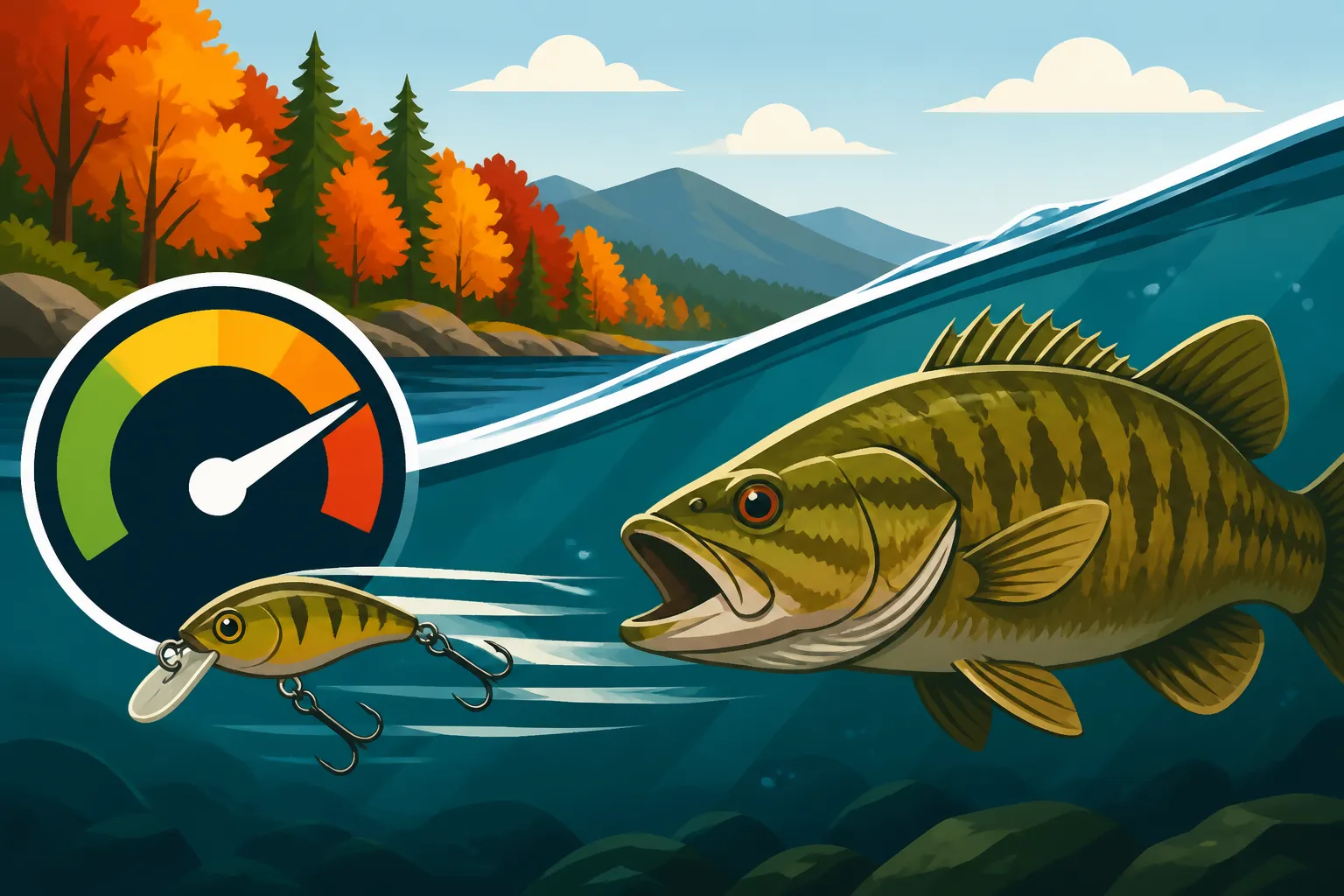
Best lure retrieve speed for smallmouth in fall
As the crisp autumn air settles over New Hampshire, many anglers find themselves scratching their heads when it comes to fall smallmouth bass. What worked all summer suddenly seems to fall flat, and those aggressive strikes become few and far between. The truth is, smallmouth behavior changes dramatically with the seasons, and cracking the code often comes down to one crucial factor: your lure retrieve speed. This guide will dive deep into understanding why and how to fine-tune your approach to keep those bronzebacks biting.
Understanding Fall Smallmouth Behavior in New Hampshire Waters
The transition from the long, warm days of summer to the cooler, shorter days of fall is a pivotal time for smallmouth bass. Their entire world shifts, and their metabolism, feeding patterns, and locations adjust accordingly. If you’re still ripping baits like it’s July, you’re likely missing out on some fantastic opportunities.
Pre-Turnover vs. Post-Turnover Stages
New Hampshire's lakes and larger ponds experience an annual event called "turnover." During summer, lakes stratify into distinct temperature layers: a warm surface layer (epilimnion), a rapidly cooling middle layer (thermocline), and a cold, deep layer (hypolimnion). As fall approaches and surface temperatures drop, the epilimnion cools to match the hypolimnion, and eventually, the entire water column reaches a uniform temperature and density. This causes the layers to "turn over," mixing oxygen and nutrients.
Before turnover, typically in early to mid-fall, smallmouth can still be somewhat active, especially in the thermocline where cooler, oxygenated water meets warmer zones. They might be chasing baitfish, but not with the same summer aggression. Post-turnover, usually after water temperatures drop below 55°F, the whole lake is a uniform temperature. This is when smallmouth begin to gather in deeper, more stable areas, often following baitfish schools. Their metabolism slows significantly, and they become much less inclined to expend energy chasing down a fast-moving meal. Understanding these phases is crucial for pinpointing not just where they are, but how they want their food presented.
Forage Fish Movement and Smallmouth Bass Habits
The primary driver for smallmouth behavior in the fall, beyond temperature, is the movement of their forage. In many New Hampshire lakes, rainbow smelt are a key food source, especially for larger smallmouth and other predators like lake trout and landlocked salmon. As water temperatures drop, these baitfish often migrate from open water towards deeper structures or coves. Smallmouth will follow suit, schooling up in anticipation of gorging themselves before winter truly sets in.
This means that while summer might see smallmouth scattered across various structures, fall often concentrates them. They’ll hold tight to deep humps, rocky points, ledges, and transition zones where they can ambush baitfish. Finding these bait balls on your fish finder is often the first step; the second is presenting a lure at the right speed to entice these less-than-enthusiastic predators. A struggling, slow-moving baitfish is far more appealing to a cold-water smallmouth than one zipping by like it's trying out for the Olympics.
The "Slow and Low" Mantra for Fall Smallmouth
Forget everything you know about power fishing from the summer months. When the leaves start turning crimson and gold, and the lake water takes on that refreshing chill, it's time to embrace the art of slow presentation. This isn't just about reducing your retrieve speed by a tiny margin; it's about a fundamental shift in your approach.
The Metabolism Factor in Cold Water
Fish are cold-blooded, meaning their body temperature, and subsequently their metabolism, directly correlates with the surrounding water temperature. As the water cools down, a smallmouth's internal processes slow down dramatically. They don't need to eat as frequently, and they certainly don't have the energy reserves or the inclination to chase a fast-moving meal that requires a lot of effort to catch. Think of it like a bear preparing for hibernation – they're looking for easy, calorie-dense meals, not engaging in high-speed pursuits.
A slow retrieve mimics a struggling, vulnerable baitfish that is easy prey. This triggers an instinctual feeding response, not necessarily an aggressive chase. It's about presenting the meal right in front of their face, making it irresistible because of its ease of capture. This becomes even more critical in late fall when water temperatures dip into the low 40s or even upper 30s. At these temperatures, smallmouth can be incredibly lethargic, sometimes only moving a few feet to inhale a bait.
Reading the Fish and Adjusting on the Fly
While "slow and low" is a great starting point, successful fall smallmouth fishing isn't just about a single, static retrieve speed. It's about constant observation and adjustment. Pay close attention to what the fish are telling you. Are you getting light taps? Are they just bumping the bait without committing? This could indicate you're still retrieving too fast, or perhaps the lure isn't staying in their strike zone long enough.
Sometimes, a complete pause, letting the bait fall or suspend motionless, is the key. On other occasions, a subtle twitch after a long pause can trigger a strike from a hesitant fish. Experimentation is crucial. Start slow, but be prepared to go even slower. If you're not getting bites, try extending your pauses, reducing the intensity of your jerks, or even just reeling in a foot or two every 10-15 seconds. Think like a slow-motion video camera and imagine how a lethargic baitfish would move.
If you are seeing fish on your sonar but not getting bites, it's a sure sign that your presentation isn't quite right. Sometimes just a half-turn slower on the reel handle or an extra second of pause is all it takes to make the difference between a frustrating day and a successful one.
Adjusting for Water Temperature and Depth
The nuances of retrieve speed in the fall are heavily influenced by the specific water conditions you encounter. New Hampshire offers a wide variety of lake and pond depths, as well as rivers that cool at different rates, all of which demand a tailored approach.
Thermocline and Oxygen Levels in Early Fall
In early fall, before the full lake turnover occurs, the thermocline can still be a critical zone. This is where oxygen levels are often optimal, and temperatures are cooler than the surface but not yet frigid. Smallmouth might still be found along the edges of the thermocline, especially where it meets structure like drop-offs, humps, or submerged islands. In this transitional period, your retrieve speed might be slightly faster than true late-fall conditions, but still significantly slower than summer.
You're looking for a retrieve that keeps your lure just above or within this thermocline, mimicking a baitfish that's trying to stay in the comfortable zone. If your fish finder shows a distinct thermocline, focus on lures that can be easily controlled at specific depths. Jigging spoons or football jigs that are allowed to fall slowly and then subtly hopped can be deadly here. Pay attention to fish arches on your sonar; if they're holding at 20 feet, make sure your lure spends ample time at 20 feet, moving just enough to be enticing.
Deep Water vs. Shallow Ambush Points in Late Fall
As fall progresses into its later stages, and water temperatures dip below the crucial 50°F mark, smallmouth will invariably move deeper. They seek the most stable water temperatures and often school up tightly on deep structure. This could be main lake points that drop into deep water, offshore humps, ledges, or deep basins where baitfish congregate.
In these deep-water scenarios, your retrieve speed becomes even more critical, and often, even slower. You want your lure to be practically crawling along the bottom or suspended motionless right in the fish's face. Jigging spoons can be vertically jigged with minimal lifts and long pauses. Drop shots become king, allowing you to present a bait almost perfectly still in front of a suspended fish. If you're dragging a tube or a jig, think glacial speed – just enough movement to impart some action, but not so much that it triggers a chase response from a sluggish bass.
However, don't completely discount shallow water, especially on sunny days or after a few days of stable, milder weather. Smallmouth might push up onto shallow flats or rock piles adjacent to deep water to sun themselves or ambush baitfish that briefly move shallower. Even then, a slow, methodical retrieve is key. A jerkbait retrieved with extremely long pauses, sometimes up to 10-15 seconds, can be deadly in these ambush spots. It's about teasing them into striking, not forcing them to commit to a chase.
Here's a quick guide to retrieve speeds based on water temperature:
| Water Temperature Range | Typical Smallmouth Behavior | Recommended Retrieve Speed | Lure Examples |
|---|---|---|---|
| 55°F – 65°F (Early Fall) | Moderately active, following bait schools. | Slow to moderate, with occasional pauses. | Crankbaits, jerkbaits, spinnerbaits, jigs. |
| 45°F – 55°F (Mid-Fall) | Grouping up, metabolism slowing. | Slow, deliberate, longer pauses. | Jerkbaits, jigs, tubes, dropshot, jigging spoons. |
| 35°F – 45°F (Late Fall) | Lethargic, tightly schooled, seeking deep stability. | Extremely slow, minimal movement, very long pauses. | Jigs, tubes, dropshot, blade baits, jigging spoons. |
Specific Lure Types and Their Ideal Fall Retrieves
While the "slow and low" principle applies broadly, different lure types inherently demand different retrieve styles to maximize their effectiveness in cold fall waters. Having a versatile tackle box, readily available through retailers like Amazon, is always a good idea.
Jerkbaits and Blade Baits
Jerkbaits are absolute assassins for fall smallmouth. Their erratic, darting action perfectly mimics a dying or struggling baitfish, and the ability to pause them indefinitely makes them irresistible to lethargic bass.
Retrieve Technique: The key with jerkbaits is the pause. Cast your jerkbait, then give it two or three sharp jerks of the rod tip to get it down to its running depth. After that, the magic happens in the pause. In early fall, your pauses might be 3-5 seconds. As the water cools further, extend those pauses to 5-10 seconds, or even 15-20 seconds in very cold water. Watch your line closely during the pause; many strikes happen when the bait is completely still. Vary the number and intensity of your jerks; sometimes a single, subtle twitch is all it takes after a long pause. Lures like the Rapala X-Rap or the Megabass Vision 110 are fall staples. For more insights on this style of fishing, consider reading about How to fish a jerkbait for early spring bass, as many of the principles apply equally to fall.
Blade baits, like the Johnson Thinfisher or the Damiki Vault, are fantastic for vertical presentations on deeper structure.
Retrieve Technique: Drop the blade bait to the bottom or to the depth where you see fish. Lift your rod tip sharply about 1-2 feet, then immediately drop it back down, allowing the bait to flutter and vibrate as it falls on a semi-slack line. The bite often comes on the fall. In fall, slow down the lift, and extend the pause on the bottom, sometimes letting it sit for 5-10 seconds before the next subtle lift. The vibration on the retrieve and the flash on the fall are excellent for attracting smallmouth in deep, clear New Hampshire lakes.
Jigs and Tubes
Jigs and soft plastic tubes are classic smallmouth baits, and their effectiveness only increases in the fall when fished correctly. They are incredibly versatile for mimicking crawfish or bottom-dwelling baitfish.
Retrieve Technique: For jigs, whether a football jig with a creature bait trailer or a hair jig, the retrieve should be excruciatingly slow. Cast it out, let it sink to the bottom, and then either drag it or hop it very subtly. When dragging, keep your rod tip low and slowly sweep your rod to the side, taking up slack as you go. When hopping, lift your rod tip just enough to get the jig to "hop" off the bottom a few inches, then let it fall back down on a slack line. The fall is crucial. In cold water, extend your pauses after each hop or drag. A 10-second pause is not uncommon. A jig that sits motionless on a deep rock or slowly crawls along a ledge can be irresistible. Consider exploring Best Hair Jig Technique for Winter Smallmouth for more details, as those same slow-motion principles directly apply to late fall.
Tubes are similar. They are phenomenal imitators of crawfish or gobies (if present, though less common in NH).
Retrieve Technique: Texas-rigged or internally weighted tubes are best fished by casting them out, letting them sink to the bottom, and then either dragging them with long pauses or giving them very subtle hops. The unique spiraling action of a tube as it falls can be a major trigger. For fall smallmouth, drag-and-pause is often the most effective. Just a slow, steady retrieve with long pauses on the bottom, letting the tube sit and "breathe" with the current or subtle rod movements. Many strikes will feel like a slight "thump" or simply the weight of the fish, so stay vigilant! Looking for specific options? Check out Amazon for a wide selection of tubes in natural crawfish colors.
Crankbaits and Swimbaits
While crankbaits are often associated with aggressive power fishing, certain types can be highly effective for fall smallmouth, particularly in the earlier stages or when fish are still somewhat active. Swimbait use also increases in effectiveness.
Retrieve Technique (Crankbaits): For crankbaits, focus on deeper-diving models that can reach the depths where smallmouth are holding. In early to mid-fall, a slower, steady retrieve can work, but incorporating pauses is still beneficial. Consider a "stop-and-go" retrieve: crank it down to depth, pause for 2-3 seconds, then resume cranking. This erratic action can often provoke a strike. The key is to make contact with the bottom or structure; deflect the crankbait off rocks or logs, then pause briefly. This deflection often triggers a reaction strike.
Retrieve Technique (Swimbaits): Soft plastic swimbaits, especially paddle-tail varieties rigged on a jig head, are excellent for mimicking baitfish. In fall, the retrieve should be a slow, steady roll, just fast enough to get the tail to kick. You want it to look like an easy meal. This is particularly effective when smallmouth are suspended over deep water, following schools of smelt. A great swimbait on Amazon can make a huge difference in attracting those larger smallmouth. You can also vary your depth by counting down the lure after casting. Let it sink for a few seconds before starting your slow retrieve to get it into the strike zone. For deeper presentations, you can also use a heavier jig head and let it fall to the bottom, then perform a slow lift-and-drop retrieve, similar to how you might fish a jig.
Remember that a crucial part of maximizing your time on the water is ensuring you understand New Hampshire Fishing Regulations Explained and New Hampshire Bass Limits and Slot Rules, especially if you plan to keep any fish. Fall is also a great time to experiment, so don't be afraid to try different lures and retrieve speeds until you find what the smallmouth are keying in on that particular day. Knowing How to Catch Smallmouth Bass in New Hampshire Lakes is a foundational skill that truly shines in the fall when these adjustments are mastered.
Final Thoughts on Fall Retrieve Speed
Ultimately, consistently catching New Hampshire smallmouth bass in the fall boils down to patience and adaptability. The water is cooling, their metabolism is slowing, and they're not going to chase a lightning-fast meal. Embrace the "slow and low" mantra, and don't be afraid to fish your lures slower than you think is necessary, then slow down even more. Pay close attention to environmental cues like water temperature and baitfish location, and adjust your retrieve based on the specific lure you're using.
Invest in a quality fish finder if you don't have one, as locating these schooling fish in deep water is often half the battle. Then, take your time, experiment with different lures and pause durations, and you'll find that fall smallmouth fishing in New Hampshire can be incredibly rewarding, offering some of the biggest and healthiest fish of the year. Finding the right gear, from specific lures to electronics, is often made easy with a quick browse on Amazon, ensuring you're always ready for whatever the Granite State's waters throw your way. For a broader understanding of seasonal patterns, also check out our guide on the Best Time of Year to Fish in New Hampshire.
Disclaimer
Please note that fishing regulations and conditions can change. Always consult the latest New Hampshire Fish and Game Department regulations before heading out on the water. This guide is for informational purposes only and does not constitute official legal advice. Enjoy your time fishing safely and responsibly.