How to fish deep structure for summer lake trout
Summer in New Hampshire offers some incredible fishing, but when the heat cranks up, finding those elusive lake trout can feel like searching for a needle in a haystack. They don't just vanish; they head for the cool, deep sanctuaries of our larger lakes, seeking out specific underwater structures where they can thrive. This guide is your deep dive into understanding exactly how to locate these thermal refuges and present your offerings effectively to target lake trout throughout the warmer months.
Understanding Summer Lake Trout Behavior and Their Deep Dive
When the surface waters of a lake begin to warm in late spring and early summer, lake trout—being coldwater fish—start to feel the heat. Their metabolism thrives in much colder temperatures, typically in the low to mid-50s Fahrenheit. As a result, they begin a migration to the deepest, coolest parts of the lake, often associating with specific underwater features that provide both thermal comfort and access to their preferred forage. This makes summer fishing a game of precision and understanding the underwater landscape.
The Thermocline and Lake Trout Comfort Zones
One of the most critical concepts to grasp for summer lake trout fishing is the thermocline. In deep lakes like Winnipesaukee, Newfound Lake, or Sunapee Lake, the water stratifies into distinct layers during the warmer months. The top layer, or epilimnion, is warm and often low in oxygen. Below that is the thermocline, a transitional layer where the temperature drops rapidly. Underneath the thermocline is the hypolimnion, a deep, cold, and typically oxygen-rich layer.
Lake trout will almost exclusively be found in or just below the thermocline, or deeper in the hypolimnion, where water temperatures are in their optimal range. The depth of the thermocline can vary from lake to lake and even within a single lake, often ranging from 30 to 60 feet deep, but sometimes much deeper. Your fish finder is your best friend here, as it will clearly show this thermal break. Knowing where this comfort zone lies is the first step in figuring out how deep lake trout go in summer and where to present your bait or lure. They’re not just looking for cold water; they're looking for cold water that also holds their food.
Identifying Forage and Their Deep-Water Hangouts
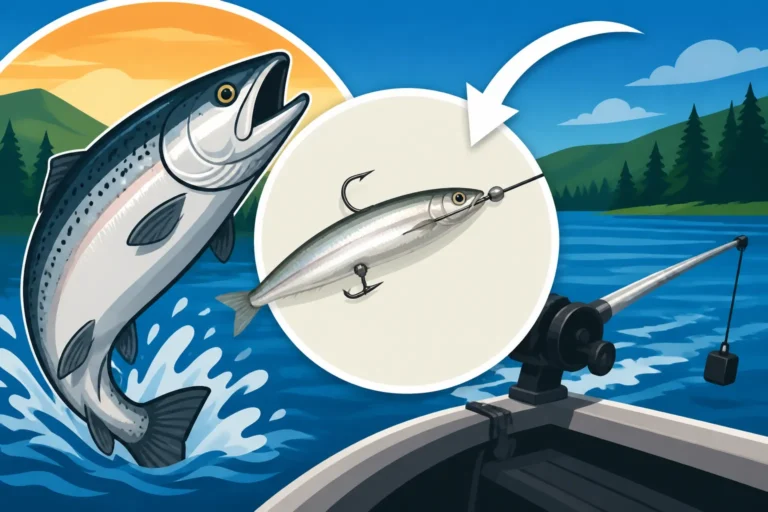
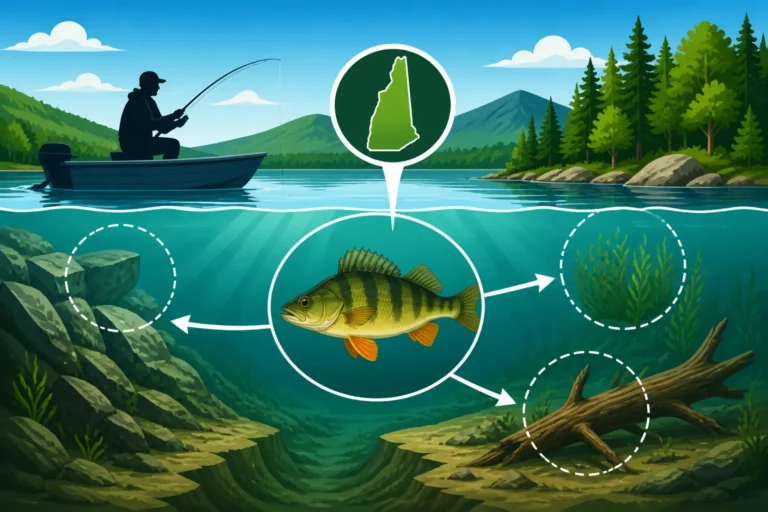
Lake trout are primarily piscivores, meaning they eat other fish. In New Hampshire's deep lakes, their main forage species include rainbow smelt, cisco (lake herring), and sometimes juvenile yellow perch or white perch. These baitfish also seek out cooler waters, often congregating around deep structures or suspended in schools.
When lake trout head deep, they're not just escaping the heat; they're following their food source. If you can locate schools of baitfish on your electronics, especially those tightly balled up, you can bet that hungry lake trout won't be far away. These schools often hang out over or near deep humps, along ledges, or suspended in the open water where the thermocline meets a sharp drop-off. Understanding this predator-prey relationship is key to productive summer fishing. Pay close attention to what your electronics are showing – marks near baitfish mean potential success.
Essential Gear for Targeting Deep Structure Lake Trout
Catching lake trout in deep water during the summer isn't just about knowing where they are; it's about having the right tools to get your presentation down to them effectively. This isn't your casual pond fishing setup; it requires some specialized gear to reach those depths and handle the powerful fight of a laker.
Electronics: Fish Finders and Mapping
Without good electronics, you're essentially fishing blind for deep structure lake trout. A high-quality fish finder is non-negotiable. You'll want a unit with excellent sonar resolution, capable of distinguishing individual fish from structure and clearly identifying the thermocline. Many modern fish finders offer CHIRP sonar, DownScan, and SideScan imaging, which can provide incredibly detailed views of the bottom and water column.
Beyond just finding fish, your electronics help you interpret the underwater landscape. Detailed lake maps, often preloaded into your unit or available as add-on cards, are vital for identifying deep humps, drop-offs, submerged points, and ledges. GPS functionality allows you to mark waypoints on productive structures or baitfish schools, helping you return to them later. Brands like Garmin, Lowrance, and Humminbird offer a range of units suitable for this kind of fishing. When looking for accessories or specific models, check online retailers like Amazon, where you can often find a wide selection of transducers and mapping cards to enhance your system. Knowing how to read structure for smallmouth on Winnipesaukee, for instance, translates well to finding deep-water lake trout structure.
Rods, Reels, and Lines for Deep Water
Your rod and reel setup needs to be robust enough to handle the weight of deep-diving lures, lead core line, or the drag of a downrigger, and powerful enough to subdue a strong lake trout from significant depths.
- Rods: Look for rods specifically designed for trolling or deep jigging. A medium-heavy to heavy power rod, typically 7 to 9 feet in length, with a moderate to fast action, is ideal. The length helps spread out your lines if trolling, while the power ensures you have enough backbone to fight a fish that's pulling hard in deep water.
- Reels: Large capacity baitcasting reels are preferred for deep-water lake trout. They handle heavy lines well and have the necessary drag power. A reel with a line counter is incredibly useful for trolling, allowing you to precisely replicate productive depths. For those interested, the Best Rods for New Hampshire Lakes often include options suitable for this application.
- Line: This is where things get interesting.
- Braided Line: For vertical jigging or when using downriggers, braided line is excellent due to its no-stretch properties, which provide superior sensitivity and hook-setting power at depth. You'll typically use a fluorocarbon leader with braid.
- Lead Core Line: For trolling without downriggers, lead core line is a game-changer. It's a specialized line with a lead core encased in a colored nylon sheath. Each color segment (usually 10 yards) sinks to a predictable depth at a given trolling speed, allowing you to get lures down without extra weights. Matching the Best Line Weight for Lake Trout Trolling to your chosen method is crucial for success.
Downriggers and Dipsy Divers
These tools are indispensable for precise depth control, especially when trolling for lake trout.
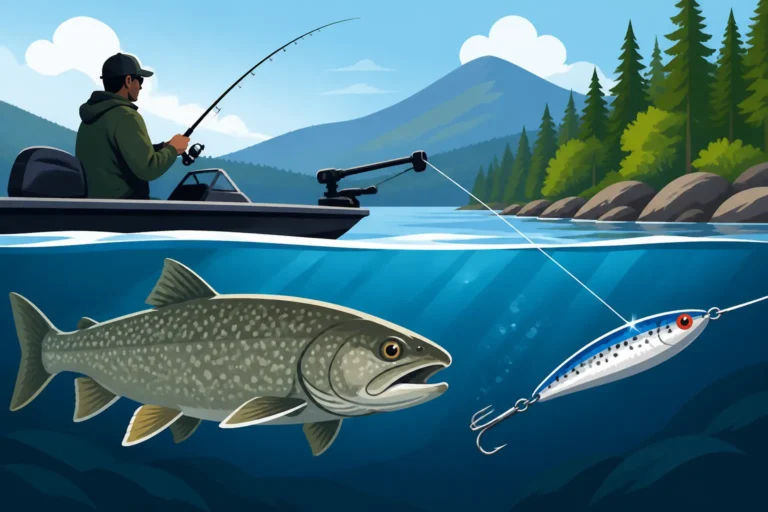
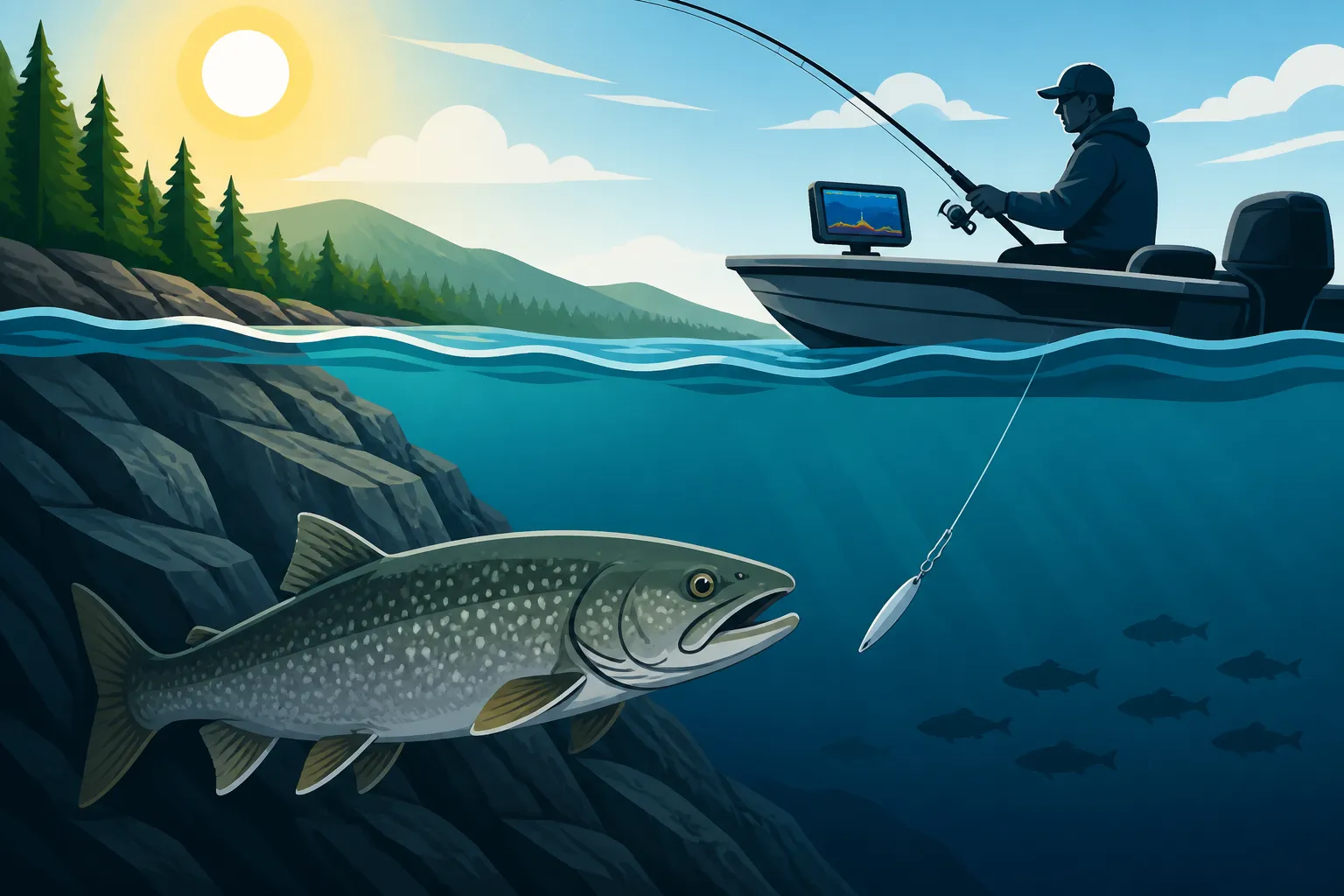
- Downriggers: A downrigger uses a heavy ball (cannonball) attached to a cable, which is lowered to a set depth. Your fishing line, with a lure attached, is then clipped to the downrigger cable using a release clip. When a fish strikes, the line pops free from the clip, allowing you to fight the fish directly without the weight of the cannonball. This allows you to use lighter, more natural-looking presentations at precise depths. For detailed information on the Best Trolling Gear for New Hampshire Lake Trout, downriggers are a central component.
- Dipsy Divers (or Planer Boards): While less precise than downriggers, Dipsy Divers are excellent for spreading out lines and achieving specific depths. They are disc-shaped devices that clip onto your main line and dive when pulled through the water, also deflecting your line out to the side of the boat. This helps cover a wider area and avoid tangles, especially when running multiple lines. They come in various sizes and can be adjusted to dive to different depths and track to different angles.
Strategies for Locating and Fishing Deep Structure
Finding and catching lake trout on deep structure requires a blend of technological understanding and angling intuition. It's about systematically dissecting the underwater world and presenting your offerings in a way that triggers a strike.
Interpreting Lake Maps and Sonar
Before you even launch your boat, pore over detailed lake maps (bathymetric charts). Look for key features:
- Deep Humps: Submerged hills that rise from the lake bottom but remain well below the surface. These are magnets for baitfish and, consequently, lake trout.
- Ledges and Drop-offs: Abrupt changes in depth, often forming a "wall" underwater. Lake trout patrol these edges, ambushing prey that moves between different depth zones.
- Submerged Points: Extensions of land that continue underwater, creating long, tapering fingers of structure.
- Rock Piles and Boulder Fields: These provide cover and ambush points, especially in areas with current or baitfish activity.
Once on the water, use your sonar to confirm what the map suggests. Drive over potential structures at varying speeds, watching for baitfish schools, individual fish arches (often larger, stronger arches for lake trout), and the thermocline. Pay attention to how the fish are relating to the structure – are they on top, along the edges, or suspended just off it? Marking waypoints on promising features is essential for revisiting them. For instance, when fishing areas like "The Broads" on Lake Winnipesaukee, understanding the deep contours is paramount for targeting lake trout.
Effective Deep-Water Trolling Techniques
Trolling is arguably the most effective method for covering water and finding active lake trout in the summer. Precision is key.
- Depth Control: This is where downriggers and lead core shine. Aim to present your lure at or just above the depth where you're seeing lake trout or baitfish on your electronics. If the thermocline is at 40 feet, start by running lures between 35 and 45 feet.
- Speed: Lake trout often prefer slower trolling speeds, typically 1.5 to 2.5 mph. However, experimentation is crucial. Sometimes a subtle increase or decrease in speed can trigger a bite.
- Lure Selection: Long, slender spoons (like Sutton spoons, Northern King, or other brands found on Amazon) that imitate smelt or cisco are perennial favorites. Large stickbaits, often referred to as "minnow baits," can also be very effective. Lure color can matter too; silver, blue/silver, green/silver, and chartreuse are popular choices. To get specific recommendations, check out Best Lures for Lake Trout Trolling.
- Patterns and Presentation: Troll in S-curves or figure-eights around structures. This varies the speed and depth of your lures on the inside and outside turns, often triggering strikes. If you mark fish on a specific spot, make repeated passes over it.
Vertical Jigging and Dropping Baits
While trolling covers water, vertical jigging is excellent for targeting fish you've specifically marked on your sonar, or for working a very precise piece of structure.
- Marking and Positioning: Use your GPS and trolling motor (if equipped) to hold your boat directly over the marked fish or structure.
- Lure Choice: Heavy jigging spoons, often 1 to 3 ounces, are popular. Tube jigs, blade baits, and soft plastics rigged on heavy jig heads can also be effective. Some anglers will drop a live or dead smelt (where legal) on a weighted rig directly down to marked fish.
- Technique: Drop your jig to the depth of the fish. Use a lift-and-drop retrieve, varying the cadence and height of your lifts. Watch your sonar to see how fish react to your presentation. Sometimes a subtle quiver is all it takes, other times an aggressive rip. Lake trout will often hit on the fall, so pay close attention for any slack in your line. This is a highly targeted technique, perfect for when you've pinpointed a specific school or individual laker on a hump.
Common Deep Structures and How to Approach Them
Understanding what structure to look for is one thing; knowing how to fish it effectively is another. Different types of deep structure demand slightly different approaches to maximize your chances.
Submerged Islands and Humps
These are truly prime real estate for summer lake trout. A submerged island or hump provides a focal point in an otherwise featureless deep basin. Baitfish will often congregate on top or around the sides of these structures, drawn to currents or specific forage opportunities, and the lake trout will be right there with them.
- Approach: Start by making broad passes over and around the entire structure, using your electronics to map its contours and identify any baitfish or laker concentrations. Look for the deepest parts of the hump where fish might be staging, or the shallower tops where baitfish could be grazing.
- Trolling: For trolling, make passes that traverse the top of the hump and cut across its sides. Pay particular attention to the "breaks" – where the slope changes significantly. Fish often hold right on these edges. Using downriggers allows you to keep your lure just above the hump, preventing snags while still being in the strike zone.
- Jigging: If your sonar shows a tight school of lake trout on a specific section of the hump, drop your vertical jigs or bait directly onto them. Holding your boat steady with a good trolling motor or anchor system is vital here. A thorough Best Fish Finders for New Hampshire Lakes article will highlight units that excel at showing you these precise deep structures.
Deepwater Points and Ledges
Just like their shallow-water counterparts, deepwater points and ledges act as natural funnels and ambush points. They are transitional zones where lake trout can move from deeper water up to slightly shallower feeding areas, or simply patrol the edge for passing baitfish.
- Approach: These structures are best fished by trolling parallel to the drop-off, or by making passes that cut diagonally across the point. The intersection of a deep point and the thermocline can be a particularly productive zone.
- Trolling: When trolling a deep point, start wide and gradually work your way tighter to the structure with each pass, until you find the productive depth. For ledges, run your downriggers so that one lure is just above the ledge and another is slightly deeper, covering both the top and the face of the drop-off. Watch for changes in depth on your sonar, as even a small change can concentrate fish.
- Jigging: If you see a cluster of fish holding tight to a specific section of a ledge, you can position your boat and drop jigs right on them. This is especially effective if the ledge has small shelves or pockets where fish might be holding. Remember that Trolling Techniques for New Hampshire Lake Trout are often fine-tuned to these exact types of underwater topography, ensuring your lures are in the strike zone longer.
Fishing deep structure for summer lake trout in New Hampshire is a rewarding challenge. It combines technology, patience, and a keen understanding of fish behavior. With the right gear and a strategic approach, you'll be well on your way to hooking into some magnificent lakers. For general advice on Best Time of Year to Fish in New Hampshire, remember that summer means deeper, cooler water for these incredible fish.
Deep Water Lake Trout Fishing Methods Comparison
To help you decide which technique might be best for your next New Hampshire lake trout adventure, here's a quick comparison of the primary methods for targeting them on deep structure.
| Method | Best for | Key Gear | Advantages | Disadvantages |
|---|---|---|---|---|
| Trolling | Covering large areas, finding active fish | Downriggers, lead core, line counter reels | Covers lots of water, consistent depth control | Requires boat, can be equipment-intensive |
| Vertical Jigging | Pinpointing marked fish, specific structures | Heavy jigs, sensitive rod, good electronics | Precise presentation, direct fish contact | Less coverage, requires boat positioning |
| Live Bait Dropping | Suspended fish, reluctant biters | Weighted rigs, fresh bait (smelt), sensitive rod | Natural presentation, highly effective | Bait acquisition, sometimes slower action |
Each of these methods, especially when combined with a solid understanding of the thermocline and the Lake Trout Fishing in New Hampshire habits, can lead to a successful day on the water.
Disclaimer
This article is for general informational purposes only and does not constitute professional advice. Laws, prices and regulations vary by location and change over time. Consult a qualified professional for guidance on your specific situation.