Best Fish Finder for Deep Lake Fishing
Navigating the expansive, often mysterious depths of New Hampshire's larger lakes like Winnipesaukee, Squam, or Newfound can feel like searching for a needle in a haystack, especially when you're targeting elusive deep-water species like lake trout or landlocked salmon. Without the right tools, you might spend more time guessing than fishing. This guide is dedicated to helping you demystify the deep and choose the best fish finder to uncover those hidden honey holes and productive structures that hold the fish you're after.
Understanding the Challenges of Deep Lake Fishing in New Hampshire
Fishing in the deep, clear waters of New Hampshire's major lakes presents a unique set of challenges that can leave even seasoned anglers scratching their heads. It’s not just about dropping a line and hoping for the best; it requires a strategic approach, and a high-quality fish finder is your indispensable ally.
The Vastness of Deepwater Environments
Imagine the sheer size of Lake Winnipesaukee, with its numerous islands, countless coves, and depths plunging hundreds of feet. Or picture the deep basins of Squam Lake, where fish can suspend at various levels. These aren't small ponds where you can easily spot cover or structure. The scale is immense, and fish can be anywhere. This vastness makes random casting or trolling incredibly inefficient. Without a clear picture of what's beneath your boat, you're essentially blind to the underwater world, missing crucial details like sudden depth changes, submerged humps, or schools of baitfish that attract larger predators.
Elusive Deepwater Species
New Hampshire is home to fantastic deep-water game fish, particularly lake trout and landlocked salmon. These species are masters of their environment, often preferring specific temperatures and depths, especially during warmer months when they retreat to cooler, oxygen-rich zones. Finding a school of smelt that lake trout are actively feeding on, or locating a thermalcline where salmon are suspended, is nearly impossible without advanced sonar technology. They don't hang out in shallow weed beds for easy spotting; they're out in the open water, often relating to subtle contours or bait concentrations that only a good fish finder can reveal. Successfully targeting these fish relies heavily on your ability to read the water column and pinpoint their preferred habitat. For more on these elusive fish, check out our guide on Lake Trout Fishing in New Hampshire or Landlocked Salmon Fishing in New Hampshire.
The Impact of Water Clarity and Light Penetration
New Hampshire's lakes are renowned for their incredible clarity, which, while beautiful, can sometimes make fish harder to locate with traditional methods. Light penetrates deeper, meaning fish might be more spread out or less inclined to hold tight to visible cover. Moreover, this clarity can sometimes affect how certain sonar frequencies perform, requiring a unit that can effectively penetrate deep while still providing crisp, detailed images. A cheap, low-power unit might struggle to give you a clear reading when you're in 80-100 feet of water, showing only a messy return or failing to distinguish fish from structure. You need something that cuts through the water, providing accuracy regardless of depth.
Key Features of a Great Deep-Water Fish Finder
When you're trying to unlock the secrets of New Hampshire's deep lakes, not just any fish finder will do. You need specific features that are designed to perform reliably and accurately in challenging deepwater conditions. Think of these as your essential tools for seeing what others can't.
High Power Output (Wattage)
This is perhaps the most critical factor for deep lake fishing. Think of wattage like the strength of your voice; a higher wattage means the sonar signal can "shout" louder and penetrate deeper into the water column. Fish finders with low wattage might give you decent readings in shallow water, but once you hit 50 feet or more, their signal weakens, leading to blurry images, lost bottom readings, and missed fish. For truly effective deep-water performance on lakes like Winnipesaukee or Newfound, you'll want a unit with at least 500 watts RMS (Root Mean Square) output, and ideally, 1,000 watts or more. This robust power ensures that the sonar pulse travels down to the deepest parts of the lake and bounces back with enough energy to create a clear, detailed image of the bottom, structure, and any fish in between. It's the difference between guessing and truly knowing what's below.
Dual-Frequency or CHIRP Sonar Capabilities
Standard fish finders often operate on a single or a few fixed frequencies (like 50/200 kHz). While these can work, CHIRP (Compressed High-Intensity Radiated Pulse) sonar is a game-changer for deep water. Instead of sending out a single frequency, CHIRP sends a continuous sweep of frequencies, from low to high. This technology provides much greater target separation and clarity. Imagine trying to distinguish between a single lake trout and a clump of baitfish in 100 feet of water. With traditional sonar, they might appear as one blob. With CHIRP, you can often see them as distinct returns, allowing you to identify individual fish within a school or differentiate fish from submerged timber. Dual-frequency capabilities are also valuable, as lower frequencies (e.g., 50 kHz) are better for deep penetration, while higher frequencies (e.g., 200 kHz or even Mega Imaging) offer greater detail in shallower or specific target zones. You'll want a system that can handle both effectively.
Large, High-Resolution Display
What good is all that powerful sonar if you can't clearly see the information? A large, high-resolution display is paramount for deep lake fishing. In deep water, fish targets, especially suspended ones, can appear small on the screen. A bigger screen allows for more pixels, which means a clearer, more detailed image where you can zoom in without losing fidelity. Look for displays that are at least 7 inches diagonally, though 9 inches or larger is ideal for split-screen viewing (e.g., traditional sonar on one side, side imaging on the other). High pixel count (e.g., 800×480 or higher) is also crucial. The clarity of the display means you can discern subtle changes in bottom contour, identify different species of fish based on their arch, and spot bait balls with precision, even in bright sunlight or when viewing from a distance. Investing in a good display enhances your ability to interpret the data your powerful sonar is sending back.
Types of Sonar Technology for Deep Water
Modern fish finders offer a dazzling array of sonar technologies, and understanding which ones are most effective for deep lake fishing is key to making an informed choice. Each type provides a unique perspective on the underwater world, and combining them often yields the best results.
Traditional 2D Sonar (Broadband/CHIRP)
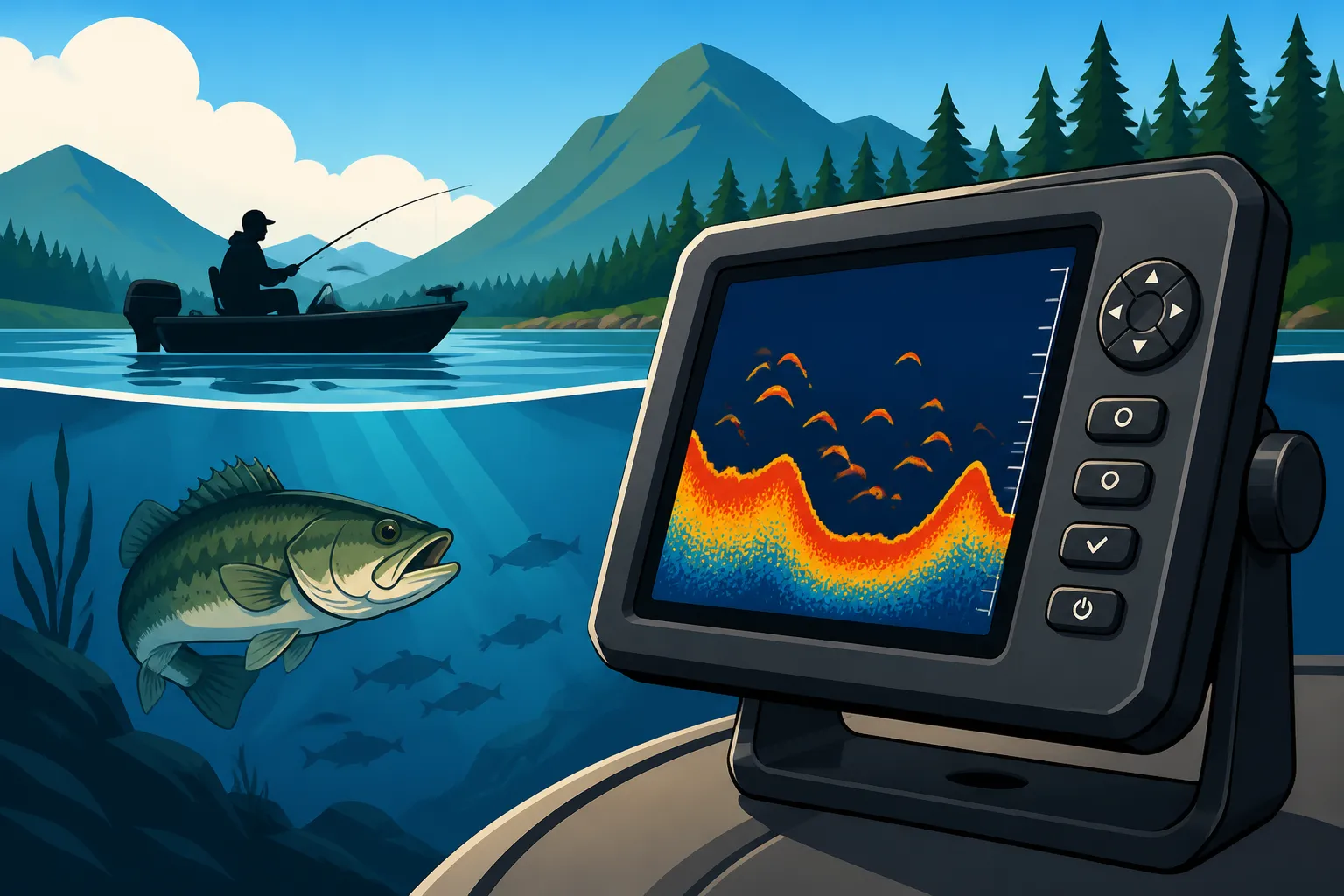
Traditional 2D sonar is the classic "fish arch" view, showing you what's directly beneath your boat. For deep water, you'll want a unit with powerful broadband or CHIRP-enabled 2D sonar. Broadband sonar utilizes a wider range of frequencies than older fixed-frequency units, leading to better target separation and less noise. CHIRP takes this a step further, sweeping through a continuous range of frequencies to create an even sharper, more accurate image.
In deep New Hampshire lakes, a good 2D CHIRP sonar will show you distinct fish arches, bait schools, and the bottom contour with surprising clarity, even at depths exceeding 100 feet. For instance, when you're trolling for New Hampshire Landlocked Salmon Regulations on Lake Sunapee, you're relying on that 2D view to mark suspended fish or schools of smelt. It’s excellent for determining water depth, identifying vertical structure, and seeing fish directly below you, making it indispensable for vertical jigging or precise lure placement. The ability to distinguish a single fish from a tightly packed school, or to see your downrigger ball relative to a fish, comes down to the quality of your 2D CHIRP.
Down Imaging / DownScan Imaging
Down Imaging (often called DownScan or ClearVü by different brands) offers a photographic-like view of what's directly beneath your boat. Instead of arches, fish appear as brighter dots or blobs, and structure like submerged trees, rock piles, or old foundations are rendered with incredible detail. It essentially slices the water column into thin beams and stitches them together to create a picture.
While 2D sonar shows fish arches, Down Imaging excels at showing you exactly what that structure is. Imagine seeing a sunken boat on Merrymeeting Lake, and being able to tell it's a boat, not just a vague lump on the screen. This technology is incredibly helpful for dissecting deep ledges, pinpointing transition areas where lake trout might ambush bait, or identifying specific types of forage like schools of rainbow smelt. It's not as good for identifying individual fish in the water column as 2D CHIRP, but for interpreting what the bottom composition and structure truly look like, it's invaluable, especially when trying to understand subtle changes in a deep basin.
Side Imaging / SideScan Imaging
Side Imaging (or SideScan) is arguably the most revolutionary sonar technology for covering vast deep-water areas efficiently. Instead of looking straight down, Side Imaging transducers send out beams to the sides of your boat, scanning up to hundreds of feet on either side. This creates an expansive, detailed image of the bottom and structure across a wide swath.
This is a game-changer for scouting large bodies of water. You can quickly scan an entire bay on Lake Winnipesaukee for submerged humps, rock piles, or weed lines that extend into deeper water, which might be holding fish. When you’re searching for areas mentioned in the Lake Winnipesaukee Fishing Guide, Side Imaging lets you cover ground faster, revealing features that you might completely miss with traditional 2D sonar alone. You can spot schools of baitfish, individual fish (appearing as shadows), and even track your lure as it moves through the water column, all off to the side of your boat. For example, if you mark a fish far off to your port side, you know exactly where to turn your boat or cast your line. It dramatically reduces the amount of time you spend blindly searching, allowing you to pinpoint productive spots with precision. While its range is vast, remember that deep-water performance means you might need to adjust your sensitivity or frequency settings to get the clearest image at maximum depth.
Here’s a quick comparison of these sonar types:
| Sonar Type | Best For | Deep Water Performance | Key Benefit |
|---|---|---|---|
| Traditional 2D CHIRP | Identifying fish arches, bait balls, bottom | Excellent, especially with high wattage | Great target separation, vertical view |
| Down Imaging | Interpreting structure detail, bottom composition | Good, offers photographic detail of bottom | Clear, picture-like view of what's directly below |
| Side Imaging | Scouting wide areas, finding submerged structure | Good, covers large areas quickly | Expansive view to the sides of the boat |
Display and User Interface Considerations
Having the most advanced sonar technology is fantastic, but if the display is difficult to read or the unit is complicated to operate, you'll be spending more time frustrated than fishing. The user experience is just as important, especially when you're out on the water in varying conditions.
Screen Brightness and Sunlight Readability
New Hampshire offers some truly gorgeous, sunny days, but that bright sunlight can turn a low-quality fish finder screen into an unreadable mirror. When you're trying to spot a subtle bait ball or a faint fish arch at 80 feet, you need a screen that cuts through the glare. Look for displays with high nits (a measure of brightness) and anti-glare coatings.
Consider a scenario where you're out on Lake Squam on a cloudless July afternoon, and the sun is beating down directly on your console. A dim screen will force you to squint, create shade with your hand, or even move your boat to an awkward angle just to see what’s going on. This is not only annoying but can also distract you from watching your lines or navigating. High-quality fish finders are designed with screens that remain vibrant and clear even in direct sunlight, often employing advanced bonding technologies to reduce reflections. This ensures that you can always see the critical information without a struggle, whether you're trying to dial in your trolling depth or pinpoint structure.
Intuitive Menus and Customization Options
Let's face it, nobody wants to be buried in a complicated manual while fish are biting. An intuitive user interface (UI) is essential for quickly accessing features, adjusting settings, and making the most of your fish finder. Look for units with clear, logical menus that are easy to navigate, perhaps with touchscreen capabilities or well-labeled buttons.
Beyond ease of use, robust customization options allow you to tailor the display and data to your specific fishing style and the conditions of New Hampshire's deep waters. For instance, being able to create custom split-screen layouts is incredibly valuable. You might want to see 2D CHIRP sonar on one side, Side Imaging on another, and a detailed chartplotter view on a third. Or perhaps you want to set custom color palettes that make fish arches stand out against the bottom return. Advanced units let you save these custom profiles, so you can switch between "Trolling for Lake Trout" and "Structure Fishing for Smallmouth" with a tap. This level of customization, found in popular brands, helps you optimize your viewing experience, making it quicker and easier to interpret what your sonar is showing you, whether you're using a unit from Bass Pro Shops or one purchased online via Amazon.
Installation and Power for Deep Water Units
Getting your deep-water fish finder set up correctly is almost as important as choosing the right unit. Proper installation ensures you get the clearest, most reliable readings, and adequate power is critical for consistent performance, especially when pushing sonar to its limits.
Transducer Mounting Best Practices
The transducer is the "eye" of your fish finder, sending and receiving sonar signals. Its placement is crucial for clear readings, particularly in deep, turbulent water. For optimal performance in New Hampshire's lakes, you'll generally want a transom mount, through-hull, or in-hull transducer.
- Transom Mount: This is the most common and easiest to install, attaching to the back of your boat. Ensure it's mounted in a location free from turbulence and propeller wash. An improper angle or location can lead to "cavitation" – air bubbles passing over the transducer face, which can severely degrade your sonar signal at speed or in deep water. This is particularly noticeable when you're running across a choppy Lake Winnipesaukee, and your screen suddenly goes blank with noise.
- Through-Hull: These transducers offer the best performance, as they shoot directly through the hull of the boat, minimizing interference. They require drilling a hole in your boat, which can be daunting for some, but they provide exceptionally clear readings at high speeds and in deep water, making them a favorite for serious deep-water anglers.
- In-Hull: Similar to through-hull but doesn't require drilling. The transducer is epoxied inside the hull, shooting through solid fiberglass. This works well for fiberglass boats without cored hulls but generally experiences some signal loss compared to through-hull.
Regardless of the type, the goal is to get a clean, unobstructed view of the water. For more information on proper boat setup, you might find our guide on New Hampshire Boating Laws for Anglers helpful, which also touches upon general boat maintenance.
Adequate Power Supply and Wiring
Deep-water fish finders, especially those with high wattage and large, bright screens, can draw a significant amount of power. An insufficient power supply or poor wiring can lead to erratic performance, screen flickering, or even unit shutdowns, particularly when the sonar is working hardest to penetrate deep water.
Ensure you have a dedicated power source for your fish finder, or at least ensure it's wired directly to your boat's battery with appropriate gauge wiring. Don't daisy-chain it off other electronics or use undersized wires, as this can cause voltage drops that starve the unit of power. For example, if you're running other electronics like a trolling motor or livewell pumps, they can create voltage fluctuations. A clean, consistent 12V power supply is vital. Investing in quality marine-grade wiring and connectors will prevent corrosion and ensure a stable connection over time. This also includes proper fusing to protect your expensive electronics. Many modern units come with wiring harnesses, but extending them with the wrong gauge wire can be detrimental. It’s worth the extra effort to get the wiring right for consistent, crystal-clear deep-water readings on all your Best Fishing Lakes in New Hampshire.
Top Considerations for New Hampshire Deep Lake Anglers
When you're out on the water, battling the elements and chasing those deep-water giants, certain practical considerations become paramount. What good is a high-tech fish finder if it's not suited to your specific New Hampshire fishing style or the unique conditions you'll encounter?
Integration with GPS and Mapping
In the vastness of New Hampshire's deep lakes, navigation and finding your way back to productive spots are just as crucial as finding the fish initially. A fish finder with integrated GPS and detailed mapping capabilities is no longer a luxury; it's a necessity.
Imagine you've just found a deep underwater hump on Lake Winnipesaukee, teeming with smelt and marked with a few promising lake trout arches. Without GPS, how do you mark that spot precisely to return to it later, or share it with a friend? Integrated GPS allows you to save waypoints, create routes, and track your trolling patterns with pinpoint accuracy. High-definition lake maps (like those often pre-loaded or available for purchase) provide detailed contours, depth changes, and navigation aids, which are critical for safe travel and targeting specific structures. This combination allows you to understand where the fish are in relation to known features and how to get back there. For instance, when exploring specific fishing spots outlined in the Lake Winnipesaukee Lake Trout Fishing guide, having your sonar data overlaid on a detailed map instantly shows you the relationship between depth, structure, and fish location, making your efforts incredibly efficient.
Portability vs. Fixed Mount Units
Your fishing style and boat type will heavily influence whether a portable or fixed-mount fish finder is best for you. Both have their advantages in the New Hampshire landscape.
- Fixed Mount Units: These are typically larger, more powerful, and feature more advanced technologies (like Side Imaging) and bigger screens. They're permanently installed on your boat's console or bow and are ideal for dedicated power boat anglers who spend significant time on larger lakes. They offer the best performance and integration but aren't easily transferable between vessels. If you're running a full-sized fishing boat on Sunapee or Winnipesaukee, a fixed-mount unit is likely your best bet for maximizing deep-water performance and screen real estate.
- Portable Units: Designed for versatility, these units often come in a self-contained case with a battery and suction-cup transducer, making them perfect for smaller boats, kayaks, canoes, or ice fishing. While typically less powerful and with smaller screens than fixed units, many portable options offer excellent deep-water 2D CHIRP sonar, perfectly capable of marking fish under your Best Kayaks for New Hampshire Fishing. For ice fishing on Lake Winnisquam, for instance, a portable flasher or portable digital fish finder is invaluable for seeing your jig and fish in the water column below the ice. If you fish from multiple boats, borrow a friend's boat, or frequently hit various small ponds in addition to big lakes, a robust portable unit could be the flexible solution you need.
Budgeting for Performance
Let's be real: quality deep-water fish finders are an investment. You'll find a wide range of price points, and generally, you get what you pay for in terms of features, power, and display quality. It’s important to balance your budget with your fishing needs.
Think of it this way: a cheaper, less powerful unit might seem appealing upfront, but if it consistently fails to give you clear readings in the depths of Lake Squam or constantly loses the bottom, it's a wasted investment. The frustration alone isn't worth it. Higher-end units, especially those featuring advanced CHIRP, Down Imaging, and Side Imaging, along with large, bright displays, will naturally command a higher price. However, they also offer unparalleled performance and efficiency. You might consider starting with a mid-range unit that offers strong 2D CHIRP and GPS, and then upgrade to units with Side Imaging later if your budget allows. When browsing options at Bass Pro Shops or online at Amazon, pay attention to the wattage, screen resolution, and included transducer type, as these are the primary drivers of deep-water performance. Don't just look at the price tag; consider the value it brings to your deep lake fishing success over many seasons.
Maintaining Your Deep-Water Fish Finder
Just like any other piece of critical fishing gear, your deep-water fish finder needs a little love and care to ensure it continues to perform flawlessly season after season. Especially in New Hampshire's varied conditions, from scorching summer sun to freezing ice fishing days, proper maintenance is key to protecting your investment.
Software Updates and Calibration
Modern fish finders are essentially specialized computers, and just like your phone or laptop, they benefit from regular software updates. Manufacturers frequently release updates that improve sonar performance, add new features, fix bugs, and enhance map detail. Ignoring these updates means you might be missing out on crucial enhancements that could make your unit perform better in deep water.
Check your manufacturer's website periodically for the latest firmware. Updates are usually free and can be downloaded to an SD card, then loaded into your unit. For instance, an update might improve the target separation of your CHIRP sonar, making it easier to distinguish lake trout from baitfish at depth. Additionally, proper calibration, such as setting keel offset or adjusting transducer angles, can fine-tune your readings. If you notice strange readings or believe your depth is off, a quick calibration check can often resolve the issue. Don't let your high-tech gear get stuck in the past when a simple update could unlock its full potential.
Cleaning and Storage Best Practices
After a long day of fishing, especially in saltwater areas like Great Bay, or in the often muddy conditions of spring runoff on some rivers, a little cleaning goes a long way. Salt, dirt, grime, and even fish slime can build up on your screen, buttons, and transducer, degrading performance and shortening lifespan.
- Screen: Always use a soft, damp cloth and mild, non-abrasive cleaner (or just water) to wipe down your screen. Avoid harsh chemicals that can damage the anti-glare coating.
- Unit Body & Transducer: Rinse the main unit and especially the transducer thoroughly with fresh water after each outing, especially if you've been in brackish or saltwater. Inspect the transducer cable for any nicks or damage.
- Connectors: Keep power and transducer cable connectors clean and dry. A little dielectric grease can help prevent corrosion on electrical connections.
- Storage: When not in use, store your fish finder in a cool, dry place. If it's a removable unit, bring it indoors. For fixed-mount units, use a protective cover to shield the screen from UV rays and accidental damage. During the long New Hampshire winter, if your boat is stored outside, consider removing the main unit to protect it from extreme cold, which can affect electronics. Proper storage ensures your unit is ready for action, whether you're targeting New Hampshire Lake Trout Ice Fishing Season Dates or early spring bass.
Remember, your fish finder is a significant investment in your fishing success. Treating it with care will ensure it serves you well on countless adventures across New Hampshire's beautiful and challenging deep waters.
Disclaimer
This article is for general informational purposes only and does not constitute professional advice. Laws, prices and regulations vary by location and change over time. Consult a qualified professional for guidance on your specific situation.