Best Downriggers for Lake Trout Trolling
There's nothing quite like the thrill of chasing lake trout in New Hampshire's deep, pristine waters. But let's be honest, it can also be incredibly frustrating when you know those big lakers are down there, and you just can't seem to get your lure into their strike zone consistently. Trying to reach depths of 50, 80, or even 100+ feet with just a heavy jig or a few split shot often feels like you're just guessing. This guide is all about taking the guesswork out of deep-water trolling, diving into the world of downriggers and how these indispensable tools can help you put more New Hampshire lake trout in the boat.
Understanding Lake Trout Behavior and Why Downriggers are Essential
Lake trout, often called "lakers" by us Granite Staters, are incredible fish that thrive in the cold, oxygen-rich depths of New Hampshire's larger lakes. But their preference for deep, cool water means they can be notoriously difficult to target without the right gear. Forget about just casting from shore or even shallow trolling – when the sun climbs high, these fish descend.
The Deep-Water Challenge in New Hampshire Lakes
New Hampshire boasts some truly magnificent lakes, like Winnipesaukee, Sunapee, and Newfound Lake, which are prime lake trout habitat. These bodies of water are deep, often with steep drop-offs and expansive flats that can hold fish. During the warmer months, as surface waters heat up, lake trout retreat to the thermocline – a distinct layer where water temperature changes rapidly – or even deeper, where temperatures remain consistently cold. This can mean fishing at depths ranging from 40 feet to well over 100 feet, depending on the lake and the time of year.
Trying to get your lure down to these depths with standard fishing gear is a constant battle against line drag and water resistance. You might spool on a heavier line, which then affects your lure's action, or add more weight, which can make it feel like you're dragging a brick. The challenge isn't just getting your lure down there, but keeping it there at a consistent depth as you troll, mimicking the natural movement of baitfish like smelt. Without precision, you're essentially just hoping a laker happens to swim into your path, rather than actively presenting your offering in their feeding zone. This is where many anglers get discouraged, feeling like they're missing out on the best action.
How Downriggers Solve the Depth Problem
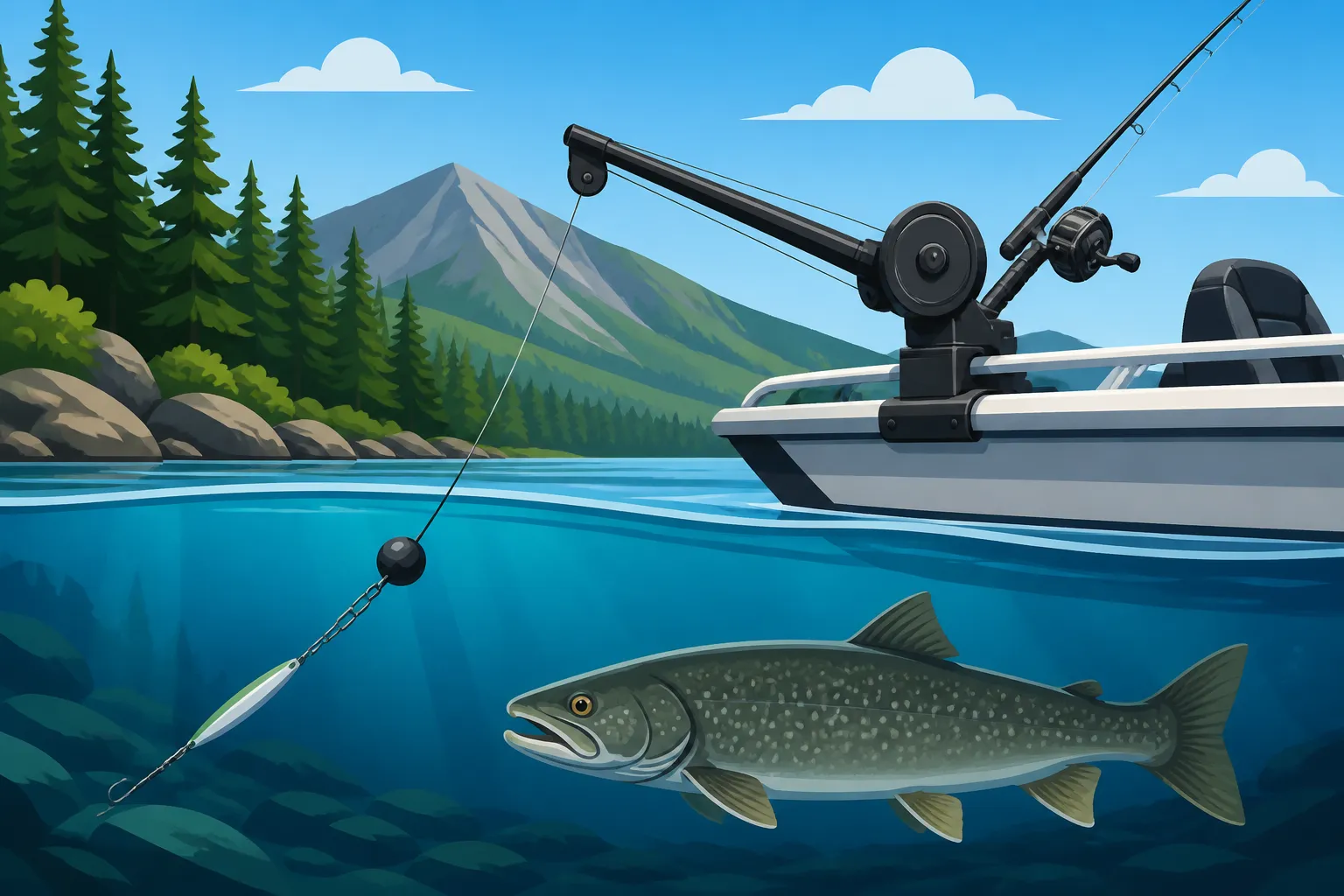
This is where downriggers become your best friend in the quest for New Hampshire lake trout. A downrigger is essentially a mechanical arm that allows you to lower a heavy cannonball (or "downrigger ball") to a precise depth, with your fishing line clipped to it. Your lure then trails behind this cannonball, swimming freely at the exact depth you've chosen.
Here’s the magic: once a fish strikes your lure, the line releases from the downrigger clip, allowing you to fight the fish directly on your rod and reel, unencumbered by the heavy cannonball. This means you can use lighter tackle and smaller, more natural-looking lures that would never reach those depths on their own. Downriggers take all the guesswork out of depth control. You can see baitfish on your fish finder at 60 feet, set your downrigger to 60 feet, and know with certainty that your lure is right in the zone. This level of precision is truly a game-changer for deep-water trolling, significantly increasing your chances of connecting with those elusive lakers. How to Catch Lake Trout in New Hampshire explains more about their habits.
Types of Downriggers: Manual vs. Electric
When you start looking into downriggers, you'll quickly realize there are two main categories: manual and electric. Both serve the same fundamental purpose, but they offer different levels of convenience and control. Your choice will largely depend on your budget, your fishing style, and the kind of boat you're running.
Manual Downriggers: Simplicity and Control
Manual downriggers are the traditional choice and still incredibly popular, especially for anglers just getting into the deep-water game or those with smaller boats. They operate much like a winch: you crank a handle to lower and retrieve the cannonball. Think of it as a heavy-duty, oversized fishing reel that manages a large spool of cable or heavy braid attached to the cannonball.
The biggest advantage of manual downriggers is their simplicity and cost-effectiveness. They are generally less expensive upfront and require minimal electrical setup on your boat. You have direct control over the lowering and raising speed, which some anglers prefer for feeling out the depth or making minor adjustments. However, the manual cranking can become quite a workout, especially if you're frequently checking baits, changing depths, or bringing up heavy cannonballs from significant depths on lakes like Sunapee. If you're running multiple lines or doing a lot of active trolling, the physical effort can add up.
Electric Downriggers: Power and Precision
Electric downriggers are the more advanced option, offering push-button convenience and often more sophisticated features. Instead of cranking, you simply press a button, and an electric motor does all the work of lowering and raising the cannonball. This is a huge benefit for reducing angler fatigue, especially during long days on the water or when fishing in strong currents that might require heavier balls.
Beyond ease of use, many electric downriggers come with advanced functionalities. Some have auto-up/auto-down features, depth counters, and even integrated sonar or GPS capabilities to help you stay on specific contours. More advanced models might offer "bottom tracking," where the downrigger automatically adjusts the cannonball's depth to follow the lake bed contour, which is fantastic for targeting fish relating to structure. While they come with a higher price tag and require a reliable 12-volt power source on your boat, the convenience and enhanced control can be well worth the investment for serious lake trout anglers. Best Trolling Gear for New Hampshire Lake Trout goes into more detail about the overall setup.
Key Features to Look for in New Hampshire Conditions
When selecting a downrigger, especially for New Hampshire's varied fishing conditions, several features are worth considering, regardless of whether you choose manual or electric.
First, consider the boom length. A longer boom helps keep your lines spread out and away from the boat, reducing tangles, especially if you're running multiple lines or have a wider boat. However, too long of a boom can be cumbersome on a smaller vessel. Second, look at the line capacity and material. Most downriggers come spooled with stainless steel cable, which is durable, but some anglers prefer heavy-duty braided line for its flexibility and resistance to kinking. Ensure it can handle the depth you plan to fish.
Next, the drag system on manual downriggers is important for smooth operation, and for electric models, the motor strength determines how quickly and effortlessly it can lift heavy cannonballs. Finally, rod holder integration is a huge plus. Many downriggers come with adjustable rod holders that attach directly to the unit, keeping your rods secure and positioned perfectly for quick hooksets after a release. Good quality, robust materials like marine-grade aluminum or stainless steel are crucial for longevity in harsh freshwater environments.
| Feature | Manual Downrigger | Electric Downrigger |
|---|---|---|
| Operation | Hand-cranked | Push-button electric motor |
| Cost | Generally lower upfront | Generally higher upfront |
| Effort | Requires physical effort, especially from depth | Minimal physical effort |
| Speed | Varies by cranking speed | Consistent, often faster retrieval |
| Features | Basic depth control, mechanical counter | Advanced depth control, auto-up, bottom tracking, integration possible |
| Power Needs | None | 12-volt DC power required |
| Maintenance | Simpler, fewer electrical components | More complex, electrical system to maintain |
| Best For | Budget-conscious, smaller boats, less frequent deep fishing | Serious anglers, larger boats, frequent deep fishing, multi-line setups |
Choosing the Right Downrigger for Your Boat and Fishing Style
Selecting the perfect downrigger isn't just about manual versus electric; it's also about how it integrates with your specific boat and the way you prefer to fish. A downrigger that works great on a large offshore fishing boat might be overkill or impractical on a smaller aluminum craft on Lake Winnisquam.
Matching Downrigger Size and Capacity to Your Vessel
The size and type of your boat play a huge role in downrigger selection. If you're piloting a large center console or a dedicated salmon boat on Lake Winnipesaukee, you'll have plenty of space and power for multiple, heavy-duty electric downriggers with long booms. These boats can easily handle the electrical draw and the physical footprint of larger units. The stability of a larger boat also means you can run heavier cannonballs with less impact on your boat's handling.
However, if you're fishing from a smaller aluminum boat, a jon boat, or even a sturdy utility boat, you'll need to be more mindful. A compact manual downrigger might be the ideal solution. You'll want something that doesn't take up too much deck space, can be easily mounted and removed, and won't significantly impact your boat's balance. Consider where the downrigger will be mounted and if it will interfere with casting, moving around, or other fishing activities. Also, assess your boat's electrical system if you're leaning towards an electric model – can it handle the additional draw without straining your battery?
Rod Holders and Mounting Options for New Hampshire Anglers
Mounting a downrigger securely is paramount, not only for effectiveness but also for safety. Most downriggers offer a variety of mounting bases, including swivel bases, fixed bases, and rail mount options. Swivel bases are particularly popular because they allow you to rotate the downrigger out of the way when not in use or adjust its angle for optimal line presentation. This is especially helpful on smaller boats where space is at a premium.
For New Hampshire anglers, consider the diverse shorelines and potential for sudden weather changes. A solid mount ensures your valuable equipment stays put. Many downriggers come with integrated rod holders, which are incredibly convenient. These holders are typically adjustable, allowing you to position your trolling rods at the perfect angle to detect strikes and keep them out of the way of other lines. If your chosen downrigger doesn't have integrated holders, you'll need to factor in additional rod holder purchases and mounting. Brands like Scotty and Cannon offer robust mounting systems that are highly regarded for their durability and ease of installation.
Single vs. Dual Downrigger Setups
The decision to run one downrigger or two (or even more!) often depends on the size of your boat, the number of anglers, and the regulations for the specific body of water you're fishing.
Single Downrigger: If you're primarily fishing alone or with one other person, and your boat is on the smaller side, a single downrigger can be perfectly effective. You can still cover a range of depths by adjusting your cannonball's position or by staggering different lure depths on the same line using a stacker release clip (more on that later). A single downrigger is simpler to manage and a more budget-friendly entry point into deep-water trolling. It allows you to focus on one presentation at a time, perfecting your retrieve and depth.
Dual Downriggers: For serious lake trout anglers, especially those targeting vast waters like Lake Winnipesaukee, a dual downrigger setup is often preferred. Running two downriggers, typically one on each side of the boat, allows you to cover a much wider swath of the water column. You can present two different lures, at two different depths, or experiment with various speeds and actions simultaneously. This significantly increases your chances of finding the fish and identifying what they're biting on. Dual setups also allow for "stacking" multiple lines from each downrigger, further expanding your coverage. While more complex to set up and manage, the increased efficiency and fish-finding capabilities often make it worthwhile for dedicated laker chasers. Just remember to always check New Hampshire Fishing Regulations Explained before you head out, as there are often limits on the number of lines you can fish.
Essential Downrigger Components and Accessories
A downrigger itself is just one part of the equation. To effectively target lake trout, you'll need a few other key components and accessories that work in harmony with your main unit. These items ensure your lure gets to the right depth, stays there, and releases cleanly when a fish strikes.
Cannonballs, Line, and Release Clips
Let's start with the workhorse of the downrigger system: the cannonball. These are typically lead weights, often coated in vinyl or plastic for protection, and come in various shapes (round, torpedo, pancake) and weights. For lake trout in New Hampshire, you'll typically be using cannonballs ranging from 6 to 12 pounds. The weight you choose depends on the depth you're fishing, the speed you're trolling, and the amount of current or drag your lures create. Heavier cannonballs help maintain depth better in strong currents or at faster trolling speeds. Shapes like torpedoes or pancakes are designed to "track" better with less blowback (the angle at which the ball trails behind the boat).
The line on your downrigger spool is critical. Most downriggers come pre-spooled with stainless steel cable, usually around 150-200 feet, which is incredibly durable and resistant to abrasion. However, cable can kink and is prone to "humming" in the water, which some anglers believe spooks fish. As an alternative, many anglers now opt for heavy-duty braided line specifically designed for downriggers. It's quieter, less prone to kinking, and often easier to handle, though it might stretch slightly more. Make sure whatever line you use is strong enough to handle the weight of your cannonball plus any additional stress from hitting bottom or snags.
Finally, release clips are perhaps the most vital component. This is the device that attaches your fishing line to the downrigger cable (or cannonball) and is designed to "release" when a fish strikes. There are various types:
- Pinch-style clips: These are the most common, using rubber pads or spring tension to hold your line. The tension can usually be adjusted to match your line diameter and lure drag.
- Stacker clips: These allow you to attach a second fishing line to the downrigger cable, above the main line. This lets you fish two lures at different depths off a single downrigger, doubling your coverage.
- Adjustable tension clips: Many clips allow you to dial in the release tension, which is crucial. Too tight, and a small fish might not trip the clip; too loose, and your lure might pop off with every bump or turn. Experiment to find the sweet spot.
A good selection of reliable release clips is essential for maximizing your catch rate.
Swivels, Snubbers, and Shock Absorbers
These smaller, often overlooked accessories play a big role in the smooth and effective operation of your downrigger system.
Swivels: You'll want heavy-duty ball bearing swivels where your downrigger line attaches to the cannonball, and also where your fishing line attaches to the release clip. Swivels prevent line twist, which can weaken your line and create tangles, especially when your cannonball is rotating or your lure is spinning. For the main downrigger line, a robust barrel swivel or ball bearing swivel rated for heavy-duty use is a must.
Snubbers and Shock Absorbers: These are flexible, stretchy sections of heavy rubber or bungee material that are typically attached between your downrigger line and the cannonball. Their primary purpose is to absorb shock and reduce stress on your downrigger and line when the cannonball hits bottom, or when there's sudden surge from waves. They also help to prevent the cannonball from swinging wildly, which can lead to tangles or premature releases. In the choppy conditions sometimes found on large lakes like Winnipesaukee, a snubber can greatly improve the stability of your downrigger presentation. Think of it as a suspension system for your cannonball.
Fish Finders and Downrigger Integration
In modern deep-water fishing, your downrigger and your fish finder are truly a team. A high-quality fish finder is absolutely essential for locating lake trout, identifying baitfish schools, and understanding the depth and contours of the lake bottom. You can see how deep the thermocline is, spot schools of rainbow smelt, and then precisely position your downrigger to present your lure right in that strike zone. Best Fish Finders for New Hampshire Lakes offers a great resource for choosing the right one.
Some advanced electric downriggers, particularly those from brands like Cannon, offer integration with compatible fish finders or GPS units. This can mean features like:
- Bottom Tracking: The downrigger automatically adjusts its depth to maintain a set distance from the lake bottom, following contours without manual intervention. This is invaluable when trolling over irregular terrain.
- Controlled Descent/Ascent: Precise control over how fast the cannonball drops or rises, allowing you to fine-tune your presentation.
- Depth Memory: Setting specific depths to return to with the touch of a button.
This level of integration transforms your downrigger from a simple depth delivery system into a highly intelligent fishing tool, maximizing your efficiency and helping you stay on the fish in New Hampshire's vast lakes. You might find great deals on these advanced systems at a place like Bass Pro Shops or even when browsing online through Amazon.
Operating and Maintaining Your Downrigger for Success
Getting a downrigger is one thing; learning to operate it effectively and keeping it in top condition is another. There's a bit of a learning curve, but once you get the hang of it, you'll wonder how you ever fished for lake trout without one. Proper setup, smart deployment, and regular maintenance will ensure your downrigger serves you well for many seasons on New Hampshire's lakes.
Setting Up Your Downrigger for First Use
Before you even hit the water, a thorough setup is crucial. First, mount your downrigger securely to your boat. Ensure the mounting plate is fastened to a sturdy part of the transom or gunwale, capable of handling the force of a heavy cannonball and the drag of trolling. If you have a swivel base, make sure it locks firmly into place.
Next, spool your downrigger line or cable. If it didn't come pre-spooled, carefully wind on the appropriate cable or heavy braid, making sure it's tight and evenly distributed. Attach a heavy-duty ball bearing swivel to the end of the downrigger line. To this swivel, attach your snubber or shock absorber, and then finally, your cannonball.
Now, for the release clip setup. Clip your chosen release clip to the downrigger line, usually a few feet above the cannonball. The exact distance can be adjusted based on preference and how much separation you want between your lure and the ball. When you're ready to fish, you'll attach your main fishing line (the one from your rod and reel) into this clip. Experiment with the tension of the clip to ensure it holds your line securely during trolling but releases easily when a fish strikes. A good starting point is usually enough tension to hold the weight of your lure and the drag of the water, but not so much that a smaller fish can't trip it.
Deployment and Retrieval Techniques for Lake Trout
Once you're on the water and have located promising lake trout territory, it's time to deploy. Here’s a typical sequence:
- Prepare your fishing rod: Have your lure tied on, and let out about 20-50 feet of line behind the boat. The exact distance will depend on your lure's action and how far back you want it to trail the cannonball.
- Attach your fishing line to the release clip: Carefully pinch your fishing line into the downrigger release clip. Make sure it's secure but will still trip with a strike.
- Lower the cannonball: Slowly lower the downrigger cannonball to your desired depth. If using a manual downrigger, crank slowly and steadily. If electric, just press the button. Watch your depth counter closely. As the cannonball descends, your lure will follow behind it at the same depth.
- Set your rod: Once the downrigger is at the target depth, set your fishing rod in its holder. You'll often see a bend in the rod tip from the line tension between the rod and the downrigger clip. This "bow" in the rod is important; when a fish hits, the line releases, and the rod tip will spring back straight, giving you a clear visual indication of a strike. This is often referred to as "the snap."
- Troll at the right speed: Maintain a consistent trolling speed that gives your lure its best action. Lake trout often prefer slower speeds, but experiment with different rates. Trolling Techniques for New Hampshire Lake Trout has more on this.
- Retrieval: When it's time to check your bait, change depths, or move spots, retrieve the cannonball slowly and steadily. If you've just caught a fish, you'll already be fighting it directly on your rod and reel!
Don't forget the importance of adjusting your depth throughout the day. Lake trout can move up and down in the water column as light conditions, water temperatures, and baitfish movements change. Constantly monitoring your fish finder and making small depth adjustments can be the difference between a slow day and a successful one.
Troubleshooting Common Downrigger Issues and Maintenance Tips
Even the best downriggers can encounter issues, but many are easily fixable with a little know-how.
Common Issues:
- Line not releasing: Your release clip tension might be too high, or your line might be wrapped incorrectly. Double-check the clip adjustment and how you're seating the line.
- Line releasing too easily: Conversely, if your line keeps popping out without a fish, the clip tension is too low. Tighten it slightly.
- Kinks in steel cable: This is common with steel cable. Prevent kinks by avoiding rapid retrieval or letting the cable unwind too quickly. If a kink occurs, gently try to straighten it, but if it's severe, replace that section of cable.
- Cannonball blowback: If your cannonball is riding too far behind your target depth, you might be trolling too fast, using too light of a cannonball, or encountering strong currents. Adjust speed, try a heavier cannonball, or a different shape.
- Electrical issues (for electric downriggers): Check battery connections, fuses, and ensure your boat's power supply is sufficient. Corrosion on terminals is a common culprit.
Maintenance Tips:
- Rinse thoroughly: After every use, especially if you're fishing saltwater or brackish areas like Great Bay (though lake trout are freshwater!), rinse your downrigger thoroughly with fresh water to remove salt, dirt, and grime.
- Lubricate moving parts: Apply a marine-grade lubricant to all moving parts, gears, and the reel spool periodically.
- Inspect cable/line: Regularly check your downrigger cable or braid for frayed spots, kinks, or wear. Replace it at the first sign of damage.
- Check electrical connections: For electric downriggers, periodically inspect all electrical connections for corrosion and ensure they are tight.
- Store properly: When not in use, store your downrigger in a dry, protected area. Some anglers use covers to protect them from the elements.
By understanding these components, refining your techniques, and staying on top of maintenance, your downrigger will be a reliable ally in your pursuit of New Hampshire's magnificent lake trout. Don't forget, sometimes even seasoned anglers pick up new tips by checking out what's new on Amazon or chatting with the experts at Bass Pro Shops.
Disclaimer
This article is for general informational purposes only and does not constitute professional advice. Laws, prices and regulations vary by location and change over time. Consult a qualified professional for guidance on your specific situation.