Best trolling depth for lake trout in spring
After a long New Hampshire winter, the ice finally gives way, and anglers eagerly hit the water, but finding those elusive lake trout can feel like a game of hide-and-seek, especially when figuring out just how deep to troll. This guide is all about demystifying the best trolling depths for lake trout during the spring season, helping you hook into more of these magnificent cold-water fish in the Granite State.
Understanding Spring Lake Trout Behavior
Lake trout, or "lakers" as many of us lovingly call them, are creatures of cold water. Their entire existence revolves around finding and staying in the coolest, most oxygenated parts of a lake. This fundamental truth dictates their behavior year-round, but it takes on a unique dynamic in the spring after the long grip of winter ice finally releases its hold.
When the ice first breaks up, often around mid-April or early May in lakes like Winnipesaukee, Sunapee, or Newfound Lake, the entire water column is still quite cold and relatively uniform in temperature. There isn't a distinct thermocline—that invisible barrier separating warmer surface water from colder deep water—that develops later in the summer. This lack of stratification means lake trout have the freedom to roam almost anywhere in the lake where their primary forage, like rainbow smelt, can be found. It’s a brief window of opportunity where they might be much shallower than you'd expect. They often follow these baitfish into shallower coves and along shorelines, especially areas warmed by the first strong spring sun or fed by inflowing tributaries that carry nutrients and potentially even warmer water. This makes the early spring a fantastic time for active fish, as they're often hungry after a winter under the ice and less restricted by depth. Understanding these subtle shifts is key to successful spring fishing. For a broader perspective, you might want to read our guide on New Hampshire Fishing Season Dates and Closures.
Factors Influencing Spring Trolling Depth for Lakers
Determining the "perfect" trolling depth for lake trout in the spring isn't an exact science; it's a dynamic puzzle influenced by several critical environmental factors. Being aware of these elements can help you make on-the-water adjustments that really pay off.
Water Temperature Gradients
While early spring sees a fairly uniform cold water column, as the days lengthen and the sun gets stronger, the surface water begins to warm. This warming creates subtle temperature gradients, even before a true thermocline forms. Lake trout will naturally gravitate towards water temperatures they find most comfortable, typically in the 40s and low 50s Fahrenheit. If the surface water hits 50°F, they might start moving deeper to find that optimal 45°F zone. If a strong cold snap hits, they might even push shallower again. Your fish finder's temperature gauge, if it has one that reads at different depths, can be an invaluable tool. Look for those slight drops in temperature as you descend, as those often indicate where the lake trout are holding.
Location of Forage Species
Lake trout are predators, and their movements are intimately tied to the location of their food. In New Hampshire, rainbow smelt are a primary forage fish for lake trout, and understanding where these baitfish are in the spring is paramount. After ice-out, smelt often come shallower to spawn, making them accessible to cruising lake trout in relatively shallower water (think 15-40 feet). As spring progresses and smelt finish spawning, they might disperse or retreat to deeper, cooler water. A good fish finder will show you schools of baitfish. If you mark bait at 30 feet, that’s where you should be presenting your lure. Sometimes, lake trout will be right in the middle of a bait ball, other times they'll be just below it, waiting to ambush. Don't just look for the big arches of trout; look for the clouds of bait!
Sunlight and Lake Characteristics
The amount of sunlight penetrating the water also plays a role. On bright, sunny days, especially with clear water, lake trout might prefer to hold a bit deeper to avoid the intense light, or they might stick to shaded areas provided by structure. On overcast or rainy days, they might feel more comfortable cruising shallower. Every lake has its own personality, too. A deep, clear lake like Lake Winnipesaukee will have different depth considerations than a slightly shallower, stained lake. Steep drop-offs, underwater humps, and deep points are classic lake trout haunts. They use these features for ambush points and for quick access to deeper, colder water if conditions change. When you're out on the water, pay attention to these variations and let the fish tell you what they prefer. If you're looking for general advice on how to target these fish, our How to Catch Lake Trout in New Hampshire guide has more tips.
Recommended Trolling Depths by Spring Phase
The spring season for lake trout in New Hampshire isn't one monolithic period; it's a progression, and understanding these phases is crucial for pinpointing the best trolling depths.
Early Spring Ice-Out Period
This is perhaps the most exciting time for many lake trout anglers. Immediately after ice-out, which can be anytime from early April to early May depending on the lake and specific year, the entire water column is still very cold, often hovering around 38-45°F from top to bottom. During this window, lake trout are often surprisingly shallow. They'll cruise points, coves, and shorelines, especially where there's good structure or where tributaries enter the lake, bringing in slightly warmer water and nutrients.
Recommended Depths: From 15 to 40 feet is a fantastic starting point. You might even find them shallower, as close as 10 feet, particularly on overcast days or in stained water. They are actively feeding and less concerned with depth due to the uniform cold water. This is when you can sometimes catch them casting from shore or from a kayak, something that's nearly impossible in mid-summer. Focus on main lake points, rocky outcroppings, and areas where baitfish like smelt might be gathering for their own post-winter activities. Trolling in a zigzag pattern can help you cover a range of depths in this zone effectively.
Mid-Spring Transition
As we move into mid-May, the sun's intensity increases, and the surface water begins to warm more noticeably. While a hard thermocline might not be fully established, a significant temperature difference will start to develop between the upper layers and the deeper water. Lake trout will begin to adjust their depth to stay within their preferred temperature range. Smelt, their main food source, may also start to disperse or move slightly deeper after their spawning rituals.
Recommended Depths: A good range to focus on during mid-spring is 30 to 60 feet. The fish are still active, but they're starting to seek out those cooler pockets of water. This is where precision trolling gear, such as downriggers, really starts to shine. You'll want to cover more open water, concentrating on depths where you mark baitfish schools or where the bottom contours offer ledges and shelves that provide access to both shallow and deep water. Lakes like Squam Lake, with its many islands and drop-offs, become excellent spots during this phase.
Late Spring Warming Period
By late May and early June, just before the full heat of summer sets in, the surface waters warm considerably, often pushing into the upper 50s and even 60s Fahrenheit. This is when lake trout truly begin their migration towards their deeper, cooler summer haunts. A strong thermocline will be forming, pushing these cold-water specialists down.
Recommended Depths: Expect to find lake trout deeper, typically from 50 to 80+ feet. On some of New Hampshire's deepest lakes, like Winnipesaukee or Newfound, you might even find them pushing into the 90-100 foot range as they seek out that consistent cold. This period requires more meticulous depth control and often slower trolling speeds. It’s also a time when you might find them suspended over deep water, rather than hugging the bottom, if that's where the baitfish are holding. Mastering these deeper techniques will pay dividends for Trolling Techniques for New Hampshire Lake Trout as the season progresses.
Here's a quick reference table to summarize the key depth recommendations:
| Spring Phase | Typical Water Temps (Surface) | Recommended Trolling Depth Range | Key Behavior |
|---|---|---|---|
| Early Spring (Ice-out – Early May) | 38-45°F | 15-40 feet | Cruising near shore, following bait in upper water column, actively feeding |
| Mid-Spring (May) | 45-55°F | 30-60 feet | Starting to seek cooler, deeper water, but still opportunistic |
| Late Spring (Late May – Early June) | 55-65°F | 50-80+ feet | Moving towards deeper, cooler zones; beginning summer pattern |
Essential Gear and Techniques for Depth Control
Achieving and maintaining the correct trolling depth is paramount for catching spring lake trout. Without the right tools and techniques, you're essentially just dragging lures around hoping for a lucky strike.
Downriggers for Precision
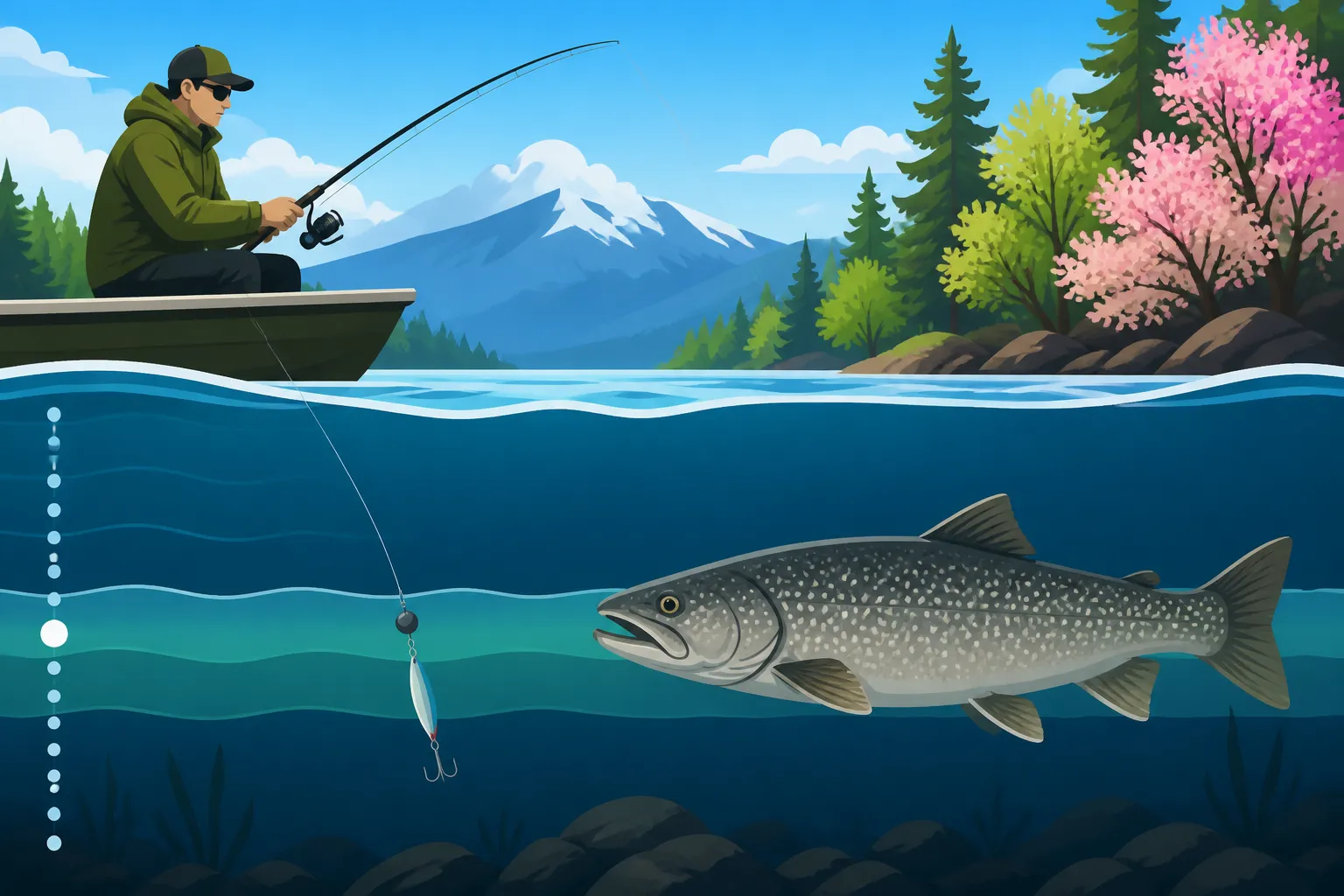
If you're serious about lake trout trolling, especially as they move deeper, downriggers are your best friend. These devices allow you to set your lure at a precise depth, say 45 feet, and keep it there regardless of your boat speed or lure action. They consist of a heavy cannonball weight, a cable, and a release clip. Your fishing line attaches to the clip, and when a fish strikes, the line pops free from the clip, allowing you to fight the fish directly without the weight. This precision is invaluable when lake trout are holding to a very specific depth or following subtle thermoclines. You can find excellent downriggers and a wide variety of Best Lures for Lake Trout Trolling on Amazon, making it easy to gear up for your spring adventures. Look for models with a line counter and adjustable retrieve speed.
Lead Core Line
For anglers without downriggers, or those who prefer a simpler setup, lead core line is an excellent alternative for reaching moderate depths. This specialty line has a lead core wrapped in a braided sheath, which causes it to sink. The general rule of thumb is that each "color" (which is typically 10 yards or 30 feet) of lead core will take your lure down approximately 5 feet at a trolling speed of 2-2.5 mph, depending on your lure's action and line diameter. So, if you want to fish at 25 feet, you'd let out about 5 colors of lead core. It's not as precise as a downrigger, as your depth will fluctuate with speed, but it's very effective for the 20-60 foot range often found in mid-spring. Pairing it with a fluorocarbon leader (10-20 feet) helps with stealth. Our guide on Best Line Weight for Lake Trout Trolling offers more insights into line choices.
Dipsy Divers and Planer Boards
Dipsy Divers are disc-shaped devices that clip onto your main line and dive, taking your lure down to a specific depth, which can be adjusted. They also have a trip mechanism that releases them on a strike. They're great for getting lures down without heavy weights directly on your line. Planer boards, on the other hand, are designed to take your lure away from the boat, allowing you to spread out multiple lines and cover a wider trolling path. While they don't add much depth on their own, they can be used in conjunction with lead core or other weights to reach wider, deeper zones, which is particularly useful in open water.
Electronics: Your Eyes Below the Surface
A quality fish finder is absolutely indispensable for lake trout fishing. It’s not just about seeing the fish; it’s about understanding the underwater world. Look for fish arches, baitfish schools (often appearing as clouds or dense balls), and bottom contours like humps, ledges, and drop-offs. Many modern fish finders, especially those from brands like Garmin, Lowrance, or Humminbird, also feature water temperature graphs, which can help you identify temperature breaks. Using your GPS to mark successful trolling passes and depths will help you recreate success later. For more information on picking the right unit, check out our guide on Best Fish Finders for New Hampshire Lakes.
Lure Selection and Trolling Speed
While depth is critical, the right lure and speed are the icing on the cake. In spring, lake trout often prefer larger, slow-moving baits. Common choices include flutter spoons, stickbaits, and tube jigs. Colors can vary, but silver, blue, white, and chartreuse are often productive. For spoons, brands like Sutton, Eppinger Daredevle, and Silver Horde are popular choices. The key is to find a lure that has good action at the slow speeds (1.5-2.5 mph) often preferred in colder spring water. Don't be afraid to experiment with different sizes and colors until you find what the fish are keying in on. Sometimes, a subtle change in your lure's presentation or speed can make all the difference between a slow day and a banner day. When thinking about your overall setup, our guide on Best Fishing Rods for New Hampshire Lakes can help you choose the ideal rod for this type of fishing.
Disclaimer
Fishing conditions and regulations in New Hampshire can change. Always consult the latest New Hampshire Fish and Game Department regulations before heading out on the water. This guide provides general information and recommendations.