Best paddle length for a fishing kayak
One of the biggest frustrations for new and experienced kayak anglers alike is feeling like you're fighting your paddle more than the fish. You've got your rod, your tackle, your PFD, but if your paddle isn't right, every stroke feels like a chore, leading to quickly tiring arms and a less enjoyable day on the water. This comprehensive guide will walk you through everything you need to know to select the absolute best paddle length for your fishing kayak, ensuring you can paddle efficiently and comfortably through all of New Hampshire's beautiful waterways.
Understanding the Factors That Influence Paddle Length
Picking the right paddle isn't a one-size-fits-all situation, especially when it comes to fishing kayaks. There are several key elements that play into finding that perfect length, and overlooking even one can lead to a lot of wasted energy and discomfort. It's more than just grabbing any old paddle off the rack; it's about matching the tool to your unique setup and yourself.
Kayak Width and Seat Height
Think about it: the wider your kayak, the further you have to reach over the sides to get your paddle blades into the water. This is the primary reason why a recreational kayak paddle often won't cut it for a dedicated fishing kayak. Fishing kayaks are designed for stability, which usually means they're significantly wider than their recreational counterparts. A wider beam equals a longer paddle needed to comfortably clear the gunwales and get a good, vertical stroke. If your paddle is too short, you'll find yourself leaning excessively, straining your back and shoulder, and likely hitting the side of your kayak with every stroke, which is just plain annoying and inefficient.
Beyond width, the height of your seat is a massive factor. Many modern fishing kayaks, especially popular models like those from Old Town or Perception, feature elevated seats. These seats get you up higher off the water, offering a better vantage point for spotting fish and making casting easier. However, this higher seating position means you're sitting further above the waterline. Just like a wider kayak, this increased height demands a longer paddle to maintain the correct angle of entry into the water. If you try to use a standard-length paddle from an elevated seat, you'll be practically skimming the water's surface, unable to get a powerful, effective stroke, and possibly even hitting your knees with the paddle shaft. It’s a common mistake, and one that quickly saps the fun out of a day of Kayak Fishing Techniques for New Hampshire Lakes.
Your Height and Paddling Style
While kayak dimensions are crucial, your own physical attributes and how you prefer to paddle are equally important. Your height directly influences how long a paddle feels comfortable in your hands. A taller paddler naturally has a longer torso and arm reach, and thus will generally require a longer paddle than someone shorter, assuming the same kayak. Trying to use a paddle that's too short for your height will force you to hunch over or extend your arms unnaturally, which quickly leads to fatigue in your shoulders, back, and arms. Conversely, a paddle that's too long for your height can feel unwieldy and cumbersome, making it difficult to maintain a smooth, controlled stroke.
Your individual paddling style also plays a significant role in paddle length selection. There are generally two main styles: high-angle and low-angle. High-angle paddlers keep their hands higher and closer to their body, with the paddle shaft more vertical during the stroke. This style typically generates more power and is common among those who want to cover ground quickly or paddle aggressively. Low-angle paddlers, on the other hand, keep their hands lower, extending the paddle further out from the kayak with a more horizontal shaft angle. This style is often more relaxed, conserves energy, and is very common among kayak anglers who spend more time drifting or making slower, deliberate movements. A high-angle paddler might prefer a slightly shorter paddle for quicker, more powerful strokes, while a low-angle paddler will almost always benefit from a longer paddle to comfortably reach the water without excess strain. It's all about finding that sweet spot where efficiency meets comfort, allowing you to focus on the fish, not your aching shoulders.
General Guidelines and Formulas for Initial Sizing
Getting started can feel a bit like guessing, but thankfully, there are some established guidelines and quick tests that can give you a solid starting point for paddle length. These aren't hard and fast rules, as personal preference will always come into play, but they're excellent benchmarks to prevent you from being wildly off base when you begin your search.
The Basic Paddle Sizing Chart
Most paddle manufacturers and outdoor retailers provide sizing charts to help you narrow down your options. These charts typically cross-reference your height with the width of your kayak. Remember, kayak width is measured at its widest point, usually at mid-ship. Fishing kayaks usually fall into the "wide" category, often 30 inches or more. Your height is simply your standing height.
Here's a general paddle sizing chart to give you an idea:
| Your Height | Kayak Width (23-28 inches) | Kayak Width (29-33 inches) | Kayak Width (34+ inches, common for fishing kayaks) |
|---|---|---|---|
| 5'0" – 5'4" | 210-220 cm | 220-230 cm | 230-240 cm |
| 5'5" – 5'9" | 220-230 cm | 230-240 cm | 240-250 cm |
| 5'10" – 6'2" | 230-240 cm | 240-250 cm | 250-260 cm |
| 6'3" and taller | 240-250 cm | 250-260 cm | 260-270 cm |
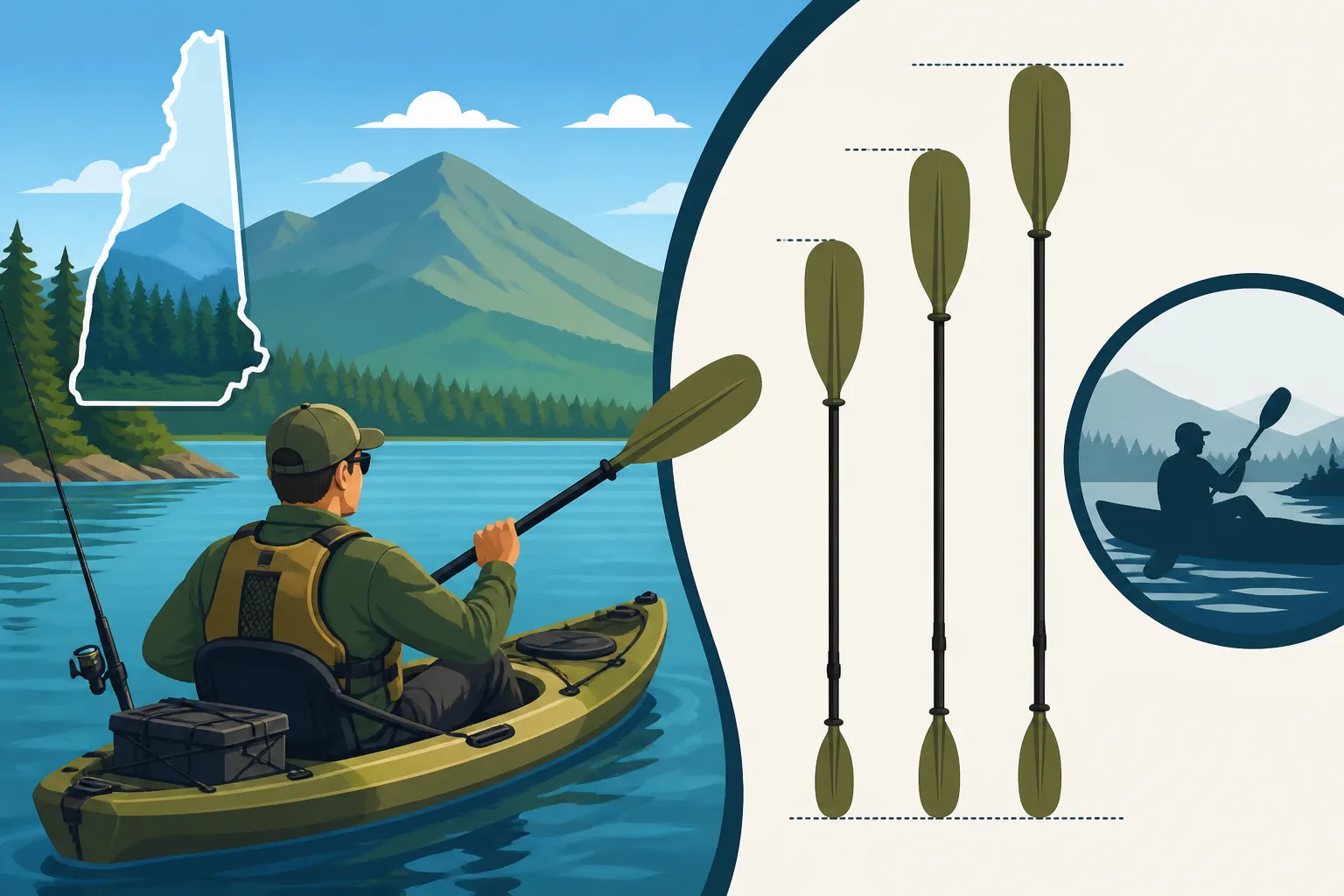
This chart is a great starting point, but it's vital to remember it's a guide, not a rigid rule. If you're near the edge of a category, or if you know you prefer a particular paddling style (high vs. low angle), you might adjust slightly. For example, a 5'9" angler in a 34-inch wide fishing kayak might lean towards a 250cm paddle if they prefer a low-angle, relaxed stroke, or stick closer to 240cm if they like a more upright, high-angle technique. The key is to use this chart to get into the right ballpark.
Armpit Test and Other Quick Checks
Once you have a general idea of the length from a chart, or if you're standing in a store like Bass Pro Shops looking at options, there are a few quick physical tests you can do. The most common is the "armpit test." To perform this, stand the paddle vertically on the ground in front of you. If the paddle tip reaches somewhere between your chin and your nose, it's generally a good length for a recreational kayak. However, for a fishing kayak, especially one with an elevated seat, you'll often want a paddle that extends a bit higher, perhaps even to your forehead. The idea is to mimic the reach you'll need from your seated position.
Another helpful quick check involves holding the paddle horizontally above your head while standing. If your elbows are bent at roughly a 90-degree angle, that's often a decent indicator for general recreational use. Again, for a fishing kayak, you might find you want a paddle that feels slightly longer even with this test, accounting for the additional height your elevated seat provides. These quick checks are best done with the specific kayak you intend to use, if possible. For example, if you're trying to figure out the Best Kayak for Winnipesaukee, and you know it has a high seat, you'll adjust your mental "armpit test" to account for that added height. If you can't test it with your actual kayak, imagine yourself sitting in it and then perform the test, envisioning the extra reach required.
Nuances for Fishing Kayaks Specifically
Fishing kayaks, by their very design, introduce a few specific considerations that don't apply to standard recreational or touring kayaks. These differences are crucial for ensuring your paddle length complements your angling setup and doesn't hinder your fishing experience. Neglecting these nuances can lead to a perfectly good fishing kayak feeling cumbersome and difficult to maneuver.
Elevated Seats and Stability Concerns
As we touched on earlier, the elevated seating in many fishing kayaks is a game-changer for paddle length. Standard kayaks have you sitting right on the bottom, close to the waterline. Fishing kayaks, however, lift you up. This enhanced visibility and casting comfort come at the cost of needing a much longer paddle. If your seat raises you 4-6 inches higher, you're going to need at least that much extra length on your paddle just to maintain the same blade angle and efficient stroke. Without it, you’ll be making short, choppy strokes, expending more energy, and likely experiencing blade flutter as you try to force a shorter paddle to do a longer paddle’s job.
Beyond the elevated seat, the inherent stability of fishing kayaks impacts paddle choice. Most fishing kayaks are built wider and flatter-hulled to provide a stable platform for standing, casting, and reeling in fish. While fantastic for stability, this width means you have to reach further out to get a good paddle stroke. A short paddle on a wide, stable fishing kayak will have you constantly leaning and stretching, throwing off your balance and making paddling feel like a continuous effort rather than a smooth glide. The paddle needs to be long enough to allow you to keep a relatively upright posture, putting power into your stroke without feeling like you're performing gymnastics. This is especially true when you're loaded down with gear for a day of Best Fishing Lakes in New Hampshire.
Different Fishing Scenarios and Paddle Adjustments
The kind of fishing you do and the waters you frequent will also influence your ideal paddle length, or at least how you might adjust an adjustable paddle.
- Covering Long Distances on Open Water: If your fishing involves long paddles across large lakes like Winnipesaukee to reach specific fishing spots, you'll appreciate a slightly longer paddle. This promotes a more relaxed, low-angle stroke that is incredibly efficient for covering ground. Longer paddles reduce the number of strokes needed and minimize fatigue over extended periods. It's about conserving energy so you have more left for fighting fish.
- River Fishing or Navigating Tight Spaces: When you're fishing smaller rivers, winding through coves, or navigating areas with current and obstacles, you might prefer a paddle that allows for quicker, more powerful, and more precise strokes. A slightly shorter paddle within your comfortable range can offer better maneuverability and a higher cadence, which can be advantageous for holding your position against a current or making quick turns. This is particularly relevant if you're exploring spots on the Best Kayak for River Fishing in New Hampshire.
- Stand-Up Fishing: If you plan on standing and fishing from your kayak, your paddle length considerations shift again. While you won't be actively paddling when standing, you'll often use your paddle as a push pole or for quick, stabilizing strokes. For this, a paddle that's adjustable or on the longer end of your range is beneficial, as it gives you more leverage and reach when standing. Some anglers even carry a separate, very long push pole in addition to their regular paddle for dedicated stand-up use. This versatility can be a big plus, especially when stalking bass in shallow coves.
Choosing and Testing Your Paddle
Once you have a good idea of the length range you need, it's time to actually choose and test a paddle. This is where the theoretical meets the practical, and often, a little hands-on experience can make all the difference in making the right decision.
Paddle Types and Materials
Paddles aren't just about length; the materials they're made from and the shape of their blades also contribute significantly to performance and comfort.
- Aluminum: These are typically the most budget-friendly option. They're durable and heavy, which can lead to fatigue over long paddles. They also tend to get hot in the sun and cold in the winter, which can be uncomfortable on the hands. While a great entry-level choice, serious kayak anglers often upgrade.
- Fiberglass: A significant step up from aluminum in terms of weight and performance. Fiberglass paddles are lighter, offer a bit more flex (which can reduce strain), and are generally warmer to the touch. They're a popular mid-range option, offering a good balance of durability, weight, and cost.
- Carbon Fiber: The crème de la crème of paddle materials. Carbon fiber paddles are incredibly lightweight and stiff, translating to maximum efficiency with every stroke. This reduced weight dramatically lessens fatigue, especially on long days or when fighting a strong headwind. They are also the most expensive. If you spend a lot of time on the water, the investment is often worth it for the sheer comfort and performance. Many experienced anglers prioritize a high-quality, lightweight carbon fiber paddle for this reason.
Beyond materials, blade shape matters.
- Asymmetrical, Spooned Blades: These are common on modern paddles. The asymmetrical shape helps prevent blade flutter and provides a smoother, more powerful stroke. The "spoon" refers to the slight curve or concavity of the blade, designed to cup the water more effectively.
- Dihedral Angle: Many blades also incorporate a dihedral angle (a slight ridge running down the center of the blade). This helps water flow evenly off both sides of the blade, making for a smoother, less tiring stroke.
For fishing kayaks, a larger blade surface area often means more powerful, albeit sometimes heavier, strokes, which can be good for maneuvering wide, heavy kayaks.
Where to Buy and What to Look For
The best place to buy a paddle, if possible, is a dedicated paddle sports or outdoor recreation store where you can physically hold and even test paddles. Places like Bass Pro Shops often have a good selection, and their staff might be knowledgeable. Many specialty kayak shops will even have tanks or local ponds where you can try paddles out in a real kayak. This "test drive" is invaluable. When you're there, sit in a kayak similar to yours (or your actual kayak if you brought it) and hold various paddle lengths. Pay attention to:
- Comfort: Does the shaft feel good in your hands? Is the grip natural?
- Reach: Can you comfortably immerse the entire blade in the water without excessive leaning?
- Stroke Angle: Does the paddle allow you to maintain an efficient stroke angle without hitting the kayak or straining your shoulders?
If an in-person test isn't feasible, don't despair! Online retailers like Amazon offer a vast selection, and their detailed product descriptions often include sizing guides specific to their models. When buying online, make sure the retailer has a good return policy, just in case the paddle isn't quite right once you get it on the water.
Finally, consider an adjustable paddle. Many fishing-specific paddles come with an adjustable ferrule (the joint where the two halves connect) that allows you to change the length by 10-20 cm (4-8 inches). This versatility is fantastic for kayak anglers because:
- It accounts for elevated seat differences: If your kayak has multiple seat height options, or if you sometimes use a stand-assist bar that changes your paddling posture, an adjustable paddle lets you adapt.
- It adapts to different conditions: You can lengthen it for efficient long-distance paddling on a calm lake, or shorten it slightly for more control in a river current or windy conditions.
- It's great for shared use: If multiple people of different heights will use the same kayak, an adjustable paddle is a no-brainer.
The ideal paddle length will significantly enhance your time on New Hampshire's waters, whether you're targeting smallmouth bass in the Merrimack River or lake trout on Winnipesaukee. By considering your kayak's width, seat height, your own physical stature, and your preferred paddling style, you'll be well on your way to a more efficient and enjoyable day of fishing. Don't forget to check out our guides on Best Kayaks for New Hampshire Fishing and Best Kayak for River Fishing in New Hampshire for more tips on getting set up for success. You might also find some helpful information in Are Kayaks Required to Be Registered in New Hampshire? to ensure you're compliant with all state regulations before heading out. For essential safety gear, take a look at Best Life Jacket for Lake Kayak Fishing. And for general gear organization, Best Dry Bag for Kayak Fishing is a must-read.
Disclaimer
This article is for general informational purposes only and does not constitute professional advice. Laws, prices and regulations vary by location and change over time. Consult a qualified professional for guidance on your specific situation.