Panfish Species Identification Guide for New Hampshire
It’s a tale as old as time for New Hampshire anglers: you’re out on a beautiful lake or pond, catching fish after fish, but when you look closely, you’re not quite sure what you’ve actually reeled in. With so many species of panfish swimming in our waters, it can be really tricky to tell them apart, especially when they’re similar in size and shape. This guide is here to unravel that mystery, giving you clear, down-to-earth tips to confidently identify the most common panfish you’ll encounter on your New Hampshire fishing adventures.
The Ever-Present Yellow Perch
Ah, the yellow perch! If you've spent any time fishing in New Hampshire, you've almost certainly encountered these feisty little fighters. They're a staple in so many of our lakes and ponds, often schooling up in large numbers, which makes them a fantastic target for beginners and seasoned anglers alike. But how do you know for sure that it’s a yellow perch and not one of its lookalikes? It’s all in the details, my friends.
Spotting a Yellow Perch
When you pull a yellow perch out of the water, the first thing that usually jumps out at you is its distinctive coloration. They typically have a brassy, golden-yellow body, often leaning towards a more olive-green on their back. What really sets them apart are those vertical, dark bands — usually six to eight of them — running down their sides. These bands are pretty irregular, sometimes forking or being a bit broken, but they're always there, creating a sort of tiger-stripe pattern. Their belly is usually white or very pale.
Another key identifier is their fins. Yellow perch have two dorsal fins; the first one is spiny, and the second one is soft-rayed. Look for a small, dark spot on the rear of the first dorsal fin. Their lower fins – the pelvic and anal fins – often have a lovely reddish or orange tint, especially during spawning season or in particularly vibrant specimens. Their mouth is moderately sized, and their body shape is somewhat elongated but chunky, with a distinct hump on their back just behind the head. They generally don't get huge, usually ranging from 6 to 10 inches, but they can be a blast to catch.
Yellow Perch Habitat and Behavior
Yellow perch are incredibly adaptable, thriving in a wide range of aquatic environments across New Hampshire. You'll find them in almost all of our larger lakes, many ponds, and even slower-moving river sections. They really love areas with some vegetation, like weed beds, as well as submerged structures such as fallen trees, docks, or rock piles. These spots provide both cover from predators and a plentiful hunting ground for their varied diet.
These fish are notoriously schooling fish, which means if you catch one, there are likely many more close by! They're active throughout the day, often feeding in shallower waters during cooler parts of the day or low light, and moving to deeper, cooler water as the sun climbs high. Their diet is quite broad; they'll gobble up insect larvae, small crustaceans, and even smaller fish. This makes them a great target for a variety of techniques, from still fishing with worms under a bobber to casting small jigs or spoons. For more detailed information on where to find these guys, check out our guide on Yellow Perch in New Hampshire Lakes.
Black Crappie: The Slab-Sided Beauty
When you hook into a black crappie, you know it. These fish have a way of putting a delightful bend in your rod, and once you get them to the surface, their distinct appearance is often unmistakable. They are a prized panfish in New Hampshire, known for their delicious white meat and their sometimes challenging, sometimes easy-to-find nature.
How to Distinguish Black Crappie
Black crappie are often described as "slab-sided" for a reason – they have a very compressed, disc-shaped body, almost like a dinner plate turned sideways. Their overall color is silvery to olive-green, adorned with irregular black blotches and speckles scattered all over their body, including their dorsal, caudal, and anal fins. Unlike the yellow perch's distinct bands, the crappie's markings are more like a messy paint splatter.
A critical identification feature lies in their dorsal fin. Black crappie have a single dorsal fin with 7 or 8 sharp spines, which is typically equal in length to their anal fin. They also have a relatively large mouth that extends back to or even past the middle of their eye, and their upper jaw is slightly longer than their lower jaw. Their eyes are also quite large, hinting at their predatory nature. They tend to be a bit deeper-bodied than yellow perch, and their average size can often surpass that of a perch, with many anglers proudly showing off "slab" crappie over a foot long. You might pick up some tackle from Amazon that specifically targets crappie if you're looking to consistently land these beauties.
Crappie Hotspots and Feeding Habits
Black crappie are often found in clear, slow-moving waters or lakes with plenty of submerged structure. Think about areas with brush piles, fallen trees, old docks, bridge pilings, or dense stands of lily pads. They love to suspend themselves in cover, waiting for unsuspecting baitfish or insects to swim by. While they can be found throughout the day, dawn and dusk are often peak feeding times, when they move into shallower waters to forage.
Their diet consists mainly of small minnows, insect larvae, and zooplankton. This makes them highly susceptible to small jigs, particularly those tipped with a minnow or a soft plastic grub. Spider rigging, where multiple rods are used to present baits at different depths around a brush pile, is a popular and effective method for crappie fishing. Crappie can be a bit finicky at times, requiring a patient and subtle approach, but when you find a school, the action can be non-stop. If you want to dive deeper into the best places and techniques, take a look at our guide on Black Crappie in New Hampshire Waters.
Bluegill and Other Sunfish Species
The sunfish family is a diverse and colorful group, and New Hampshire is home to several members. The most common, and often the first fish many kids catch, is the bluegill. They are abundant, willing biters, and a blast to catch on light tackle. But beyond the bluegill, there are other sunfish that might cross your path, each with its own subtle characteristics.
Identifying Bluegill (and its lookalikes)
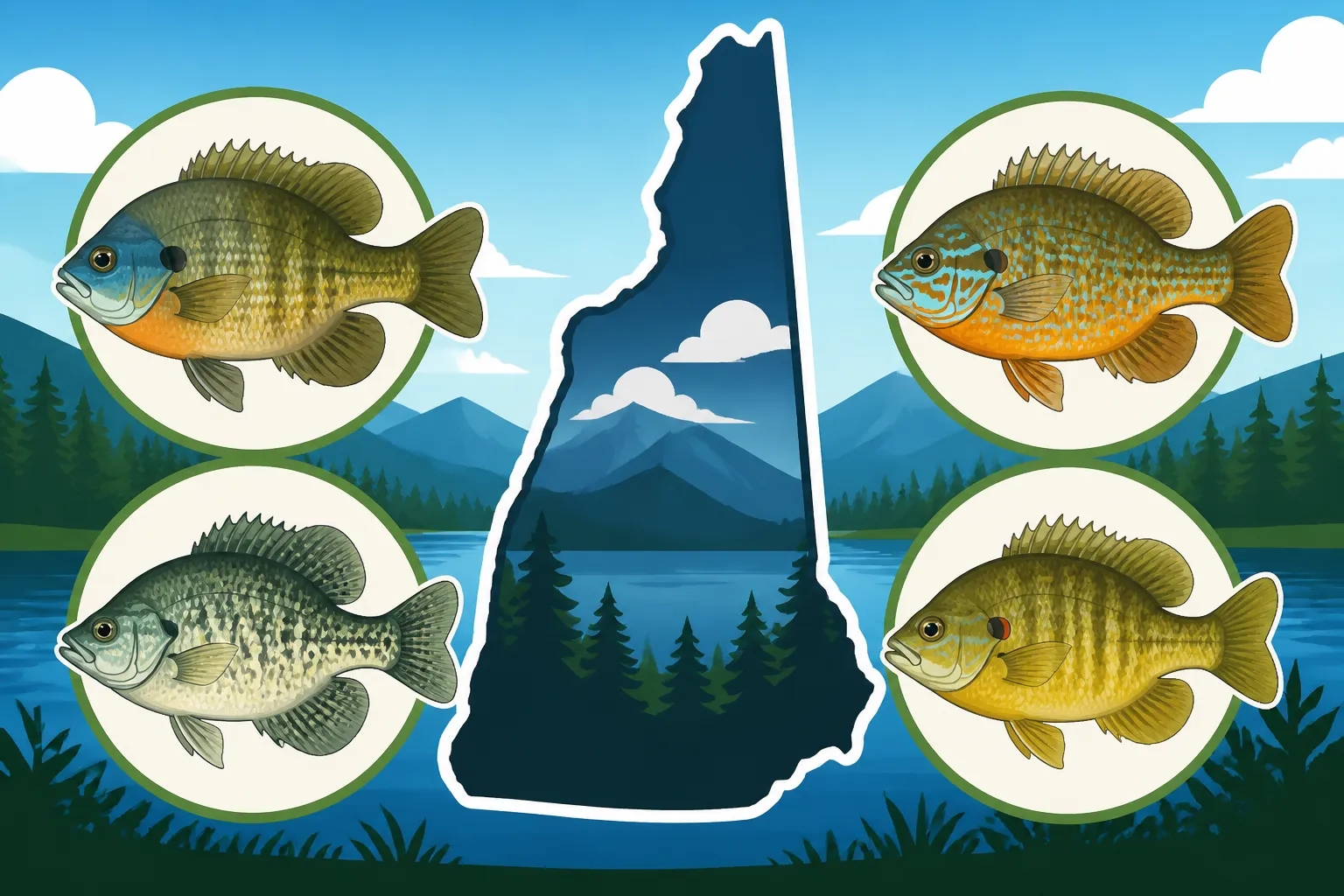
Bluegill are truly iconic. Their bodies are typically deep and compressed, similar to a crappie, but usually a bit rounder. Coloration can vary widely depending on water clarity and diet, but they generally range from a dark olive or bluish-green on their back, fading to lighter green or yellow on their sides, with a yellowish or orange belly. What truly gives them away is the deep blue or purplish sheen on their gill plates (hence "bluegill") and a distinct black spot on the posterior edge of their gill flap, often with an orange or red margin. They also usually have a small, dark spot at the base of their dorsal fin.
Another key feature is their small, terminal mouth. Unlike crappie, a bluegill's mouth rarely extends beyond the front of its eye. They also have a single, long dorsal fin with 10-12 spines, often creating a continuous fin profile.
It’s easy to confuse bluegill with other sunfish like pumpkinseeds or redbreast sunfish. Pumpkinseeds, for example, have more vibrant, almost iridescent spots and wavy blue lines on their cheek, and a bright red or orange spot on the back of their gill flap, which is often much more pronounced than a bluegill's. Redbreast sunfish, as their name suggests, have a prominent reddish-orange belly and exceptionally long, slender gill flaps that are entirely dark or black. Learning these subtle differences will help you categorize your catches more accurately.
Sunfish Behavior and Best Fishing Spots
Bluegill and other sunfish are warm water fish, preferring shallow, vegetated areas of lakes, ponds, and slow-moving streams. They love sunny spots around docks, fallen trees, lily pads, and brush piles. You often find them nesting in large colonies during spawning season, creating circular depressions in the substrate that are easy to spot in clear water.
Their diet is varied but primarily consists of aquatic insects, insect larvae, small crustaceans, and sometimes fish eggs. They're opportunistic feeders, which is why they're so eager to bite a small worm, piece of corn, or tiny artificial lure. Fly fishing with small poppers or nymphs can be incredibly effective and fun. These fish are fantastic for teaching kids to fish due to their aggressive feeding habits and abundance. You can often find a variety of small, panfish-specific baits and tiny hooks on Amazon that are perfect for a family fishing trip. For more specific details on their habits, you can look up Bluegill Habits in New Hampshire Ponds.
The Misunderstood Chain Pickerel (Often Caught While Panfishing)
Now, this is where things get interesting! While not traditionally considered a "panfish" due to their predatory nature and slender, toothy profile, chain pickerel are very frequently caught by anglers targeting panfish in New Hampshire. They share similar habitats and will readily strike the same baits, often leading to a surprise fight! It's important to be able to identify them quickly, not just for regulations but also because those teeth mean business.
Key Pickerel Identification Marks
The chain pickerel is unmistakable once you know what to look for. Their body is long, slender, and cylindrical, much more torpedo-shaped than any true panfish. They have a distinctive chain-like pattern of dark markings on their olive-green to yellowish-brown sides, which gives them their common name. Their back is darker, fading to a lighter belly.
The most critical identification feature is their head. Pickerel have a long, duck-bill shaped snout, and it’s packed with sharp, needle-like teeth. Their entire cheek and gill cover are fully scaled, which helps differentiate them from their larger cousins, northern pike (which only have scales on the upper half of their gill cover) and muskellunge (which have no scales on their gill cover). This scaling pattern is a key diagnostic. They also have a single, far-back dorsal fin located directly above their anal fin, giving them a streamlined appearance for ambushing prey. Don't forget, these fish can grow quite large, sometimes exceeding 20 inches in length, making them a formidable catch on light panfish gear.
Why Pickerel Are Often Near Panfish
Pickerel are ambush predators, and they thrive in similar shallow, vegetated habitats where panfish love to congregate. Think dense weed beds, lily pad fields, and submerged timber. Why are they there? Because that's where their food is! Panfish like yellow perch, bluegill, and even small crappie make up a significant portion of a pickerel's diet. So, when you're casting a small jig or drifting a worm for bluegill in a weed line, it’s not uncommon for a hungry pickerel to dart out and snatch your bait.
Their aggressive nature means they'll strike a wide variety of lures and baits, from small spoons and spinners to live shiners. While it might be a surprise when you hook one, especially on an ultralight setup, landing a pickerel can be a thrilling experience. Just be mindful of those teeth when unhooking them – a good pair of long-nosed pliers is essential, and a fish gripper can save your fingers! You can learn more about these fascinating predators in Chain Pickerel Fishing in New Hampshire.
The Bottom-Dwelling Horned Pout (Bullhead)
Moving from the sleek predators to the often-underestimated bottom dwellers, we arrive at the horned pout, more commonly known as the bullhead. These whiskered wonders are a favorite target for many New Hampshire anglers, particularly those who enjoy night fishing or just want to catch a meal that's both abundant and delicious. They might not be the prettiest fish in the lake, but they certainly have their charm and a distinct identity.
Telling a Horned Pout Apart
Horned pout have a very unique look that separates them immediately from other panfish. Their body is generally dark, ranging from muddy brown to black on their back, fading to olive or yellowish-brown sides, and a lighter belly. They have a stout, somewhat stocky body with a broad, flat head.
The most obvious identification feature is their barbels – those distinctive whisker-like sensory organs around their mouth, similar to a cat. They have eight of these barbels, which they use to root around in the mud and detect food. Their skin is smooth and scaleless, setting them apart from scaled fish like perch or sunfish. They have prominent, sharp spines on their dorsal and pectoral fins, which can deliver a painful poke if you're not careful when handling them. Their caudal (tail) fin is typically square or slightly emarginate, rather than forked. Horned pout also have a very characteristic "squeak" or "grunt" when handled, which is another dead giveaway! These fish don't typically grow to enormous sizes, often in the 10-14 inch range, but they can be quite plump and pack a punch on the dinner table.
Where to Find Bullheads in New Hampshire
Horned pout are true bottom dwellers, preferring soft, muddy bottoms in lakes, ponds, and slow-moving rivers. They are incredibly tolerant of low oxygen levels and murky water, making them adaptable to many environments where other fish might struggle. You'll often find them lurking in deeper holes, under lily pads, around downed trees, or along the edges of weed beds, always close to the bottom.
They are primarily nocturnal feeders, which is why night fishing with a lantern or headlamp is a popular and very effective way to target them. Their diet consists of pretty much anything they can find on the bottom – insect larvae, worms, leeches, small fish, decaying organic matter, and even plant material. This makes them easy to catch on common baits like nightcrawlers, hot dogs, chicken livers, or even corn, fished directly on the bottom with a simple sinker and hook rig. They're a forgiving fish for beginners and can provide consistent action when other species are slow. Our guide on Horned Pout (Bullhead) Fishing in New Hampshire has even more great tips for landing these bottom-feeder beauties.
White Perch: A Coastal Cousin
While many panfish conversations focus on freshwater species, New Hampshire also boasts a fantastic coastal panfish that ventures into our brackish and even some freshwater environments: the white perch. These fish are schooling machines and offer incredible action, especially during certain times of the year. Often mistaken for other perch or even young striped bass, knowing their specific identifiers is key.
Identifying White Perch
White perch have a sleeker, more oval-shaped body than their yellow perch cousins, without the distinct vertical bars. Their color is generally silvery-white on their sides and belly, with a darker, sometimes greenish or grayish back. Some individuals can have a subtle golden or bronze tint, especially when pulled from brackish water.
A crucial characteristic is their two dorsal fins, which are distinctly separated or only slightly joined at the base. The first dorsal fin is spiny, and the second is soft-rayed. Unlike the yellow perch, they lack the dark spot on the first dorsal fin. Their mouth is moderately sized, and their body profile has a noticeable curve or arch to the back. When you compare them side-by-side with a small striped bass, white perch are generally deeper-bodied and lack the prominent horizontal stripes that define a striper. They also tend to be smaller than stripers, typically ranging from 6 to 12 inches, though larger specimens are certainly caught.
White Perch Habitat in New Hampshire
White perch are truly fascinating in their habitat preferences. While often considered a brackish water species, common in estuaries like Great Bay and the lower sections of coastal rivers, they are also found in purely freshwater environments in many New Hampshire lakes and ponds, having become landlocked in some systems. In brackish water, they'll congregate in channels, around oyster beds, and near structure like docks and bridge pilings. In freshwater lakes, they'll school in open water, often suspending over deeper areas, or cruising along structure like drop-offs and humps.
They are ravenous feeders, and when you locate a school, the fishing can be unbelievably fast-paced. Their diet consists of small fish, crustaceans, worms, and aquatic insects. This makes them vulnerable to a wide array of baits and lures. Small jigs (especially those tipped with a piece of clam or a worm), sabiki rigs, or even shiny spoons and spinners are highly effective. Light tackle offers an exhilarating fight. Many anglers specifically target these fish for their fight and their excellent table fare. You can often find specialty rigs designed for schooling fish on Amazon, which can be a game-changer when targeting white perch. For more on where to find these prolific fish, check out our article White Perch in New Hampshire Lakes.
Panfish Identification at a Glance
To help you quickly differentiate between New Hampshire's most common panfish species, here's a handy table summarizing their key identification features:
| Feature | Yellow Perch | Black Crappie | Bluegill (and Sunfish) | Chain Pickerel | Horned Pout (Bullhead) | White Perch |
|---|---|---|---|---|---|---|
| Body Shape | Elongated, chunky | Deep, compressed (slab-sided) | Deep, rounded, compressed | Long, slender, cylindrical | Stout, broad, flat head | Oval, sleek, compressed |
| Color/Markings | Yellowish w/ 6-8 dark bands | Silvery w/ irregular black blotches | Olive/blue back, yellow belly, blue gill plate, black spot on gill flap | Olive/brown w/ chain pattern | Dark brown/black, mottled | Silvery-white, darker back |
| Dorsal Fins | 2 separate (spiny/soft) | 1, 7-8 spines | 1, continuous (spiny/soft) | 1, far back, above anal fin | 1, short, spiny | 2 separate (spiny/soft) |
| Mouth | Moderate size | Large, extends to/past eye | Small, terminal | Long, duck-bill, very toothed | Broad, terminal | Moderate size |
| Scales | Yes | Yes | Yes | Yes, entire cheek/gill cover | No (smooth skin) | Yes |
| Other Features | Dark spot on 1st dorsal fin | Large eyes | Blue/purple sheen on gill plate | Sharp teeth | 8 barbels ("whiskers"), spines, grunts | No bands, lacks distinct stripes |
| Average Size | 6-10 inches | 8-12 inches | 5-8 inches | 15-22 inches | 10-14 inches | 6-12 inches |
This table provides a quick reference, but remember that fish coloration can vary with their environment. The more you observe these subtle differences, the better you'll become at identifying them on the water. Knowing your species not only satisfies your curiosity but also helps you follow important regulations outlined in resources like New Hampshire Bag and Possession Limits by Species.
Ultimately, whether you're catching a feisty yellow perch, a prized black crappie, a vibrant bluegill, or even a toothy chain pickerel by accident, every fish caught in New Hampshire offers a unique experience. By learning these identification tips, you'll gain a deeper appreciation for the diverse aquatic life that calls our lakes, ponds, and rivers home. So grab your Best Tackle for Panfish, head out there, and enjoy the thrill of the catch!
Disclaimer
This article is for general informational purposes only and does not constitute professional advice. Laws, prices and regulations vary by location and change over time. Consult a qualified professional for guidance on your specific situation.