How to tell landlocked salmon from lake trout
It's a familiar scenario for many New Hampshire anglers: you've got a feisty fish on the line, it's putting up a fantastic fight, and as you bring it closer to the boat or shore, your mind races. Is it a landlocked salmon or a lake trout? These two iconic coldwater species, both highly sought after in the Granite State, can look strikingly similar at first glance, leading to confusion and sometimes even a moment of panic if you're trying to adhere to specific regulations. This guide is here to help you confidently tell the difference between these magnificent fish, ensuring you can identify your catch quickly and accurately.
The Core Differences: A Closer Look at Anatomy
When you're holding a fish in your hands, or even just getting a good look at it in the net, there are some tell-tale anatomical features that can quickly clear up any confusion between a landlocked salmon and a lake trout. It's all about paying attention to the details.
Visual Cues: Shape, Size, and Coloration
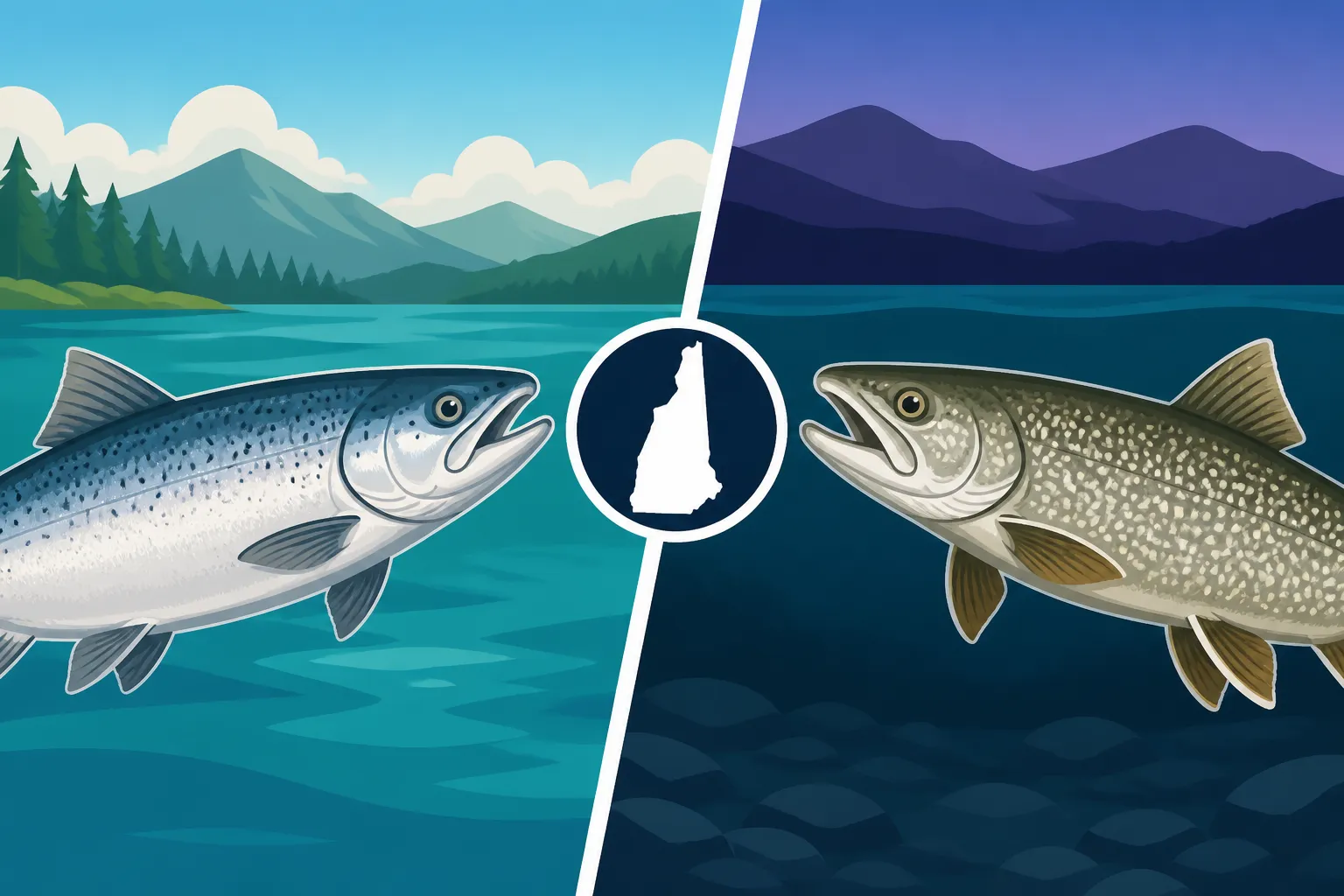
Let's start with the overall impression. Landlocked salmon tend to have a more streamlined, torpedo-shaped body, built for speed and acrobatic leaps. Their bodies are typically sleeker, often with a silvery, almost iridescent sheen, especially when freshly caught from cold, clear water. You might notice a slightly forked tail, which is another indicator of a fast-moving fish. Their general coloration is usually silver fading to a darker back, with minimal spotting.
Lake trout, on the other hand, usually present a more robust, chunkier appearance. They are often deeper-bodied and can have a more muted, darker overall coloration, ranging from olive green to grayish-brown on their backs, fading to lighter sides and bellies. While they can still be silvery, it's usually less pronounced than a salmon. Their tails are also typically more deeply forked than a salmon's. Think of a powerful, deep-water dwelling fish – that's often the lake trout's build. While size can be a bit tricky because both species can grow quite large in New Hampshire's productive lakes like Winnipesaukee or Sunapee, a truly massive, deep-bodied fish is often leaning towards a lake trout. However, don't rely solely on size; a small lake trout can still be confused with a larger salmon if you're not looking at other features. For a broader understanding of different species, check out our Trout Species Identification Guide for New Hampshire.
Mouth and Teeth: Key Identifying Features
Now, let's get a little closer and examine the mouth. This is where you'll find some of the most reliable clues.
Landlocked Salmon:
When you gently open a landlocked salmon's mouth, you'll generally notice smaller, sharper teeth. They have teeth on both jaws, but they tend to be more uniform in size. A key feature to look for is the vomerine teeth, which are located on the roof of the mouth. On a landlocked salmon, these teeth are typically found only at the very front of the vomer bone and don't extend down the shaft in a continuous row. Their upper jaw (maxilla) will usually not extend past the back of the eye.
Lake Trout:
With a lake trout, the teeth are often more pronounced and robust. Their vomerine teeth are distinctively different: they form a continuous, strong row that extends down the shaft of the vomer bone, almost like a ridge of teeth. This is a primary differentiator. Additionally, the upper jaw of a lake trout often extends noticeably past the back of the eye, giving them a larger, more predatory-looking mouth. This adaptation helps them grab and hold onto larger baitfish, which are a staple of their diet.
Spot Patterns: Your Best Bet for Identification
If you learn nothing else, learn the spot patterns. This is often the most definitive visual characteristic for distinguishing the two, and it's something you can spot even from a distance with practice.
Landlocked Salmon:
Landlocked salmon typically have dark, often X-shaped or irregular spots on a lighter, silvery body. These spots are usually concentrated on their back and upper sides, becoming sparser or disappearing entirely on their lower sides. The spots are darker than their background color. Think of it like a starry night sky, but with dark stars on a silvery-blue canvas. They might also have spots on their gill covers and fins, but these are generally less distinct than those on their body.
Lake Trout:
Lake trout, by contrast, have light-colored spots (usually white, gray, or yellowish) on a darker background. These spots are often rounder or irregular in shape and are distributed much more broadly across their entire body, including down to their belly and sometimes even onto their fins. The spots are lighter than their background color. Imagine someone flicking white paint onto a dark rock – that's closer to the lake trout's pattern. The contrast is usually very clear once you know what to look for. This pattern is consistent across different ages and sizes, making it an excellent identifier.
Here's a quick comparison table to help visualize these key differences:
| Feature | Landlocked Salmon | Lake Trout |
|---|---|---|
| Body Shape | Streamlined, torpedo-shaped, sleeker | Robust, deeper-bodied, chunkier |
| Overall Color | Silvery, iridescent, darker back | Olive green, grayish-brown back, more muted |
| Tail Shape | Moderately forked | Deeply forked |
| Spot Pattern | Dark spots (often X-shaped) on a lighter body | Light spots (white, gray, yellow) on a darker body |
| Vomerine Teeth | Only at front of vomer bone | Continuous row extending down vomer shaft |
| Upper Jaw (Maxilla) | Usually does not extend past back of eye | Often extends noticeably past back of eye |
Habitat and Behavior: Where You'll Find Them
Beyond their physical characteristics, understanding where and how these fish live can provide additional clues to their identity. Both are coldwater species, but they have distinct preferences within that niche.
Water Preferences and Depth
New Hampshire is blessed with numerous lakes that hold both salmon and lake trout, making identification crucial. These fish are often found in the same large, deep, oligotrophic (nutrient-poor, clear water) lakes. Think of places like Lake Winnipesaukee, Newfound Lake, or Lake Sunapee. However, within these shared habitats, they tend to occupy slightly different niches.
Landlocked Salmon:
Landlocked salmon are often considered more "pelagic" fish, meaning they prefer the open water columns. While they will utilize structure, especially during certain times of the year, they are frequently found cruising the main lake basins, following schools of their primary food source: rainbow smelt. They require very cold, well-oxygenated water, often seeking out temperatures in the low 50s Fahrenheit. In spring, after ice-out, they might be found closer to the surface or near tributary mouths as they feed actively. As summer progresses and surface waters warm, they'll retreat to deeper, cooler sections of the lake, but still often in the open water. For more details on these magnificent fish, you can read our Landlocked Salmon Fishing in New Hampshire guide.
Lake Trout:
Lake trout are true deep-water specialists. While they also require cold, oxygen-rich water, they are much more structure-oriented than salmon. They are often found near underwater humps, ledges, deep points, rock piles, and submerged islands. They use these structures for ambush points and for security. You'll rarely find a lake trout cruising the top 20 feet of water in mid-summer, unlike salmon which can occasionally dart up for a baitfish school. Instead, lake trout prefer depths ranging from 50 to 100 feet or more, depending on the lake and time of year. They are more sluggish in warmer temperatures and will seek the coldest water available, often hunkering down near the bottom. To learn more about targeting these deep-water denizens, check out Lake Trout Fishing in New Hampshire. The Best Fishing Lakes in New Hampshire will also highlight many waters where both species coexist.
Feeding Habits and Prey
Their anatomical differences, especially in their mouths, tie directly into their feeding habits. Both rely heavily on forage fish, particularly rainbow smelt, in New Hampshire's larger lakes.
Landlocked Salmon:
Salmon are active, aggressive predators that often "slash" through schools of baitfish. Their streamlined bodies and smaller, sharper teeth are perfect for chasing down quick-moving prey like smelt. They are opportunistic feeders but have a strong preference for actively pursuing their meals. In spring and fall, when water temperatures are ideal, they can be found feeding closer to the surface. As the seasons change, they follow the smelt into deeper waters. Understanding What landlocked salmon eat in New Hampshire lakes is key to catching them.
Lake Trout:
Lake trout are also significant predators of smelt, but their feeding strategy is often more about ambush and engulfing. Their larger mouths and continuous vomerine teeth are well-suited for holding onto struggling prey. While they can and do chase baitfish, they are more prone to waiting near structure for an unsuspecting meal to pass by. They also have a more diverse diet, sometimes consuming other fish like cisco, suckers, or even smaller lake trout. In the deepest parts of the lake, they'll often feed on organisms living on or near the bottom. Knowing What lake trout eat in New Hampshire lakes will definitely inform your lure and bait choices.
Angling Considerations and Regulations
Beyond simple identification, knowing which species you've caught has significant implications for how you handle the fish and what you do with it after landing. New Hampshire has specific regulations for both, and misidentification can lead to violations.
Fighting Style and Angler Experience
Even the fight on the line can sometimes give you a hint, though this isn't a reliable identification method by itself.
Landlocked Salmon:
These fish are renowned for their incredible fighting ability, often making spectacular aerial displays. When you hook a salmon, be prepared for long, blistering runs and several jumps clear out of the water. Their speed and acrobatic nature make them a thrilling catch. Many anglers describe it as a "hot" fight, full of energy and unpredictable moves. They can feel much lighter on the line for their size compared to a lake trout, due to their agility.
Lake Trout:
Lake trout, while powerful, typically offer a different kind of fight. Instead of aerial acrobatics, they tend to make deep, heavy, sustained runs, often hugging the bottom or diving deep into structure. It's more of a "dogged" or "bulldog" fight, characterized by immense strength and resistance rather than speed and jumps. You'll often feel like you're pulling up a heavy log from the depths, and they can be incredibly difficult to turn once they decide to run. Despite their power, they don't usually jump.
Regulations and Conservation
This is arguably the most critical reason to be able to tell these two species apart. New Hampshire Fish and Game regulations are distinct for landlocked salmon and lake trout, covering aspects like daily bag limits, possession limits, and minimum length requirements. Violating these rules, even unintentionally due to misidentification, can result in penalties.
For instance, at times, there might be different limits for salmon and lake trout, or even specific slot limits for one but not the other in certain bodies of water. You might be allowed to keep a certain number of salmon of a specific size, but lake trout could have a higher minimum length or a lower bag limit. The exact numbers change, so it's always, always essential to consult the latest regulations before you head out. A quick check of the New Hampshire Fishing Regulations Explained or diving into the New Hampshire Freshwater Fishing Digest PDF is a must. Many anglers keep a copy of the digest, either printed or on their phone, which you can also find on resources like Amazon if you prefer a physical, laminated guide.
Proper identification ensures you are legally compliant and also supports conservation efforts. Accurately reporting catches helps wildlife agencies manage fish populations effectively. If you're unsure, it's always best to err on the side of caution or, better yet, release the fish unharmed if it's not immediately clear. You can learn more about specific catch rules in New Hampshire Bag and Possession Limits by Species, How big landlocked salmon get in New Hampshire, and How big lake trout get in New Hampshire.
Practical Tips for On-the-Water Identification
So, you've got a fish on the line. What's the best way to make that ID quickly and confidently, especially if you plan to release it?
What to Look for Immediately After Landing
Once you've safely landed the fish, perhaps in a net, here's a mental checklist to run through:
- Overall Impression: Is it sleek and silvery, or more stout and dark-bodied?
- Spot Check: Immediately look at the spots. Are they darker than the body, or lighter? Are they scattered everywhere, or mostly on the back? This is often the quickest and most reliable indicator.
- Tail Fork: Observe the tail. Is it moderately forked (salmon) or deeply forked (lake trout)?
- Jaw Line: If safe and easy, gently open the mouth. Does the upper jaw extend past the eye? Can you see a continuous row of teeth along the roof of the mouth (vomerine teeth)?
- Fin Colors: While less definitive, sometimes the lower fins of lake trout can have a subtle orange or reddish tint, whereas salmon fins are generally plainer.
Remember, fish coloration can vary somewhat based on the specific water body, their diet, and even the time of year. A lake trout from a very deep, dark lake might appear almost black, while one from shallower, clearer water could be lighter. However, the contrast of the spots (light on dark vs. dark on light) remains remarkably consistent.
Photography and Resource Use
In this digital age, you have some great tools at your disposal to help with identification.
- Take a Picture: If you're unsure, snap a clear photo of the fish, focusing on its side profile, especially the spot pattern, and a close-up of its mouth if possible. You can then refer to your copy of the Reading the New Hampshire Freshwater Fishing Digest or online resources later, or even ask a more experienced angler. Just be sure to handle the fish gently and return it to the water quickly if you plan to release it.
- Field Guides: Many anglers carry small, waterproof field guides specific to New Hampshire fish species. These are invaluable resources for quick identification. You can often find these, along with other essential fishing gear, on platforms like Amazon. Having a physical guide that doesn't rely on battery power or cell service can be a lifesaver in remote areas.
- Fish and Game Resources: The New Hampshire Fish and Game Department website is an excellent, up-to-date resource. They often have detailed species descriptions and photographs that can aid in identification. Consider downloading their latest fishing digest to your phone or tablet before you head out, especially since some areas in New Hampshire can have spotty signal.
Being able to confidently distinguish between a landlocked salmon and a lake trout will enhance your fishing experience in New Hampshire, helping you appreciate the unique characteristics of each species and ensuring you stay within the bounds of the law. Happy fishing!
Disclaimer
This article is for general informational purposes only and does not constitute professional advice. Laws, prices and regulations vary by location and change over time. Consult a qualified professional for guidance on your specific situation.