How deep to troll for salmon at Winnipesaukee
Trying to figure out just how deep to troll for landlocked salmon on a massive, complex lake like Winnipesaukee can feel like searching for a needle in a haystack. The depths these powerful, elusive fish inhabit change dramatically with the seasons and even the time of day, leaving many anglers frustrated and wondering if they're even presenting their lure in the right zone. This guide aims to pull back the curtain on the mysteries of salmon depth, providing you with the knowledge and techniques to confidently target these magnificent fish in New Hampshire's largest lake.
The Seasonal Dance: Why Salmon Depth Changes in Winnipesaukee
Landlocked salmon are creatures of habit when it comes to temperature and food, and understanding these fundamental drivers is the key to knowing where to find them at any given time of year in Lake Winnipesaukee. They're constantly on the move, chasing their preferred water temperatures and, more importantly, their primary food source.
Temperature is King for Landlocked Salmon
Salmon, much like their anadromous relatives, are cold-water fish. They thrive in water temperatures generally ranging from the low 40s to the low 60s Fahrenheit (around 5-17°C). Outside of this comfort zone, they become stressed and inactive. Lake Winnipesaukee, being a deep, oligotrophic (nutrient-poor) lake, offers a wide range of thermal layers throughout the year, creating a dynamic environment that dictates where salmon will hold.
During the warmer months, as the surface waters heat up, a distinct thermocline forms. This is a layer in the water column where the temperature changes rapidly with depth. Above the thermocline, the water is too warm for salmon. Below it, the water can become anoxic (lacking oxygen) in deeper areas, or simply too cold and devoid of baitfish to be attractive. Salmon will typically suspend themselves right at or just above this thermocline, seeking that perfect temperature balance while staying close to their prey. The exact depth of the thermocline can vary year to year and even week to week based on weather patterns, so keeping an eye on your fish finder's temperature gauge is crucial.
Following the Forage: Rainbow Smelt
While temperature is a primary driver, it's the availability of food that truly dictates where you'll find landlocked salmon. In Winnipesaukee, their diet is almost exclusively made up of rainbow smelt. These small, schooling baitfish are also cold-water species, and they, too, will follow specific temperature bands throughout the lake.
If you find a dense school of smelt on your electronics, you can bet that hungry salmon won't be far behind. Often, salmon will be lurking just below, within, or on the edges of these baitfish schools, ready to ambush. This means that successful salmon trolling isn't just about finding the right depth for the salmon, but finding the right depth for the smelt. Throughout the year, from the shallow rocky shores of spring to the deep basins of summer, the movements of rainbow smelt will directly influence the movements of landlocked salmon. Many anglers spend as much time looking for bait on their sonar as they do looking for actual salmon marks.
Decoding Depth: Tools and Techniques for Reaching Salmon
Reaching the precise depth where salmon are holding in Winnipesaukee requires more than just guessing. Modern angling has provided us with a suite of tools and techniques to ensure our lures are presented exactly where they need to be.
Downriggers: Precision Depth Control
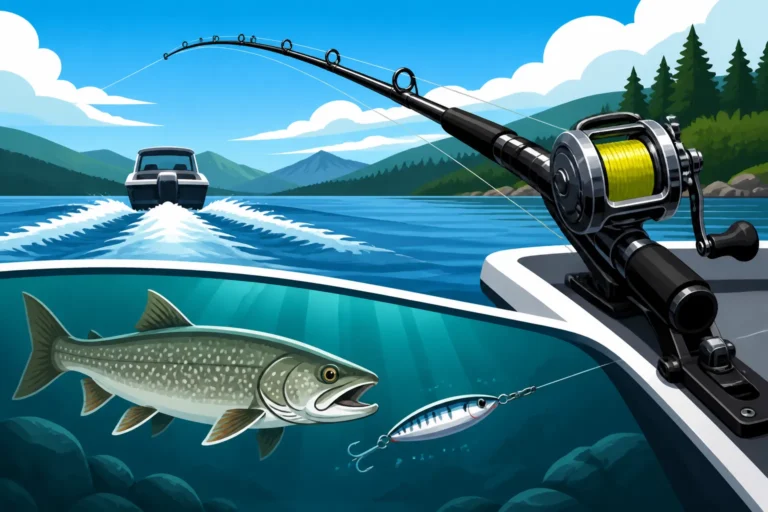
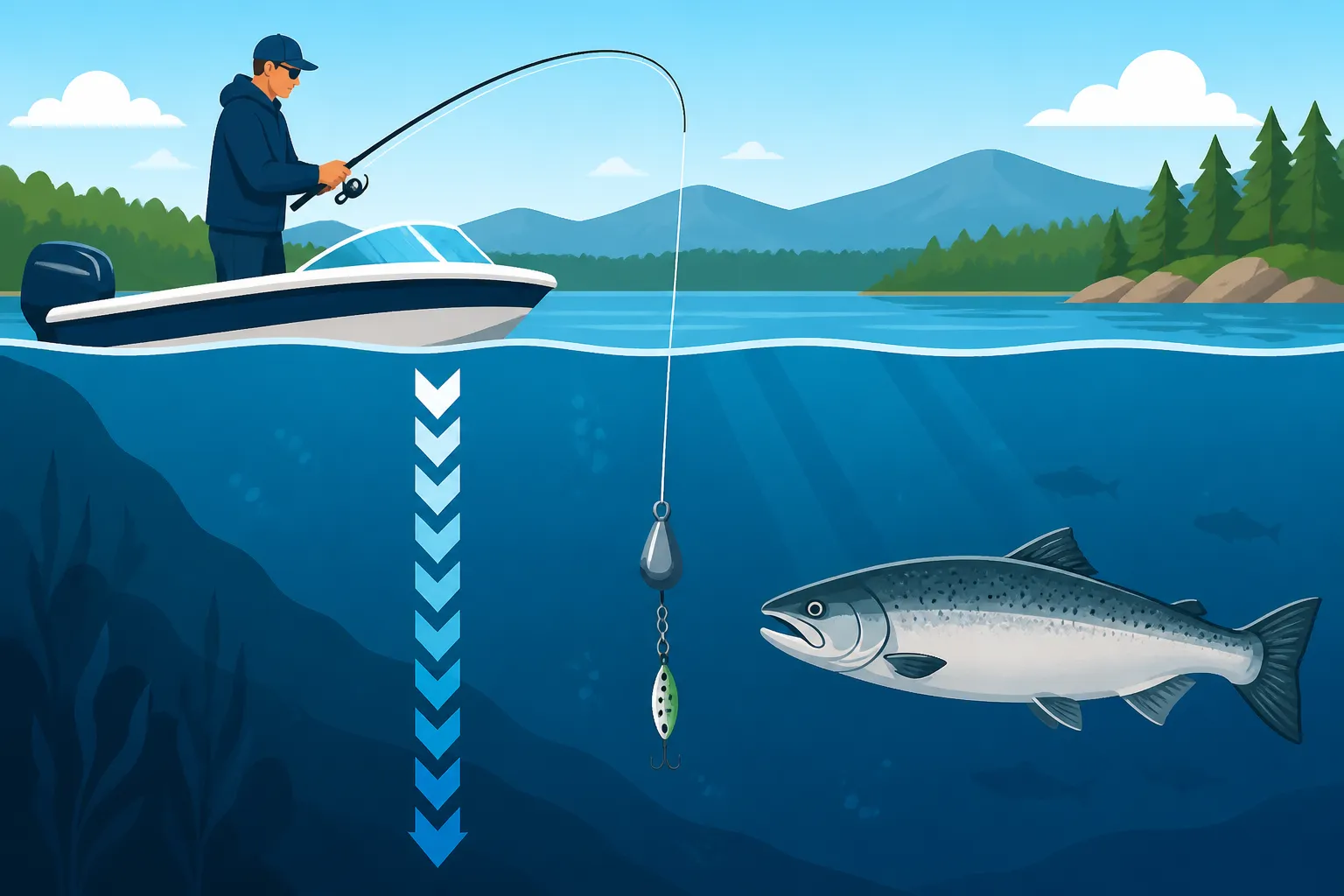
For most serious landlocked salmon anglers on Winnipesaukee, downriggers are indispensable. These mechanical devices allow you to clip your fishing line to a heavy cannonball weight, which is then lowered to a precise depth. When a fish strikes, the line is released from the clip, allowing you to fight the fish directly without the weight. This system offers unparalleled control over your lure's depth, making it possible to consistently target the thermocline or baitfish schools.
Downriggers typically come with a depth counter, ensuring you know exactly how deep your cannonball is. The key is to run your lure a specific distance behind the cannonball, often 50 to 150 feet, which allows the lure to swim naturally without being influenced by the weight itself. Some models even integrate with fish finders, allowing for a truly scientific approach to depth management. If you're looking to consistently hit those deeper zones, exploring options like the Scotty Depthpower or Cannon Uni-Troll downriggers on Amazon can be a great starting point for precision trolling.
Lead Core Line and Copper Line: Gradual Depth Achievers
While downriggers offer pinpoint accuracy, lead core and copper lines are excellent alternatives, especially for covering a wider range of depths or when you prefer a less mechanical setup. These lines are designed to sink, with their depth determined by factors like boat speed, line length deployed, and lure type.
- Lead Core Line: This line consists of a lead filament core braided into a colorful nylon sheath. Each color segment (usually 10 yards) represents an approximate depth increment. A common rule of thumb is that one full color (100 feet of line) will get you about 5-7 feet deep at standard trolling speeds, though this can vary. So, if salmon are at 30 feet, you might run 4-6 colors of lead core. It's a fantastic system for covering a range of depths in the water column or when fish are suspending at moderate depths.
- Copper Line: Similar to lead core but made entirely of copper wire, this line sinks much faster and achieves greater depths with less line out. It's often used for targeting very deep fish without downriggers, though it requires heavier rods and reels due to its weight and lack of stretch.
Both lead core and copper lines offer a stealthy presentation as there's no cannonball to spook fish. However, they don't allow for the same precise depth adjustments on the fly as downriggers. The amount of line out, boat speed, and even current can affect the depth. It's often a matter of trial and error and experience to consistently hit a target depth. When setting up a deep-trolling rig, you'll want to ensure you have a robust reel capable of holding a significant amount of line, which you can often find a good selection of on Amazon.
Dipsy Divers and Planer Boards: Expanding Your Spread
To effectively cover more water and different depths simultaneously, anglers often incorporate dipsy divers and planer boards into their trolling spread.
- Dipsy Divers: These disc-shaped devices dive to a predetermined depth and angle away from the boat, allowing you to run lures off to the side without tangling your main lines. They come in various sizes and can be adjusted to dive deeper or shallower and to run to the port or starboard. A key benefit is that they trip when a fish strikes, allowing for a direct fight. They're excellent for targeting fish that are spooked by boat traffic or for covering additional zones.
- Planer Boards: Used primarily for widening your trolling spread, planer boards tow your line out to the side of the boat, away from the prop wash. While they don't inherently add depth, they can be used in conjunction with lead core, copper, or snap weights to present lures at specific depths horizontally away from the boat. This is particularly effective when fish are shallower and spread out, allowing you to present multiple lures without crossing lines.
By combining these tools, you can create a complex and highly effective trolling presentation that covers multiple depths and widths, increasing your chances of intercepting active salmon in Winnipesaukee. You might run a downrigger at 40 feet, a lead core line fishing 25 feet, and a Dipsy Diver running 15 feet off to the side, all at once.
Winnipesaukee by Season: Specific Salmon Trolling Depths
The beauty and challenge of fishing for landlocked salmon on Lake Winnipesaukee lies in their seasonal movements. To consistently catch them, you need to adapt your trolling depths throughout the year.
Spring (Ice-Out to June): Shallow and Active
When the ice melts off Winnipesaukee, typically in April, the lake's water column is relatively uniform in temperature. Salmon, invigorated by the cold, oxygen-rich water and the abundance of smelt moving into shallower areas to spawn, will be found much closer to the surface. This is arguably the easiest time of year to target them without heavy gear.
- Depths: Early spring, right after ice-out, salmon can be caught very shallow, often in the top 10-20 feet of the water column. As the spring progresses and the surface warms slightly, they might drop to 20-35 feet, particularly on sunny days or in the middle of the day. They'll actively cruise along the shorelines, points, and island structures where smelt are congregating.
- Techniques: Flat lines (just your lure and a small weight or nothing at all) or a single lead core line can be very effective. Long lining with thin monofilament or fluorocarbon is also popular, allowing lures to run naturally in the top water column. This is an excellent time to target them with spoons and stickbaits that imitate smelt. For a deep dive into the nuances of early season tactics, check out our guide on how to fish for salmon right after ice-out.
Summer (July & August): The Deep Retreat
As New Hampshire's summer sun beats down, Winnipesaukee's surface waters warm considerably, and the thermocline sets up firmly. This is when salmon make their deep retreat to find those crucial cold-water refuges. This is also when downriggers become absolutely essential for consistent success.
- Depths: Salmon will typically be found much deeper, often in the 35-70 foot range, sometimes even deeper on hotter days, depending on the specific basin and the depth of the thermocline. They will suspend over deep water, often near submerged structure or sudden depth changes, always with an eye on the thermocline and any dense schools of rainbow smelt.
- Techniques: Downriggers are the primary tool for precisely positioning your lures at these depths. Trolling speeds might need to be adjusted slightly slower than in spring to keep lures in the strike zone longer. Focus on deeper areas of the lake, like the Broads, the areas around the deeper islands, and the main lake basin. Electronics are key to locating both bait and salmon. Consider lures that mimic larger smelt, as summer salmon are often looking for a substantial meal.
Fall (September & October): Rising to the Occasion
As the crisp autumn air returns, Winnipesaukee's surface waters begin to cool, and the thermocline slowly breaks down. This triggers a change in salmon behavior; they'll start to move shallower again, becoming more active and aggressive as they prepare for their spawning rituals later in the season.
- Depths: In early fall, salmon might still be found around the deeper edges of the breaking thermocline, perhaps 25-50 feet. As the lake continues to cool and eventually "turns over" (meaning the entire water column becomes uniform in temperature), they will ascend even shallower, often found in the 15-30 foot range, especially during low light conditions or cloudy days.
- Techniques: This is a transition period, so a mix of downriggers for earlier fall and lead core or flat lines for later fall can be effective. Trolling speeds might increase as salmon become more active. Focus on areas with good baitfish presence, often the same points and structure that were productive in spring. As the water cools further into late fall, salmon will begin their pre-spawn movements, often found near river mouths or traditional spawning grounds, though they are usually protected during their actual spawning season.
Winter (Ice Fishing Season): A Different Approach
While not strictly "trolling," it's worth noting that during the ice fishing season (roughly January through March), landlocked salmon can still be caught through the ice on Winnipesaukee.
- Depths: Through the ice, salmon are often found suspended in the water column over deep water, similar to summer, but usually not as deep. Depths of 20-50 feet are common, but they can be found shallower or deeper depending on baitfish movements.
- Techniques: Jigging with flashy spoons or live bait (like shiners or smelt) under tip-ups are the primary methods. Setting tip-ups at varying depths across a wide area is a good strategy to locate active fish. Ice fishing for salmon requires a different set of skills and specialized gear, but it can be incredibly rewarding. Our guide on how deep ice needs to be before New Hampshire anglers fish it can offer some vital safety information for winter enthusiasts.
Here's a quick summary table of approximate trolling depths for landlocked salmon on Lake Winnipesaukee:
| Season | Typical Water Temperature Range (F°) | Primary Trolling Depth Range (Feet) | Key Gear/Technique | Notes |
|---|---|---|---|---|
| Spring | 40-55° | 10-35 | Flat Lines, Lead Core, Light Trolling | Salmon are active and often shallow, especially near smelt spawning areas. |
| Early Summer | 55-65° (surface warming) | 25-45 | Downriggers, Lead Core | Thermocline begins to set; salmon follow cooling waters. |
| Mid-Summer | 60-70°+ (surface) | 35-70+ | Downriggers | Salmon retreat to deep, cool water, often near the thermocline. Essential to find bait. |
| Early Fall | 65-50° (surface cooling) | 25-50 | Downriggers, Lead Core | Thermocline breaks up; salmon become more active and move shallower. |
| Late Fall | 50-40° | 15-30 | Lead Core, Flat Lines | Salmon are very active as water cools uniformly, pre-spawn movements. |
Note: These are general guidelines. Always use your electronics to confirm baitfish and fish presence.
Mastering Your Setup: Gear for Precision Deep Trolling
Having the right gear is paramount to effectively target landlocked salmon at their preferred depths in Lake Winnipesaukee. It's not just about getting your lure down there, but doing it efficiently, safely, and with the ability to detect subtle strikes.
Rods, Reels, and Line: A Matched System
For deep trolling, especially with downriggers or heavy sinking lines like copper or lead core, you need a robust setup that can handle the stress.
- Rods: Look for trolling rods that are typically 7 to 9 feet long with a moderate to heavy action and a forgiving tip. The length helps spread out your lines and absorb the shock of a strike, while the action provides the backbone to handle heavy weights or diving devices. For downriggers, a softer tip is often preferred as it acts as a visual strike indicator, bending under the tension of the downrigger clip and springing back when a fish hits. If you're looking for a versatile rod, consider models from St. Croix or Fenwick, widely available for various fishing applications.
- Reels: Large capacity conventional reels are essential for lead core and copper lines, as you'll be deploying hundreds of feet of line. Look for models with a strong drag system and a line counter, which is absolutely critical for replicating successful depths. For downrigger setups, high-quality baitcasting or conventional reels are common, also with smooth drags. A quality reel like those from Daiwa or Penn will offer the durability and performance needed for repeated deep-water battles.
- Line:
- Main Line (Downrigger): For downrigger fishing, your main line can be 10-15 lb test monofilament or fluorocarbon, or even braided line. Many anglers prefer mono or fluorocarbon for its stretch, which can act as a shock absorber. Braided line offers excellent sensitivity and less drag in the water, but its lack of stretch requires a more forgiving rod.
- Lead Core/Copper: The line itself acts as the weight, so you'll attach a leader (typically 10-20 lb fluorocarbon or monofilament) to the end, usually 25-100 feet long. This leader provides stealth and abrasion resistance.
- Fluorocarbon Leader: Regardless of your main line choice, a good fluorocarbon leader is always a smart idea. It's nearly invisible underwater, extremely abrasion resistant, and sinks, which can help get your lure a tiny bit deeper. It's crucial for wary salmon.
For those getting into deep trolling, a good starting point is a medium-heavy trolling combo, and you can often find great value and diverse options for these setups on Amazon.
Electronics and Lake Maps: Your Eyes Below the Surface
In a large, deep lake like Winnipesaukee, your electronics are your best friend for salmon fishing.
- Fish Finder/Sonar: A quality fish finder is non-negotiable. Look for models with good screen resolution, dual-frequency sonar (or CHIRP technology) for clear target separation, and the ability to display water temperature and depth. You'll use it to locate baitfish schools (those tell-tale arches or clouds), identify individual fish marks (which could be salmon), and precisely mark the thermocline. Brands like Garmin, Lowrance, and Humminbird offer excellent units that are invaluable for understanding the underwater topography and where the fish are holding. These devices are your window into the underwater world, showing you where the "action" is.
- GPS/Chartplotter: Integrated with your fish finder, a GPS unit with detailed lake maps allows you to mark waypoints for productive areas, track your trolling passes, and navigate safely around the lake's many islands and submerged hazards. Understanding Winnipesaukee's topography, including sudden drop-offs, underwater humps, and deep channels, is crucial for finding salmon. High-definition contour maps will show you these features, allowing you to plan your trolling runs more effectively. For instance, knowing the deep water structure spots on Winnipesaukee will allow you to focus your efforts.
- Temperature Gauge: While most fish finders have a temperature sensor, a dedicated or highly accurate temperature display is beneficial. Knowing the exact water temperature at the surface and being able to infer or measure the thermocline depth is key to understanding why salmon are at a certain depth. Some advanced units even allow you to track the temperature profile of the water column.
Investing in reliable electronics isn't just a luxury; it's a strategic advantage that will dramatically improve your success rate in targeting deep-dwelling salmon. If you’re just starting out, there are many excellent beginner-friendly fish finders that offer robust features at a reasonable price point.
Lures and Baits: Matching the Hatch
While the depth is critical, the presentation is what ultimately entices the strike. For landlocked salmon on Winnipesaukee, matching the size, shape, and action of rainbow smelt is usually your best bet.
- Spoons: Classic trolling spoons like the Mooselook Thinfish, Sutton Spoons, or similar brands are perennial favorites. Their wobbling action imitates a wounded baitfish. Colors like silver, blue/silver, green/silver, and pearl are often productive, especially those with some prism or scale pattern. Vary sizes from 2.5 to 4 inches.
- Stickbaits/Minnow Plugs: Long, slender plugs that mimic smelt, such as Rapala Original Floaters, Yo-Zuri Crystal Minnows, or various jointed minnows, can be deadly. These lures have a tight wiggle and can be very effective, especially in cooler water or when fished higher in the water column.
- Flies: Streamer flies, often tied to imitate smelt (e.g., Grey Ghost, Supervisor, Black Ghost, Smelt patterns), are incredibly effective behind a small dodger or flasher. The dodger adds attraction and motion, while the fly provides a realistic profile. Trolling flies can be especially productive when salmon are feeling finicky.
- Live Bait: Live smelt (where legal) or shiners can be absolutely irresistible to salmon, especially when presented naturally at the correct depth. Rigged behind a small weight or on a downrigger, live bait can often trigger strikes when artificials fail.
Experiment with different lure types, sizes, and colors until you find what the salmon are keying on that day. Always keep an eye on your boat speed; subtle changes in speed can dramatically alter a lure's action and trigger a strike. For more specific recommendations, our article on the best baits for smallmouth bass on Winnipesaukee (while for bass, many lure concepts can cross over) might provide additional ideas, as both species often react to similar baitfish patterns.
Disclaimer
The information provided in this guide is for general informational purposes only and is subject to change. Always consult the most current New Hampshire Fish and Game Department regulations before fishing, as rules regarding seasons, bag limits, and specific water body regulations can vary. Fishing always carries inherent risks, and it is your responsibility to ensure your safety and adherence to all local, state, and federal laws.