Best drop shot weight for lake current
There's nothing quite as frustrating as trying to fish a beautiful New Hampshire lake or river with a drop shot rig, only to feel your weight constantly dragging, rolling, or being swept away by an unseen current. You've got your bait perfectly presented, but the moment you try to hold it steady, it's off to the races, ruining your presentation and leaving you wondering if you're even fishing effectively. This guide is all about helping you conquer those tricky currents by choosing the absolute best drop shot weights for your New Hampshire adventures, ensuring your bait stays exactly where the fish are lurking.
Understanding Lake Current and Its Impact on Drop Shot Fishing
When we talk about "current" in a lake, it's not always as obvious as a river's flow, but it's absolutely present and can make or break your drop shot success. Many anglers new to New Hampshire's vast waters often underestimate these subtle movements, leading to a lot of head-scratching when their presentations aren't working as planned. Understanding why and how current manifests in lakes is the first step to choosing the right gear.
What Creates Current in New Hampshire Lakes?
You might think of lakes as static bodies of water, but that couldn't be further from the truth. New Hampshire's lakes, from the massive expanse of Lake Winnipesaukee to the smaller, more intimate ponds, are dynamic ecosystems with various forces at play that create current.
First, inflow and outflow are huge contributors. Rivers and streams constantly feed into our lakes, bringing fresh water and creating noticeable currents, especially near their mouths. Conversely, water flowing out through dams or natural outlets generates pull. Think about fishing near the Squam River inflow on Squam Lake, or the dam outflows on the Merrimack River – these are obvious current zones. Secondly, wind-driven currents are incredibly common. A sustained breeze pushing across a large body of water, like Newfound Lake, can create significant surface currents that extend surprisingly deep, especially on the windward side or points. This isn't just surface chop; it's a genuine water movement that can drag your line and bait. Lastly, thermoclines and underwater springs can create subtle but impactful currents. Thermoclines, the layers of distinct water temperatures, can have internal seiches (standing waves) or slow, density-driven flows, while cold, nutrient-rich springs can introduce localized current and cooler water favored by certain species.
How Current Affects Your Drop Shot Presentation
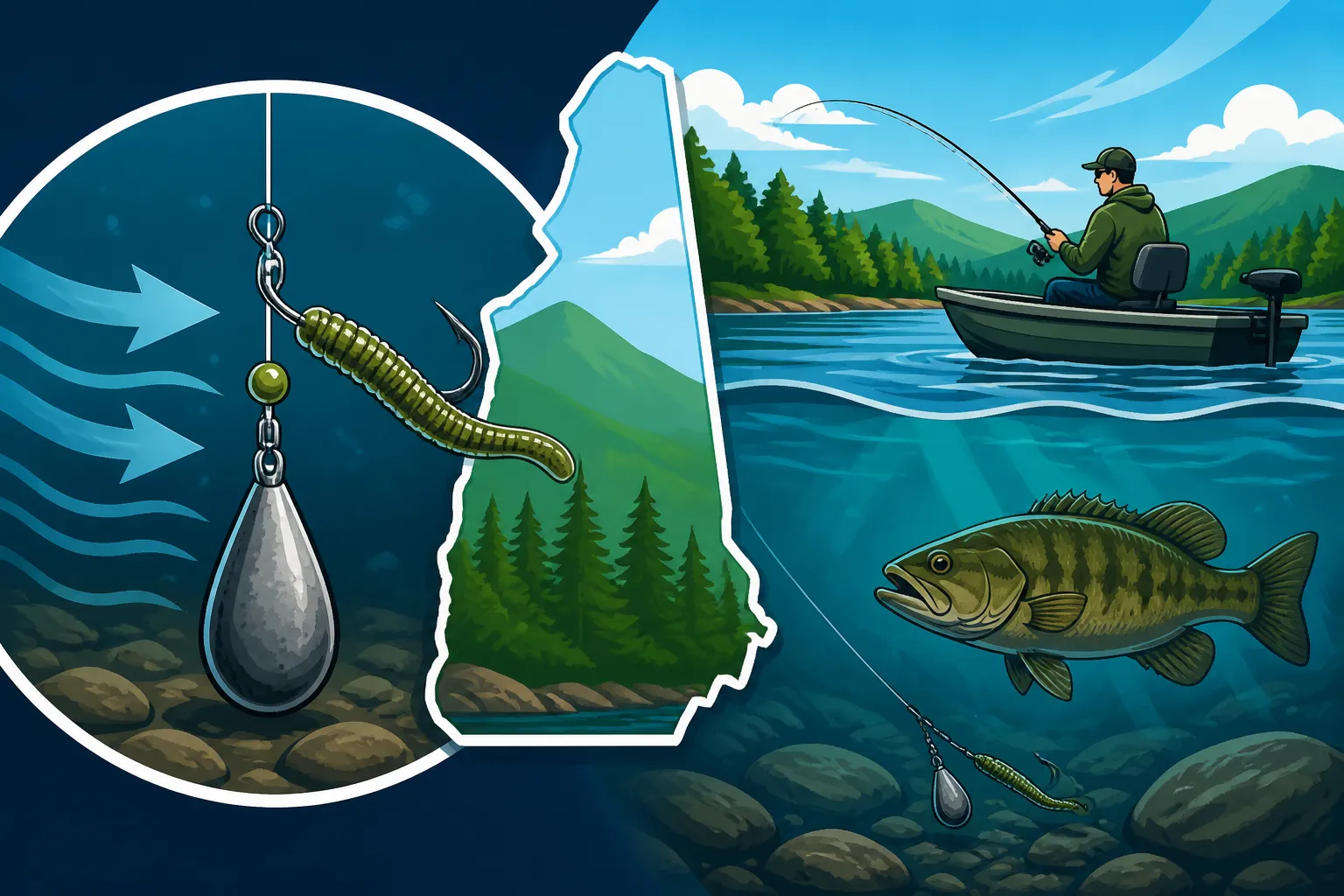
The primary goal of a drop shot rig is to suspend your bait at a specific depth, directly in the strike zone, above your weight. Current, even a slight one, throws a wrench into this delicate balance. The most immediate effect is drift. Instead of your weight holding bottom and your bait fluttering above it, the current will push your weight along the bottom, making it slide, tumble, or even lift off. This not only moves your bait out of the target zone but also creates an unnatural presentation.
Beyond the weight itself, current causes line bow. As your fishing line enters the water and goes down to your weight, the current pushes against it, creating a "bow" or curve in the line. This bow makes it incredibly difficult to feel subtle bites, as the slack in the line absorbs any taps or bumps. You might be missing strikes altogether! It also makes it harder to control your lure, as the line bow delays your movements and reduces sensitivity. Imagine trying to gently twitch your bait and having that action lost in a curve of line – it's incredibly frustrating and diminishes the effectiveness of this otherwise deadly technique.
Why Standard Drop Shot Weights Fall Short in Moving Water
Most standard drop shot weights are designed with still water in mind. They're often round, teardrop, or skinny pencil shapes, made to drop quickly and sit relatively still on a calm bottom. While these are fantastic for suspended fish in deeper, quiescent sections of lakes, they simply aren't up to the task when current becomes a factor.
A common round or teardrop weight, while efficient at sinking, has a shape that's easily rolled or dislodged by water flow. Think of a smooth pebble in a stream – it moves with ease. A skinny pencil weight, while having less surface area for drag, often lacks the mass to truly anchor in moderate to strong currents and can still roll if the current hits it from the side. Furthermore, many anglers gravitate towards lighter weights for drop shotting, typically 1/8 to 1/4 ounce, which are ideal for sensitivity in calm conditions. However, these light weights become completely ineffective in current. They'll drift, roll, and drag without providing the necessary bottom contact or bait stability. Trying to use these in a current-prone area of Lake Winnipesaukee, for instance, would be like trying to hold a balloon in a stiff breeze – a losing battle.
Key Factors When Choosing Drop Shot Weights for Current
So, if your standard weights aren't cutting it, what should you be looking for? It's not just about adding more lead (or tungsten!). There's a science to selecting the right drop shot weight for current, involving shape, material, and how it all integrates with your entire fishing setup.
Weight Shape and Material: The Unsung Heroes
When battling current, the shape of your drop shot weight plays an even more crucial role than in still water. Forget the standard round or teardrop weights; you need shapes that resist rolling and digging into the bottom more effectively.
Pencil and cylinder weights are often the top choice for current. Their elongated, slender profile means less surface area for the current to push against, and they tend to "slice" through the water more efficiently on the drop. Once on the bottom, their shape, especially if they have some texture or a slightly flattened side, can help them dig in and resist rolling better than a round weight. Many brands offer cylindrical weights specifically designed for drop shotting in current, sometimes with a slightly textured finish to enhance grip on the bottom. If the current is truly ripping, some anglers even opt for a "tear-bell" shape, which is like a teardrop but with a wider, flatter bottom, giving it more stability.
Now, let's talk about material: lead versus tungsten. This is where things get really interesting, especially for fishing in current. Lead is the traditional choice, affordable and widely available. However, tungsten is the superstar for current situations. Tungsten is significantly denser than lead, meaning a tungsten weight of the same weight as a lead one will be much smaller in size. This smaller profile has two huge advantages in current:
- Reduced Drag: Less surface area for the current to push against, minimizing drift and line bow.
- Increased Sensitivity: The density of tungsten transmits vibrations and bottom composition much more effectively up your line, even through light current. You'll feel every rock, every twig, and most importantly, every subtle bite.
While tungsten weights come with a higher price tag, the investment is often worth it for the improved performance and sensitivity, especially when you're trying to coax a bite in challenging conditions. Many serious anglers find that the enhanced feel and stability of tungsten weights from brands like Bass Pro Shops make a noticeable difference in their catch rates when fishing pressured waters or in current.
The Importance of Weight-to-Line Ratio and Rod Power
Choosing the right weight isn't an isolated decision; it needs to be harmonized with your line and rod setup. Think of it as a three-legged stool: if one leg is off, the whole thing tumbles.
Your line size and type heavily influence how much current affects your presentation. Thinner diameter lines, like braided line with a fluorocarbon leader, cut through the water much more efficiently than thicker monofilament. The less surface area your line presents to the current, the less line bow you'll experience, and the lighter you might be able to go with your weight. For instance, if you're fishing with 8-pound test fluorocarbon, you'll feel the bottom and maintain control with a lighter weight than if you were using 10-pound mono. Using a nearly invisible Best Fluorocarbon Line for Clear Lake Water can further enhance your presentation.
Rod power is also critical. A medium-light or medium power spinning rod is typical for drop shotting, offering the sensitivity and backbone needed for typical situations. However, when fishing in current, you might need to lean towards the medium power side, or even a medium-heavy if the current is exceptionally strong and you're using heavier weights. A stiffer rod (higher power) will help you maintain control of heavier weights, transmit those subtle bites through the current, and provide the leverage needed to fight fish that are also battling the flow. For general smallmouth fishing in New Hampshire, a good Best Spinning Rods for Smallmouth Bass will be versatile, but consider one with a bit more backbone for current.
Reading the Conditions: Water Depth, Current Speed, and Bottom Composition
Before you even tie on a weight, take a moment to assess the conditions. This isn't just guesswork; it's about making informed decisions that directly impact your success.
Water depth is a major player. Fishing in 10 feet of water with moderate current requires a different approach than fishing in 40 feet with the same current. The deeper the water, the longer your line is in the water column, meaning more potential for line bow and drag from the current. You'll generally need heavier weights in deeper water to ensure your bait reaches the bottom quickly and stays there. Using a reliable Best Fish Finders for New Hampshire Lakes will be crucial for accurately gauging depth and identifying those potential current breaks or deeper holding areas for fish.
Current speed is perhaps the most obvious factor. Is it a gentle drift or a strong pull? You'll need to feel this out. Start lighter and go heavier until you find a weight that allows you to maintain consistent bottom contact without excessive drag. If your weight is constantly rolling or dragging uncontrollably, you need to go heavier. Conversely, if you're using too heavy a weight, you'll lose sensitivity and the natural movement of your bait.
Finally, bottom composition matters more than you might think. A smooth, rocky bottom (common in many New Hampshire lakes, especially around points and ledges) offers little resistance to a rolling weight. A weight with a more angular or flat-sided design might "grab" these surfaces better. If you're fishing a softer, muddier bottom, a lighter, more streamlined weight might be preferred to avoid burying too deeply. In snaggy areas, where zebra mussels or submerged timber might be an issue, a pencil-shaped tungsten weight is less likely to get hung up than a round lead weight. Knowing the bottom means more time fishing and less time re-tying!
Recommended Drop Shot Weights for Various Current Scenarios
Let's get down to the nitty-gritty: what specific weights should you be reaching for when different current scenarios unfold on your New Hampshire fishing trip? Remember, this is a starting point; always be ready to adjust based on real-time feedback from your rod and line.
Light Current (e.g., protected coves, calm lake sections)
Even in seemingly calm spots, there can be just enough current to make a standard light drop shot weight drift slightly, especially if there's a gentle breeze or a distant river inflow creating a subtle draw. Think of those quiet pockets on Winnipesaukee or the slower stretches of the Pemigewasset River.
In these conditions, you're not looking to anchor a battleship, but rather to ensure your bait stays precisely where you want it without constant adjustment. A 1/4 ounce cylindrical or pencil-style tungsten weight is often the sweet spot. The tungsten's density gives you excellent bottom contact and sensitivity, even at this relatively lighter weight, while its slender shape minimizes the chances of it rolling. You might get away with a 3/16 ounce tungsten weight if the current is truly minimal and you're fishing relatively shallow (under 20 feet) with a light line. The key here is to find the lightest weight that still gives you constant, confident bottom feel. If you're using lead, you'd likely need to bump up to 3/8 ounce to get a similar effect, but you'd sacrifice some sensitivity due to the larger profile. This is where the advantage of tungsten really begins to show, as you can use a lighter feeling weight that's actually more effective.
Moderate Current (e.g., river mouths, main lake points, active thermoclines)
Now we're talking about those prime fishing locations where current actively sweeps past structure, bringing baitfish and ambushing predators. This could be a rocky point on Squam Lake where wind funnels, or the distinct current near the mouths of rivers entering larger bodies of water. These are the spots where How to Catch Smallmouth Bass in New Hampshire Lakes often congregate, but they'll test your tackle.
For moderate current, you'll typically want to step up to a 3/8 ounce to 1/2 ounce cylindrical or tear-bell tungsten weight. This range provides sufficient mass to resist a noticeable pull, allowing your bait to remain stable in the strike zone. The tear-bell shape, with its broader base, is particularly good here for "sticking" to the bottom without rolling. If you're fishing deeper water (25-45 feet), even in moderate current, leaning towards the 1/2 ounce or even 5/8 ounce might be necessary. Remember, the goal is to feel the bottom consistently, without your weight being swept away. If you feel it dragging too easily, go up a size. Many anglers keep a selection of these weights on hand, often purchased from a store like Bass Pro Shops or online through Amazon, because these are common weights for these conditions.
Strong Current (e.g., river channels, dam outflows, windy points)
These are the most challenging scenarios, where the water is really moving. Think of fishing below a dam on a river like the Merrimack, or anchoring on an exposed point on Lake Winnipesaukee during a gale, trying to target those big smallmouth bass. Your ability to maintain bottom contact here is paramount.
For strong current, you're looking at 1/2 ounce up to 3/4 ounce (and sometimes even 1 ounce) tungsten weights. Here, a true cylindrical or even a pyramid-style drop shot weight (if you can find one) will be your best friend. The smaller profile of tungsten in these heavier weights is absolutely crucial. A 3/4 ounce lead weight would be quite bulky, creating significant drag and potentially getting snagged, whereas a tungsten weight of the same mass remains compact and streamlined. It's not uncommon for anglers fishing in powerful current, or very deep, windy conditions on places like Lake Winnipesaukee, to employ weights in this heavier range. While you might sacrifice a tiny bit of finesse, the ability to keep your bait in the zone makes all the difference. In these situations, your line choice becomes even more critical; a thin braided main line with a robust fluorocarbon leader will perform far better than mono.
Here's a quick comparison table for reference:
| Current Strength | Recommended Weight Range (Tungsten) | Shape Consideration | Best Use Case | Lead Equivalent (Approx.) | Notes |
|---|---|---|---|---|---|
| Light | 1/4 – 3/8 ounce | Pencil, Cylinder | Protected coves, subtle lake drifts, shallow water | 3/8 – 1/2 ounce | Prioritize sensitivity; focus on precise depth control. |
| Moderate | 3/8 – 1/2 ounce | Cylinder, Tear-bell | River mouths, main lake points, active thermoclines | 1/2 – 5/8 ounce | Balance stability with sensitivity; crucial for holding. |
| Strong | 1/2 – 3/4 ounce (or more) | Heavy Cylinder, Tear-bell | River channels, dam outflows, severe windy points | 3/4 – 1 ounce (bulky) | Maximize bottom contact; tungsten's small profile is key. |
Tips and Techniques for Effective Drop Shot Fishing in Current
Beyond just picking the right weight, there are several techniques and strategic adjustments that can dramatically improve your drop shot success when faced with current. It's about working with the water, not against it, and making every part of your setup contribute to a successful presentation.
Adjusting Your Boat Position and Drifting Strategy
Your boat's position relative to the current is absolutely fundamental. Instead of simply casting and hoping, you need a strategy. The most effective way to drop shot in current is often to fish upstream and drift down, or to anchor upstream of your target. This allows your bait to naturally flow into the strike zone ahead of your boat, presenting it in a realistic manner. If you're casting downstream, your bait will be fighting the current to get to depth, and you'll likely experience more line bow and less natural presentation.
If you're drifting, consider using a drift sock or sea anchor to slow your progress. This gives your weight more time to settle and reduces the angle of your line, minimizing line bow and increasing sensitivity. For motorized boats, a reliable trolling motor with GPS spot-lock capabilities is a game-changer. Brands like Minn Kota or MotorGuide offer incredible technology that can hold your boat precisely over a piece of structure or along a contour, even in significant current. This allows you to focus purely on your presentation. If you're kayak fishing, consider a Best Trolling Motor for a Fishing Kayak or using a small anchor to hold your position, especially if you're targeting specific spots in a river like the Connecticut River.
Line Management and Detecting Subtle Bites
Effective line management is paramount when drop shotting in current. As mentioned, current creates line bow, making it hard to feel bites. To combat this, always try to keep as much line out of the water as possible. This means using a higher rod tip angle, especially if you're directly over your weight. The less line in the water, the less current can affect it.
When you cast, allow your weight to hit the bottom and then immediately retrieve any slack created by the current. You want to maintain a tight, but not overly stretched, line to your weight. This direct connection is vital for feeling those incredibly subtle "thump," "tick," or "mushy" bites that bass and other species often deliver on a drop shot. Many times, in current, a fish won't aggressively pull; they'll simply suck in the bait as it drifts past, and the only indication you'll get is a slight weightlessness or a subtle tension change. This is where high-quality Best Fluorocarbon Line for Clear Lake Water comes into its own as a leader material due to its low stretch and high sensitivity. Practicing with a Best Rod and Reel Combo for Beginners designed for sensitivity will help you develop this crucial feel.
Experimentation and Adaptation on the Water
No two days, or even two hours, on the water are exactly alike, especially in New Hampshire's varied fishing environments. The current speed can change with wind shifts, dam operations, or even lunar phases affecting tides in estuaries like Great Bay.
This means experimentation is key. Always start with a weight you think will work, but be prepared to adjust quickly. If you're not feeling the bottom consistently, or your bait is drifting too fast, immediately bump up to the next heavier weight. If you're feeling too much resistance and think your bait isn't moving naturally enough, try going down a size. Pay attention to how the fish are reacting. Are they hitting a moving bait, or one that's holding perfectly still? Sometimes, a very slow drift with a slightly lighter weight can be more enticing than a perfectly anchored bait, but only if you can control that drift. Always have a variety of drop shot weights in different sizes and shapes, ideally tungsten, readily available in your tackle box. This will save you valuable fishing time and increase your chances of success on any of New Hampshire's fantastic Best Fishing Lakes in New Hampshire or Best Fishing Rivers in New Hampshire.
Disclaimer
This article is for general informational purposes only and does not constitute professional advice. Laws, prices and regulations vary by location and change over time. Consult a qualified professional for guidance on your specific situation.