How to catch bass around submerged timber
There’s almost nothing more frustrating than knowing bass are lurking in a prime spot, only to have your lure snagged on a submerged log or tangled in thick branches the moment you cast. We've all been there – that perfect flip, a splash, and then… thunk. Your heart sinks as you realize your favorite jig is now a permanent resident of the underwater forest. But don't despair! Fishing around submerged timber in New Hampshire, while challenging, is incredibly rewarding, and this guide is going to walk you through exactly how to tackle these tricky spots and pull out some fantastic bass.
Understanding Submerged Timber and Why Bass Love It
Submerged timber, whether it’s a lone stump, a fallen tree, or a cluster of old branches, is an absolute magnet for bass. It’s not just a random piece of wood; it’s a living, breathing ecosystem within the water, providing everything a bass could want or need. Understanding why they love it is the first step to figuring out how to catch them.
The Allure of Laydowns and Stumps for Bass
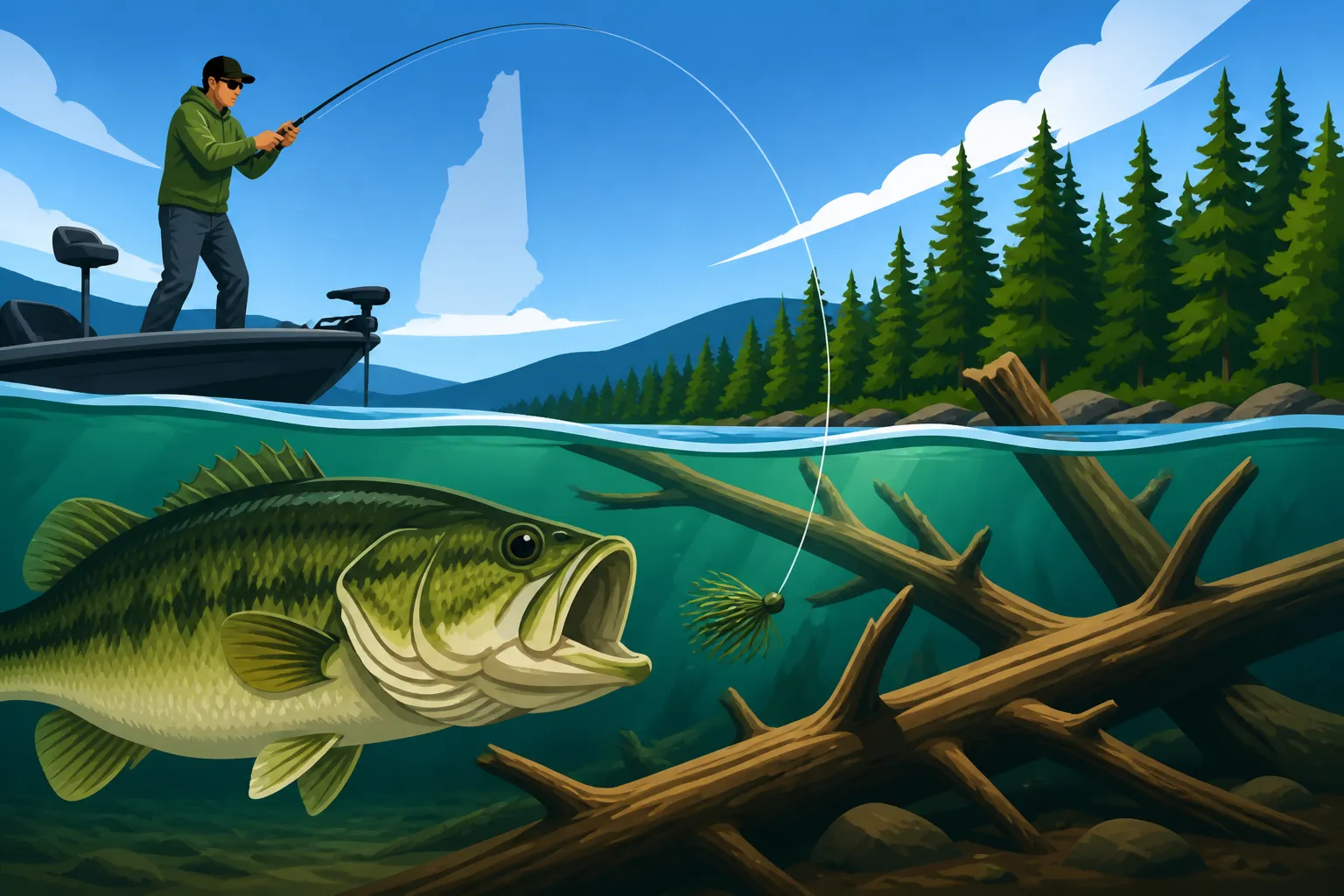
Imagine you're a bass. What's important to you? Safety from predators, a good spot to ambush prey, and comfort from the elements. Submerged timber provides all of this in spades. A fallen tree, often called a "laydown," extends from the bank into the water, creating a multi-layered haven. The thick branches offer dense cover, making it difficult for larger predators like ospreys or even bigger fish to spot a bass. This cover also gives the bass an unparalleled ambush point. They can hide just inside the shadows of a log, perfectly camouflaged, waiting for an unsuspecting minnow, crawfish, or even a smaller panfish to swim by. With a quick burst of speed, they can dart out, grab their meal, and retreat back into the safety of the wood.
Beyond security and food, timber also offers temperature regulation. On hot, sunny days common in New Hampshire summers, the dense canopy of submerged branches creates shade, providing a cooler refuge from the sun's intense rays. In contrast, during colder periods, the wood itself can retain a bit of warmth, or the structure can provide a current break, offering a cozy spot out of the main flow. Many of New Hampshire's lakes and rivers, like the quieter backwaters of the Merrimack River Fishing Spots or the timber-laden coves of Pawtuckaway Lake Fishing, are prime examples where bass use these structures extensively. It’s truly their underwater home sweet home.
Reading the Water: Identifying Productive Timber Structure
Not all timber is created equal, and learning to differentiate between a random floating branch and a truly productive bass hideout is key. Sometimes the timber is obvious: a massive tree that’s fallen into the water, with its trunk extending from the shore and branches visible just under the surface. Other times, it’s far more subtle – a lone stump lurking a few feet beneath the surface, or a scattered field of old, broken-off branches that are only visible on your sonar or during extremely clear water conditions.
When scouting for productive timber, pay attention to its depth and its relationship to other features. Timber that transitions from shallow to deeper water is often a goldmine, as bass can move up and down the water column with ease. A laydown that ends near a drop-off, a channel swing, or even a small rock pile can be phenomenal, as these create natural highways for baitfish. The type of wood can also play a role; some anglers swear by harder woods that break down slower, offering more long-term structure. Use your electronics – a good fish finder is invaluable here – to pinpoint those submerged stumps or brush piles that aren't visible to the naked eye. Even in smaller, lesser-known ponds, a keen eye can spot subtle clues, like a slight surface disturbance or darker water indicating something below. Remember, the deeper and denser the cover, the more likely a big bass is calling it home, waiting to surprise you.
Essential Gear for Fishing Submerged Timber in New Hampshire
You can’t go into a battle with submerged timber with just any old ultralight setup. This is a heavy-duty arena, and you need gear that can not only handle the abuse of constant snags but, more importantly, extract a hard-fighting bass from its woody lair without breaking your line or your spirit.
Rods, Reels, and Line: Building Your Timber Arsenal
When it comes to rods, think power. A heavy or medium-heavy action casting rod, typically between 6'6" and 7'6" in length, is your best friend here. This power gives you the backbone to wrestle a bass away from branches and the leverage to set a hook firmly through tough mouths. Shorter rods (6'6" to 7') are great for precision pitching and flipping in tight quarters, while longer rods can offer more casting distance and better leverage for longer retrieves or deeper timber.
Pair that rod with a sturdy baitcasting reel. You need a reel with a strong drag system and enough torque to pull heavy line and a heavy fish. A gear ratio around 7.1:1 or higher is often preferred, allowing you to quickly reel in slack and keep tension on a fish after it bites. Don't skimp on quality; a reliable reel can make all the difference when a big largemouth or smallmouth tries to bury itself in a log. For line, braided line is the absolute champion for timber fishing. Its incredible strength-to-diameter ratio, lack of stretch, and abrasion resistance are exactly what you need. Think 30-50lb test braid. The lack of stretch means you feel every little tap and get a solid hookset, and its abrasion resistance will save you countless lures and fish that would otherwise be lost to frayed monofilament or fluorocarbon. Many anglers will tie a short (12-24 inch) fluorocarbon leader to their braid, anywhere from 15-25lb test, for a bit of invisibility at the lure, but the braid does the heavy lifting. You can find excellent options for all these components from brands available on Amazon.
Must-Have Lures for Timber-Dwelling Bass
Choosing the right lure for timber is less about flash and more about function. You need baits that are inherently weedless or can be rigged to minimize snags while still enticing a bite. The last thing you want is to spend all your time untangling.
- Jigs: Flipping and pitching jigs are probably the most iconic timber lures. Their compact profile, weed guard, and heavy weight allow them to penetrate dense cover and fall quickly. Pair them with a craw or creature bait trailer for added bulk and action. Colors like black and blue, green pumpkin, or brown are consistently effective.
- Texas-Rigged Plastics: This is your versatile workhorse. Soft plastic worms, creature baits, and craws rigged Texas-style with a bullet weight and an EWG (Extra Wide Gap) hook are incredibly snag-resistant. The hook point is buried in the plastic, allowing the bait to slide through branches and over logs without catching. When a bass bites, the hook pulls free and sets. This is a fantastic choice for both largemouth and smallmouth, especially in places like Lake Winnipesaukee, where smallmouth bass often hug submerged structure. Best Baits for Smallmouth Bass on Winnipesaukee will give you even more ideas.
- Bladed Jigs (Chatterbaits) and Spinnerbaits: While not as inherently snag-proof as jigs or Texas rigs, bladed jigs and spinnerbaits can be surprisingly effective in more sparse timber or along the edges of heavy cover. The single upturned hook of a spinnerbait makes it relatively snag-resistant, and the thumping vibration of a bladed jig can call bass out of dense wood. When you feel a snag coming, you can often "rip" them free.
- Squarebill Crankbaits: These lipped crankbaits are designed to deflect off cover, making them excellent choices for fishing shallower submerged wood. They have a stout, often square-shaped bill that bumps and grinds over logs and stumps, creating an erratic action that often triggers reaction strikes from bass. Be prepared to lose a few, but the strikes can be explosive. Best Crankbaits for New Hampshire Smallmouth Bass might inspire you!
- Swimbaits: Smaller, soft plastic swimbaits, either rigged on a weedless swimbait hook or a simple jig head (used with caution), can be deadly for bass suspended near timber or cruising the edges. Their realistic profile and swimming action can fool even the wariest fish. You can find a vast array of these lures on Amazon to suit any condition.
Techniques for Successfully Fishing Submerged Timber
Once you have your gear dialed in, it's time to talk tactics. Fishing timber isn't about bombing long casts and hoping for the best; it's about precision, patience, and knowing how to present your bait in the bass's living room.
Pitching and Flipping: Precision Presentations
These two techniques are absolutely paramount for targeting bass in tight, heavy cover. They are designed for accuracy and stealth, allowing you to put your lure exactly where you want it without spooking the fish.
- Flipping: This technique is used for very short distances, typically within 10-20 feet of the boat. You strip a length of line from your reel, grab it with your non-dominant hand, and use your rod to swing the bait forward like a pendulum. As the bait swings, you release the line you're holding, guiding the lure silently into the cover. It’s all about a quiet entry. Once the bait is in the water, keep a short line and use your rod tip to gently hop or shake the lure, working it through the branches. The idea is to cover every nook and cranny of the timber systematically. The bite often comes as a subtle "thump" or simply a feeling of weight when the lure stops falling.
- Pitching: Similar to flipping but for slightly longer distances (20-40 feet), pitching involves a pendulum motion as well, but with a bit more rod snap and a controlled thumb on the spool of your baitcasting reel. You swing the lure forward underhand, releasing your thumb at the right moment to let the lure sail smoothly and quietly to your target. This is perfect for reaching that isolated stump or the far side of a laydown without making a big splash that might alarm the bass. With both techniques, it's crucial to stay focused. Bass often hit as the lure falls, so always be ready for the strike and a quick, powerful hookset. Your goal is to get that fish out of the timber as fast as possible once it bites, before it can wrap your line around a branch.
Slow-Rolling and Wacky Rigging: Finesse in the Wood
Sometimes, bass won't react to aggressive flipping and pitching, especially if they're pressured or in a neutral mood. This is when a more subtle, finesse approach can shine, even in heavy cover.
- Slow-Rolling Jigs or Swimbaits: Instead of aggressively working a jig, try a slow-roll. Cast your weedless jig or swimbait past the cover, let it sink to the desired depth, and then retrieve it very slowly, just fast enough to give the trailer or swimbait tail some action. Allow it to tick and bump off the submerged branches and logs. The key is maintaining bottom contact and feeling for subtle changes. This often mimics a crawfish or a stunned baitfish struggling through the cover, making it an irresistible, easy meal for a bass. This method requires a lot of patience and a good feel for your lure and the bottom.
- Wacky Rigging: While traditionally a more open-water finesse technique, a wacky-rigged worm can be surprisingly effective on the edges of submerged timber or in sparser wood. A wacky rig involves hooking a soft stickbait (like a Senko-style worm) through its middle, allowing both ends to shimmy and flutter as it falls. To make it more timber-friendly, you can use an O-ring around the worm where you insert the hook, or even use a weedless wacky hook. The slow, tantalizing fall is hard for bass to resist. Focus on pitching these to the outer branches or pockets within the timber where you know there's a clear lane for the bait to fall without getting snagged. It's a killer for bass that are hesitant to commit to a faster, more intrusive presentation.
Managing Snags and Retrieving Lures
Let's be real: if you're fishing submerged timber effectively, you're going to get snagged. It's an unavoidable part of the game. The good news is there are ways to minimize losses and retrieve your precious lures.
First, learn to feel the difference between a bite and a snag. A bite often feels like a distinct "thump" or a sudden weight. A snag, however, usually feels like your line just stops dead or gets mushy. The moment you suspect a snag, don't yank hard. Sometimes, simply letting your line go slack for a moment, then giving a gentle "pop" with the rod tip, can free the lure. Often, the lure is just resting on a branch, and a change in angle will get it off.
If that doesn't work, change your boat position. Maneuver your boat directly over the snag, if possible. This changes the angle of pull on your line from diagonal to vertical, which can often free a lure that was hung up sideways. You can even try gently jigging the rod tip up and down while positioned directly overhead.
For persistent snags, a lure retriever is your best friend. This handy tool, often a heavy lead weight with chains or wires, slides down your line, bangs into the snagged lure, and hopefully dislodges it. Many avid timber fishermen wouldn't be caught dead without one on board. You can find various models on Amazon. Some attach to your line and slide down, while others are long poles you can extend. While you might still lose a few lures, these techniques significantly cut down on your tackle casualties and keep you fishing more and fussing less.
Seasonal Considerations for Timber Bass Fishing in New Hampshire
Just like our moods change with the seasons, so do the habits of bass. Understanding how they utilize submerged timber throughout the year in New Hampshire can drastically improve your success.
Spring and Early Summer: Pre-Spawn and Spawn Timber Tactics
Ah, spring in New Hampshire! As the ice melts (check New Hampshire Ice Fishing Regulations by Water Body for specific dates) and water temperatures begin to rise, bass start to shake off their winter lethargy. During the pre-spawn period, bass will often move from deeper wintering holes to shallower areas with good cover and sunlight. Submerged timber in northern New Hampshire lakes and ponds becomes absolutely crucial for them at this time. They'll use it to stage, gathering strength and feeding heavily before the rigors of spawning. Pitching jigs, Texas-rigged creature baits, or even slow-rolled bladed jigs around timber close to spawning flats can be incredibly effective. Bass are often very aggressive as they prepare to spawn.
When the actual spawn begins, bass will often build their nests directly adjacent to or even within the cover of submerged timber. The logs and branches offer protection for their eggs and fry. During this time, male bass will guard their nests ferociously. Sight fishing for bass on beds near timber, and pitching a soft plastic bait directly onto the nest, can trigger powerful defensive strikes. Remember to practice catch-and-release with spawning bass to help ensure healthy populations. The New Hampshire Bass Catch-and-Release Season, Explained article has more details on this important topic.
Mid-Summer and Fall: Deep Timber and Ambush Points
As summer heat arrives and water temperatures soar, especially in the shallower sections of lakes and ponds, bass will often seek cooler, deeper water. This doesn't mean they abandon timber; it simply means they relocate to deeper timber structures. Think about submerged brush piles, old foundations, or large laydowns that extend into deeper water, offering shade and thermoclines. Finding timber near deep water access points, like channel swings or major drop-offs, becomes critical. During this time, vertical presentations like drop-shotting a worm or slowly jigging a spoon on the edges of deep timber can be very effective for both smallmouth and largemouth bass. They’re still looking for ambush points, but they want to stay comfortable.
As fall rolls around in New Hampshire, and water temperatures begin to cool again, bass will often go through a "feeding frenzy" in preparation for winter. They'll once again become very active around timber, often moving shallower during cooler periods and then retreating to deeper timber as cold fronts pass. Crankbaits that deflect off timber, larger jigs, and swimbaits can be excellent choices as bass aggressively chase down baitfish. The timber provides the perfect ambush points for these feeding sprees. Pay attention to how the bass use the timber at different depths as the day progresses and the sun angle changes. It's a dynamic environment, and adapting your approach will yield more fish in your net.
| Lure Type | Primary Use Case | Key Advantage | Best Timber Conditions | Retrieval Style |
|---|---|---|---|---|
| Flipping/Pitching Jig | Dense, heavy cover (laydowns, brush piles, stumps) | Weed guard, compact, heavy for penetration | All depths, especially tight cover | Short hops, gentle shakes, slow dragging |
| Texas-Rigged Plastics | Versatile for various cover types | Highly snag-resistant, natural action | Varied densities, from sparse to thick | Slow dragging, twitching, bottom hopping |
| Bladed Jig/Spinnerbait | Edges of cover, sparse timber, calling fish | Vibration, flash, relatively snag-resistant | Outer edges, open pockets within cover | Steady retrieve, occasional pauses |
| Squarebill Crankbait | Shallow timber, deflecting off cover | Deflection triggers reaction strikes | Shallow laydowns, stumps, rocky timber | Erratic retrieve, bumping off structure |
| Swimbait | Suspended fish, cruising edges, realistic profile | Natural look and action | Open lanes, edges of submerged trees | Slow and steady, occasional twitches |
Disclaimer
This article is for general informational purposes only and does not constitute professional advice. Laws, prices and regulations vary by location and change over time. Consult a qualified professional for guidance on your specific situation.