Best swivel type for trolling leaders
There's nothing quite as frustrating as spending hours on the water in New Hampshire, meticulously setting up your trolling spread, feeling that satisfying tug, and then, inexplicably, losing a fish or finding your line a tangled mess. Often, the silent culprit behind these woes is something as small yet mighty as a swivel, or more precisely, the wrong swivel. This guide dives deep into the world of fishing swivels, helping you understand the different types and how to pick the best one for your trolling leaders to ensure smoother, more successful fishing trips across our beautiful lakes and rivers.
Why Swivels Are Absolutely Essential for Trolling Leaders
Trolling can be an incredibly effective way to cover water and find fish, especially for species like lake trout, salmon, or even bass. However, it also introduces a unique set of challenges that, if not addressed, can lead to frustration and lost opportunities. Swivels are your unsung heroes in preventing these common trolling headaches, acting as critical connection points in your leader setup.
Combating Line Twist: The Silent Killer of Trolling Lines
Imagine pulling a spoon, a dodger, or even a spinner through the water for miles. Many of these lures, designed to attract fish with their erratic or flashy action, inherently spin or rotate. Without a proper swivel, this constant rotation gets transferred directly up your fishing line. Over time, your main line begins to accumulate twists, coiling up like a spring. This twisted line becomes weak, more prone to tangles, and dramatically reduces your casting distance if you ever decide to switch to casting. It can also cause your lure to behave unnaturally, putting off wary fish.
When trolling for fast-moving species like landlocked salmon in Lake Winnipesaukee, or when using larger flasher-and-fly combinations for deep-dwelling lake trout, the amount of rotational stress on your line is immense. A high-quality swivel acts as a rotational bearing, allowing the lure to spin freely without transferring that twist to your main line. This isn't just about convenience; it's about maintaining the integrity and strength of your entire fishing system, ensuring that when a fish hits, your line is ready to handle the fight.
Strengthening Leader Connections and Quick Lure Changes
Beyond preventing twist, swivels serve a crucial role in creating robust and reliable connections between your main line and your leader, and between your leader and your lure. Trolling often involves using a heavier main line for strength and a lighter, less visible fluorocarbon or monofilament leader to trick finicky fish. The knot connecting these two different lines, especially if they are of significantly different diameters, can be a weak point. A swivel provides a solid, consistent attachment point that can withstand the constant tension and sudden strikes inherent to trolling.
Furthermore, many swivels come equipped with snaps, allowing for rapid lure changes. Picture yourself on a blustery day on Squam Lake, trying to cycle through different color patterns or lure styles to find what the smallmouth bass are hitting. Fumbling with knots in cold weather or on a rocking boat is not only annoying but also takes precious time away from fishing. A good snap swivel lets you swap out lures in seconds, maximizing your time on the water and ensuring you're always presenting the most effective offering. This adaptability is key to successful trolling, allowing you to react quickly to changing conditions or fish preferences without having to re-tie your entire leader.
Different Types of Swivels for Trolling Leaders
Navigating the array of swivels available can feel a bit overwhelming, but understanding their differences is key to making an informed choice for your New Hampshire fishing adventures. Each type has its strengths and ideal applications, especially when it comes to the unique demands of trolling.
Barrel Swivels: The Basic Workhorse
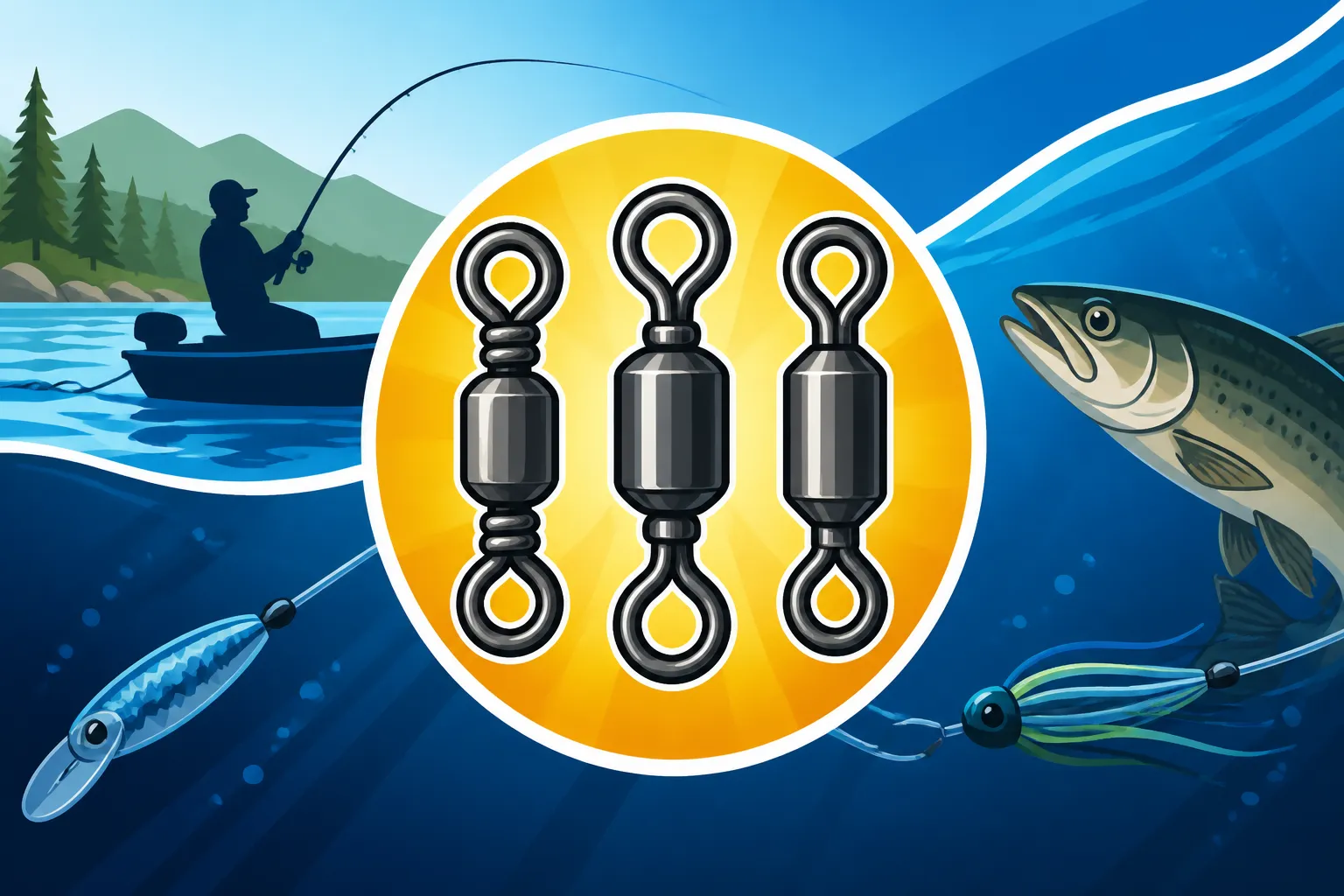
The barrel swivel is probably the most common and recognizable type of swivel out there. It consists of two rings connected by a cylindrical (barrel-shaped) body that allows them to rotate independently. They're simple, cost-effective, and effective for basic line twist prevention. You'll find these in just about any tackle box, and they're a good starting point for many applications.
However, for trolling, particularly when you're dragging lures that have a lot of inherent spin or when targeting aggressive, hard-fighting fish, a standard barrel swivel can sometimes fall short. While they do prevent twist, their rotation isn't always as free or smooth as more advanced designs, especially under heavy load or when fine debris gets into the mechanism. They're perfectly adequate for some lighter trolling scenarios, like flat-lining a simple spoon for pickerel or small bass in a pond, but if you're serious about preventing twist with high-rotation lures, you might want to look at an upgrade. Their compact size makes them less obtrusive, which can be a benefit in clear water situations where fish might be leader-shy. You can often find bulk packs of these at any Bass Pro Shops or online through Amazon, offering a very economical solution for general-purpose rigging.
Crane Swivels: A Step Up in Performance
Crane swivels are essentially an enhanced version of the barrel swivel. While they still feature the same basic two-ring, rotating body design, the body itself is often more streamlined and robust, and the internal mechanism is typically engineered for smoother, more consistent rotation. The difference might seem subtle, but it's significant, particularly for trolling applications where preventing line twist is paramount.
With a crane swivel, you'll experience less friction and better rotational performance compared to a standard barrel swivel. This makes them a much better choice for lures that spin continuously, like spoons, flashy dodgers, or even live bait rigs that might twist. They are generally stronger for their size and provide a more reliable connection point under prolonged tension. For anglers targeting salmon or lake trout in deeper waters with downriggers or lead core, where lures are subjected to constant drag and potential rotation, a crane swivel offers a noticeable improvement in line management and knot integrity. Many seasoned anglers in New Hampshire upgrade to crane swivels when they realize the limitations of basic barrel swivels for their trolling setups.
Ball Bearing Swivels: The Ultimate in Smooth Rotation
When it comes to preventing line twist, ball bearing swivels are the undisputed champions. Instead of a simple metal-on-metal pivot, these swivels incorporate tiny stainless steel ball bearings within their mechanism. This design allows for incredibly smooth, virtually frictionless rotation, even under heavy loads or when battling a powerful fish. They are specifically designed to handle extreme lure rotation without transferring any twist to your main line.
This superior performance comes at a higher cost, but for serious trollers, especially those targeting trophy lake trout or landlocked salmon where hours are spent dragging high-action lures, the investment is well worth it. Losing a valuable fish due to line failure caused by twist is a bitter pill to swallow, and ball bearing swivels significantly reduce that risk. They are also incredibly durable, offering excellent corrosion resistance, which is a major plus in both freshwater and saltwater environments. If you're running divers, flashers, or gang trolls, a ball bearing swivel is practically non-negotiable for maintaining line health and ensuring your lure presents naturally. You'll find a wide selection of these precision-engineered swivels, often from brands like Berkley or Owner, at specialty tackle shops or online retailers.
Coastlock and Duo-Lock Snaps with Swivels: Convenience and Security
While not a swivel type in themselves, snap swivels combine the functionality of a swivel with the convenience of a quick-release snap. Coastlock and Duo-Lock snaps are two of the most popular and secure designs, highly favored by anglers for their reliability. A Coastlock snap features a wire loop that locks securely over itself, while a Duo-Lock snap utilizes two opposing wire loops that provide a strong, positive closure.
Adding a snap to your swivel, whether it's a barrel, crane, or ball bearing type, dramatically speeds up lure changes. This is invaluable when you're trying to figure out the bite, needing to swap out spoons, plugs, or flies frequently. The key is to ensure the snap itself is strong enough for your target species and that it doesn't impede the action of your lure. For lighter trolling for panfish or smaller trout, a snap swivel attached to a barrel or crane swivel works wonderfully. For larger game fish, pairing a strong, quality snap with a robust ball bearing swivel provides the best of both worlds: ultimate line twist prevention and effortless lure swapping. Just be sure the snap is fully closed before you send your lure overboard!
Table: Comparing Swivel Types for Trolling Leaders
Here’s a quick overview to help you decide which swivel might be best for your trolling needs:
| Swivel Type | Primary Benefit | Trolling Performance | Typical Cost | Ideal Use Case |
|---|---|---|---|---|
| Barrel Swivel | Basic twist prevention, economical | Moderate, can bind under heavy load | Low | Light trolling, still water, less spinning lures, panfish, general purpose |
| Crane Swivel | Improved rotation, stronger | Good, smoother than barrel | Moderate | Moderate trolling, some spinning lures, general bass, smaller lake trout |
| Ball Bearing Swivel | Superior, frictionless rotation | Excellent, handles extreme spinning | High | Heavy trolling, fast-spinning lures, flashers, dodgers, large lake trout, salmon |
| Snap Swivel | Quick lure changes, twist prevention | Varies by swivel type (barrel/crane/BB) | Moderate to High (depending on swivel) | Any trolling where frequent lure changes are needed, matching snap strength to swivel |
Factors to Consider When Choosing a Trolling Swivel
Choosing the right swivel isn't a one-size-fits-all decision. The best choice for your New Hampshire fishing trip will depend on several key factors, from the size of the fish you're after to the specific environment you're fishing in and the lures you're using.
Target Species and Line Strength
The size and fighting power of your target species are primary considerations. If you're trolling for smaller brook trout in a pond or modest chain pickerel in a shallow lake, a good quality barrel or crane swivel in a smaller size will likely suffice. Your main line might be 6-10 lb test, and a correspondingly small swivel will be strong enough without being overly visible.
However, if your sights are set on the hard-fighting landlocked salmon of Sunapee Lake or the deep, powerful lake trout of Lake Winnipesaukee, you're going to need something significantly more robust. These fish demand heavier lines, often in the 15-30 lb test range, and your swivel needs to match that strength. A small, weak swivel will be the weakest link in your system, failing under the stress of a strong run or a sudden headshake. For these bigger fish and heavier lines, a ball bearing swivel is often the preferred choice due to its superior strength-to-size ratio and its ability to maintain smooth rotation under intense pressure. Don't cheap out on your swivels when targeting trophy fish; it's a small component that can have huge consequences. Consider what your Best Line Weight for Lake Trout Trolling or Best Rod Setup for Lake Trout Trolling would be, and choose a swivel to match that system.
Water Conditions and Lure Action
The environment you're fishing in and the type of lure you're presenting also play a critical role. If you're trolling clear, calm waters with lures that have minimal inherent spin, like some plugs or minnow imitations, a good quality crane swivel might be all you need. The lower visibility in clear water might also push you towards smaller, less obtrusive swivels if you're not using a long fluorocarbon leader.
Conversely, if you're fishing murky waters, or employing lures known for their aggressive, high-rotation action—think large spoons, flashers, or dodgers designed to attract fish from a distance—then a ball bearing swivel becomes almost mandatory. These lures generate immense line twist, and only a ball bearing swivel can effectively neutralize that rotational energy, keeping your line healthy and your lure running true. Fast trolling speeds, often used for salmon, also increase the amount of twist generated by lures, further highlighting the need for top-tier swivels. Understanding Trolling Techniques for New Hampshire Lake Trout or Best Trolling Speed for Landlocked Salmon will give you clues as to how much line twist potential your setup has.
Material and Corrosion Resistance
While we're primarily talking about freshwater fishing in New Hampshire, the material and corrosion resistance of your swivel are still important considerations, especially if you also fish saltwater or if your gear sees a lot of use. Most quality swivels are made from brass or stainless steel. Stainless steel offers superior corrosion resistance and strength, making it the preferred choice for heavy-duty applications and longevity. Brass swivels are more economical but can degrade faster, especially if not rinsed properly after each use.
Beyond the swivel body itself, pay attention to the rings. High-quality swivels will have strong, smooth welded rings or solid, forged rings that won't pull open under pressure. Cheaper swivels sometimes have split rings that can open up, leading to lost fish and gear. Investing in swivels from reputable brands ensures you're getting quality materials and construction that will stand up to the rigors of trolling season after season. Remember, even in freshwater, prolonged exposure to moisture and oxygen can lead to rust and degradation, so choose materials that resist this process to keep your gear reliable.
Rigging Your Trolling Leader with the Right Swivel
Once you've selected the perfect swivel for your New Hampshire trolling adventures, the next crucial step is to integrate it correctly into your leader system. Proper rigging is just as important as the swivel choice itself, ensuring that your knots are strong and your leader is optimized for success.
Knot Selection for Swivels: Strong and Reliable
Attaching your main line and leader to your swivel correctly is paramount. A weak knot can easily negate all the benefits of a high-quality swivel. For connecting your main line to one end of the swivel, popular choices include the Palomar knot or the Improved Clinch knot. Both are known for their strength and reliability, especially with braided or monofilament lines. If you're using fluorocarbon as your main line, these knots also perform well, though fluorocarbon can be a bit stiffer and requires careful cinching to avoid weakening the line.
When attaching your fluorocarbon or monofilament leader to the other end of the swivel, the same knots—Palomar or Improved Clinch—are excellent choices. However, for heavier leaders or when dealing with larger fish, some anglers prefer a Uni knot or a Triple Surgeon's knot for a robust connection. The key is to moisten your line before tightening any knot to reduce friction and heat, which can weaken the line. Always pull your knots tight slowly and deliberately, ensuring they cinch down properly. After tying, trim the tag end of your line, leaving just a small amount, to prevent any snags. A perfectly tied knot ensures that the strength of your swivel is fully utilized and your line won't fail at the connection point.
Proper Leader Length and Connection to Lures
The length of your leader is another critical consideration, and it often depends on the species you're targeting and the clarity of the water. For very clear lakes like Newfound Lake or Crystal Lake, a longer fluorocarbon leader (6-10 feet or even more) can be incredibly effective at presenting your lure naturally and keeping the more visible main line and swivel away from wary fish. Fluorocarbon is nearly invisible underwater, making it ideal for leader-shy fish. For murky waters, or when using aggressive lures, a shorter leader (3-5 feet) might be more manageable and equally effective.
When connecting your lure to the leader, you have a couple of options. If your swivel has a snap, simply open the snap, attach your lure, and close it securely. This is the fastest method for lure changes. If your swivel doesn't have a snap, you'll need to tie your lure directly to the end of your leader. A loop knot, like the Rapala knot, is an excellent choice for plugs and spoons, as it allows the lure to have maximum freedom of movement, enhancing its action. For jigs or flies, a simple Palomar or Improved Clinch knot will work well. Always check that your knots are snug and secure, and inspect your leader periodically for nicks or abrasions, especially after battling a fish or snagging on structure. Don't forget to review guides like Best Fluorocarbon Line for Clear Lake Water for tips on how to pick your leader material.
In essence, the small, often overlooked swivel plays a monumental role in the success of your trolling efforts in New Hampshire. By choosing the right type and rigging it meticulously, you're not just preventing line twist; you're building a more reliable, efficient, and ultimately, more successful fishing system. Tight lines out there!
Disclaimer
This article is for general informational purposes only and does not constitute professional advice. Laws, prices and regulations vary by location and change over time. Consult a qualified professional for guidance on your specific situation.