Best anchor for fishing moving river current
There’s nothing quite as frustrating as meticulously planning a fishing trip to one of New Hampshire’s beautiful rivers, only to find your boat stubbornly refusing to stay put. The current can be deceptively strong, dragging your craft downstream and making it impossible to hold your spot over that promising eddy or submerged structure. This guide is all about helping you understand the unique challenges of anchoring in moving water and choosing the best anchor to keep you right where the fish are biting.
Understanding the Challenges of Anchoring in River Current
Fishing New Hampshire's rivers, whether it's the winding Merrimack or the swift Pemigewasset, offers incredible opportunities, but it also presents a unique set of challenges when it comes to anchoring. Unlike a calm lake, a river is a dynamic environment, constantly pushing against your vessel and anchor. Ignoring these forces can lead to a less-than-ideal fishing experience, or worse, a dangerous situation.
The Relentless Force of Moving Water
The primary adversary when anchoring in a river is, of course, the current itself. This isn't just a gentle flow; it's a persistent force that can feel surprisingly strong, even in seemingly placid sections of a river. The faster the current, the more pressure it exerts on your boat, and subsequently, on your anchor. This pressure can cause lighter, less effective anchors to drag, pulling you away from your desired fishing spot. Imagine setting up perfectly for a smallmouth bass hotspot on the Contoocook River, only to realize a few minutes later that you’ve drifted downstream, ruining your carefully planned cast.
Furthermore, New Hampshire rivers often feature incredibly varied bottom compositions. One stretch might be soft, silty mud, perfect for certain anchor types, while just a hundred yards downstream, you could encounter a rocky, gravelly bottom, or even submerged logs and heavy vegetation. An anchor designed for mud will simply slide across rock, and one that grips well in gravel might bury itself too deeply in silt, making retrieval a nightmare. The key is finding an anchor that can adapt to these changes or having a few options ready for different conditions you might encounter, especially when targeting fish known to hold in specific river structures, like in the How to fish a river for smallmouth bass article.
Safety Concerns and Environmental Impact
Beyond the frustration of not holding your spot, inadequate anchoring in a river can quickly become a safety hazard. Drifting unexpectedly can push your boat into rapids, submerged rocks, fallen trees, or even other boats. If you're fishing alone, trying to re-anchor or untangle a snagged anchor in a strong current can be incredibly difficult and dangerous. Imagine hooking into a trophy brown trout on the Connecticut River, only for your anchor to slip, sending you hurtling towards a set of rapids while you're distracted by the fight. It's a scenario no angler wants to face.
There's also an environmental consideration. Dragging an anchor can disturb sensitive riverbeds, uproot aquatic vegetation, and potentially damage fish spawning areas. Getting an anchor snagged and having to abandon it not only means losing expensive gear but also leaves foreign objects in the river, which can be harmful to the ecosystem. Responsible anchoring practices, including choosing the right anchor and deploying it carefully, are crucial for both your safety and the health of New Hampshire's waterways. Always be mindful of local regulations, and make sure your vessel itself meets all requirements, as discussed in New Hampshire Boating Laws for Anglers.
Types of Anchors Best Suited for River Currents
When it comes to holding your ground against the flow of a New Hampshire river, not all anchors are created equal. Different designs are built to perform optimally in specific conditions. Knowing the pros and cons of each will help you make an informed decision for your fishing adventures.
Claw or Bruce Anchors
The claw anchor, often referred to as a Bruce anchor (after its original manufacturer), is a popular choice for many boaters, and for good reason. Its unique, scoop-like design with three pointed "claws" allows it to dig deep into various bottom types, making it surprisingly effective in a river environment. It's particularly good at setting quickly and holding firm in mud, sand, and even light gravel, which you'll find in many stretches of rivers like the Cocheco or Lamprey.
What makes the claw anchor so versatile is its ability to right itself. No matter how it lands on the bottom, it tends to orient itself to dig in. This means less fussing and more fishing time. While it might not be the absolute strongest holder on purely rocky bottoms where its claws can't fully penetrate, it still offers decent resistance. For those fishing from a small aluminum boat or a sturdy jon boat on the deeper, slower sections of the Merrimack, a claw anchor can provide reliable holding power without excessive weight. You can often find a good selection of these at marine supply stores or through online retailers like Bass Pro Shops.
River Anchors (Box or Mushroom-Style)
When you hear "river anchor," you might immediately picture a specialized design, and you'd be right. These anchors are specifically engineered to deal with current. The most common forms are the box anchor, pyramid anchor, or enhanced mushroom anchor. Unlike traditional anchors, they often rely on sheer weight and a design that buries or suctions into softer riverbeds. A pyramid anchor, for instance, has a low center of gravity and flat sides that help it dig in and resist dragging, particularly in muddy or sandy environments.
Mushroom anchors, especially the heavy-duty varieties, work by creating a suction effect in soft, silty bottoms. They're not great for rocky areas where they'll just bounce around, but if you're targeting areas known for deep silt and moderate current, they can be incredibly effective. Box anchors are another innovative design, opening up like a parachute when deployed to create immense drag and holding power in both soft and semi-hard bottoms. These types of anchors are excellent for anglers in larger canoes or smaller motorboats who are frequently navigating the slower, wider bends of rivers in southern New Hampshire. They are designed to hold without needing extreme scope, which can be a huge benefit in narrower river channels.
Grapple or Grapnel Anchors
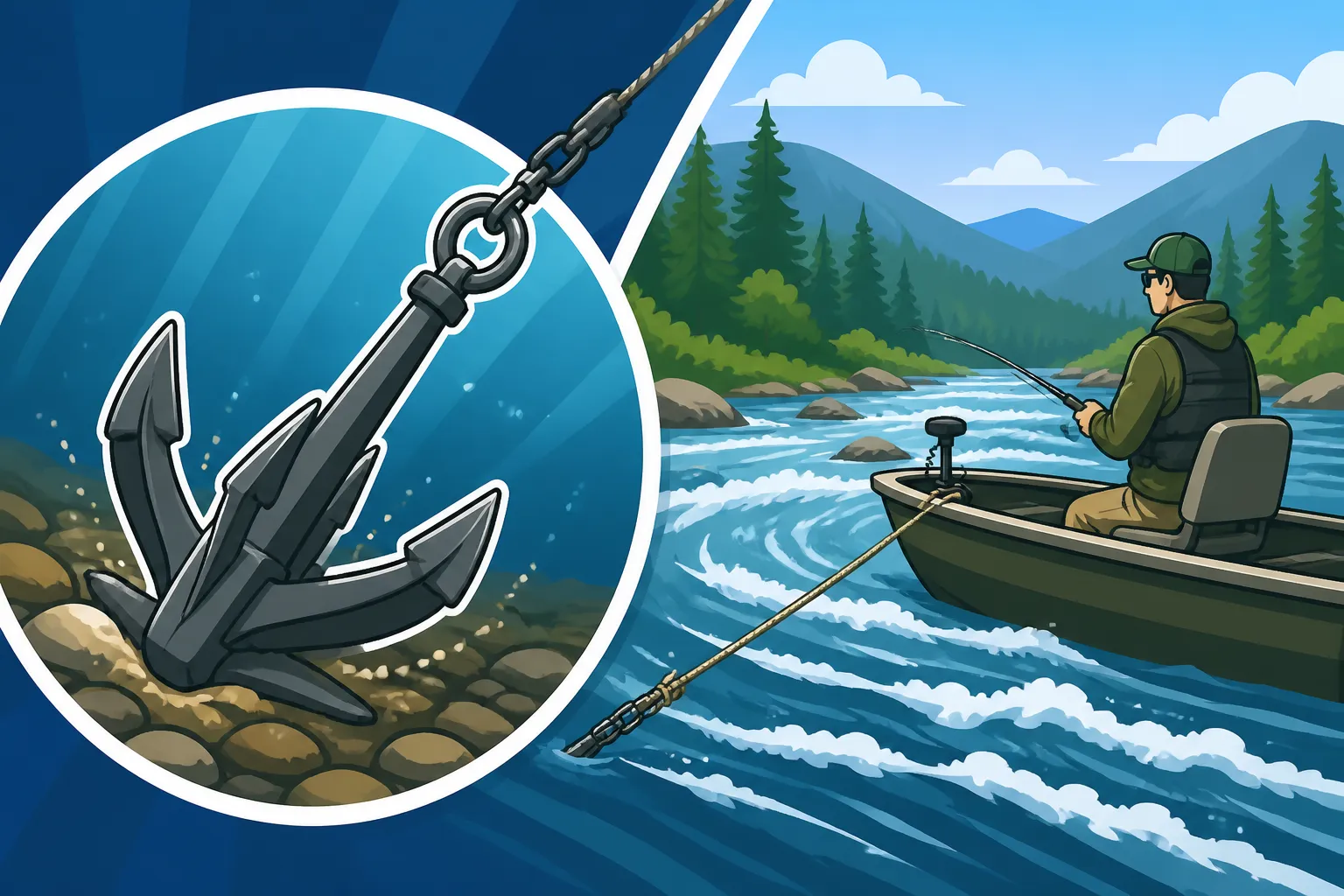
For those who explore New Hampshire's smaller, rockier trout streams or navigate rivers in a kayak or canoe, the grapple (or grapnel) anchor is often the anchor of choice. This anchor features four or more prongs that are designed to hook onto rocks, submerged logs, or other underwater debris. It's lightweight, usually foldable for easy storage, and can be incredibly effective in areas where other anchors would simply slide over the bottom. Think of those rocky stretches on the Swift River or Ellis River where trout love to hide; a grapple can latch onto the very structure the fish are holding in.
The beauty of the grapple anchor lies in its ability to find purchase where traditional flukes or claws cannot. However, this strength is also its biggest weakness: it can get notoriously snagged. If you hook onto something too solid, retrieving it can be a real challenge, sometimes even leading to a lost anchor or, worse, capsizing a smaller craft. Many anglers who use grapple anchors will rig them with a "trip line" or a break-away system (attaching the anchor line to the crown instead of the shank, with a light zip tie or string holding the shank) to aid in retrieval from snags. For kayak anglers navigating winding rivers, a lightweight grapple anchor paired with an anchor trolley system, which allows you to deploy and retrieve the anchor from different points on your kayak, is a game-changer. You can find many portable options for these anchors on Amazon.
Essential Considerations for Choosing a River Anchor
Choosing the perfect anchor isn't just about picking a type; it's about matching the anchor to your specific vessel and the conditions you expect to encounter on New Hampshire's diverse waterways. Several factors come into play, and overlooking any of them could compromise your ability to stay put.
Boat Size, Weight, and Type
The size and weight of your fishing vessel are paramount when selecting an anchor for river current. A small, lightweight fishing kayak, like those popular for exploring the Contoocook, will require a vastly different anchor setup than a heavier, 16-foot aluminum jon boat designed for navigating the Merrimack River. For instance, a 5-pound grapple anchor might hold a kayak perfectly in a moderate current, but it would be utterly useless for a larger, heavier boat.
Generally, the heavier your boat, the heavier and more robust your anchor needs to be. The current will exert more force on a larger hull, demanding greater holding power from the anchor. Consider the boat you use most often in river settings. Do you primarily use a lightweight canoe or paddleboard, or do you have a more substantial fishing boat, perhaps even one featured in Best Boats for New Hampshire Lakes and Rivers or Best Jon Boats for Shallow Rivers? Anchor manufacturers typically provide weight recommendations based on boat length and displacement, and it’s always wise to err on the side of slightly heavier if you frequently encounter strong currents.
Riverbed Composition and Current Strength
This is where local knowledge and a bit of reconnaissance truly pay off. New Hampshire rivers are incredibly varied, and the effectiveness of your anchor is directly tied to the type of bottom it's trying to grip. Is the riverbed predominantly rocky, like many sections of the Pemigewasset River? Is it silty and soft, or a mix of sand and gravel, common in wider stretches?
- Rocky Bottoms: Grapple anchors shine here, as they are designed to hook onto crevices and rocks. Claw anchors can also find some purchase, but they risk getting hopelessly wedged.
- Sandy/Gravel Bottoms: Fluke (Danforth) anchors, while not explicitly mentioned above, or claw anchors work well, digging into the loose material. Pyramid or box anchors also perform admirably by digging in or creating significant drag.
- Mud/Silt Bottoms: Mushroom anchors are king here due to their suction effect, though claw anchors also do a decent job of burying themselves.
Beyond the bottom, assess the current strength. A fast, churning current will require an anchor with superior holding power, possibly a heavier version of a specific anchor type, or a longer scope. In slower, gentler flows, you might get away with a lighter anchor. Always consider the potential for increased current after heavy rains or during spring runoff, which can turn a mild river into a raging torrent. Preparing for these conditions can be the difference between a successful outing and a precarious one.
Anchor Rode and Retrieval Systems
An anchor is only as good as the line connecting it to your boat, known as the "rode." The rode typically consists of rope, often with a length of chain near the anchor. The chain is crucial in river fishing for several reasons. Firstly, its weight helps the anchor lay flat and dig in more effectively, increasing its holding power. Secondly, it provides abrasion resistance against rocky bottoms, protecting your rope from chafing and breaking.
The length of your rode, or "scope," is also vital. The general rule of thumb for anchoring is a scope of 7:1 (seven feet of rode for every one foot of depth), but in strong river currents, you might need even more, sometimes up to 10:1 or 12:1, to ensure the anchor's fluke or claws can properly dig in. Shortening your scope in a river is a recipe for dragging.
For retrieval, especially with grapple anchors or in situations where an anchor might get snagged, a proper retrieval system is a lifesaver. An anchor ball or ring and buoy system allows you to retrieve a snagged anchor by pulling it from the opposite direction. For kayak anglers, an anchor trolley system, which runs along the side of the boat, is indispensable. It allows you to move the anchor attachment point from the bow to the stern (or anywhere in between), allowing you to orient your boat optimally for fishing the current or to free a snagged anchor from a different angle. This system is also great for safe deployment and retrieval, especially when considering safety regulations like those concerning Life Jacket Requirements for New Hampshire Boaters.
Best Practices for Anchoring in New Hampshire Rivers
Even with the perfect anchor, proper technique is essential to ensure you stay safely and effectively anchored in a moving river current. There's an art to it, one that takes a bit of practice but pays off immensely in peace of mind and successful fishing.
Scouting and Positioning
Before you even think about dropping anchor, take a moment to observe and understand the river you're fishing. This is your initial scouting mission. Look for visual cues of current strength, like riffles, eddies, and smooth glides. Pay attention to obstacles downstream – fallen trees, bridge pilings, or other hazards that you might drift into if your anchor fails. If you're on a new stretch of river, a quick pass with a depth finder or even just a slow drift can reveal valuable information about the bottom composition. Knowing if you're over sand, rock, or mud helps you choose the right anchor and anticipate its holding power.
Once you have a sense of the river, think strategically about your position. The goal is to anchor slightly upstream from your desired fishing spot, allowing the current to position your boat perfectly over it. Deploying your anchor too close to your spot will often cause you to overshoot it as your boat settles. Consider the direction of the wind as well; it can combine with the current to affect your boat's drift. Aim to deploy your anchor so that once it's set and your boat is settled, you're looking downstream at your prime fishing water, ready to cast. This kind of thoughtful preparation is just as important as having the right gear, whether you're fly fishing for trout or targeting bass. For specific guidance on where to find fish, check out guides like Pemigewasset River Fishing Guide or Connecticut River Fishing Access in New Hampshire.
Proper Deployment and Retrieval Techniques
Deploying an anchor in current isn't just about tossing it overboard; it's a careful ballet of boat control and line management. Always deploy your anchor from the bow (front) of your boat, never the stern (back). Anchoring from the stern can lead to water coming over the transom, potentially swamping your boat, especially in strong currents or when larger boats pass by.
Here’s a general sequence for safe deployment:
- Motor Upstream: Navigate your boat upstream from your desired fishing spot, giving yourself plenty of room to drift back.
- Slow Down: Reduce your speed to near-zero, or even slightly reverse, to counter the current.
- Gently Deploy Anchor: Lower the anchor to the bottom. Don't just throw it in, as this can tangle the line and prevent it from setting properly.
- Pay Out Rode: As you drift slowly downstream, or motor slowly in reverse, gradually pay out anchor line (rode). This is where your scope comes in. Ensure you’re letting out enough line for the anchor to dig in effectively.
- Let it Set: Once you’ve paid out sufficient rode, allow the current to pull against the anchor firmly. You should feel it dig in and hold. If you continue to drift, you likely haven't paid out enough line or the anchor hasn't set.
- Secure the Rode: Once the anchor is set, secure the rode to a sturdy bow cleat, ensuring there's no slack that could suddenly snap taut under pressure.
Retrieval also requires attention. Approach the anchor slowly, moving upstream until you are directly over it. This reduces the strain on the anchor and makes it easier to pull free. For snagged anchors, as discussed, a breakaway system or an anchor ball can be invaluable. Always be prepared for your anchor to be stuck, and have a sharp knife handy to cut the line if absolutely necessary, prioritizing safety over lost gear. It's an unfortunate reality sometimes, but a necessary safety measure.
Emergency Situations and Safety Gear
Despite your best efforts, sometimes things go wrong. An anchor can get hopelessly stuck, a line can break, or the current can unexpectedly strengthen. Being prepared for these emergency situations is part of being a responsible angler on New Hampshire's rivers. Always carry a sharp, easily accessible knife in case you need to quickly cut your anchor line to prevent drifting into danger. This is especially true for solo anglers or those in smaller crafts like kayaks or canoes.
Beyond the knife, ensure you have other crucial safety gear. A properly fitted life jacket for everyone on board is non-negotiable. Check out Life Jacket Requirements for New Hampshire Boaters for specific regulations. A whistle or other sound-signaling device can alert others to your presence or distress. For boats with motors, ensure your engine is in good working order and you have enough fuel to get back to shore, especially if you have to cut your anchor and motor back upstream. Having a backup paddle for smaller craft or a spare trolling motor battery for electric setups can also be a lifesaver.
Finally, communicate your plans. Let someone know where you're going and when you expect to return, especially if you're exploring remote sections of rivers. Cell service can be spotty in parts of New Hampshire, so don't rely solely on your phone for emergencies. By understanding the challenges, choosing the right anchor, and practicing safe anchoring techniques, you'll be well-equipped to enjoy the fantastic river fishing opportunities New Hampshire has to offer.
| Anchor Type | Best for Bottom Type | Current Effectiveness | Boat Size Suitability | Pros | Cons |
|---|---|---|---|---|---|
| Claw/Bruce | Mud, Sand, Light Gravel | Good | Small to Medium Motorboats | Sets quickly, good all-around holder | Can wedge in heavy rock, moderate holding |
| River (Pyramid/Mushroom) | Soft Mud, Silt | Very Good | Medium Boats, Jon Boats, Canoes | Excellent in soft bottoms, compact | Poor in rock, can be heavy for its size |
| Grapple/Grapnel | Rocky, Snaggy | Moderate to Good | Kayaks, Canoes, Small Boats | Lightweight, hooks onto structure | Prone to severe snags, lower holding power |
Disclaimer
This article is for general informational purposes only and does not constitute professional advice. Laws, prices and regulations vary by location and change over time. Consult a qualified professional for guidance on your specific situation.