How to tell a brown trout from a rainbow trout
It's incredibly frustrating when you're out on a beautiful New Hampshire stream or lake, you hook into a gorgeous trout, and then you're left scratching your head, wondering exactly what species you've landed! Both brown trout and rainbow trout are common catches here, often sharing the same waters, and at first glance, they can look quite similar. This comprehensive guide will help you confidently tell the difference between these two fantastic sport fish, ensuring you know exactly what you've caught.
Visual Identification: The Most Obvious Clues
When you've got a fish in hand, or even if you're just observing it in clear water, there are some immediate visual cues that can help you distinguish between a brown trout and a rainbow trout. It's not always about one single feature, but rather a combination of characteristics that, once you know what to look for, become quite distinct.
Spots and Patterns – The Devil's in the Details
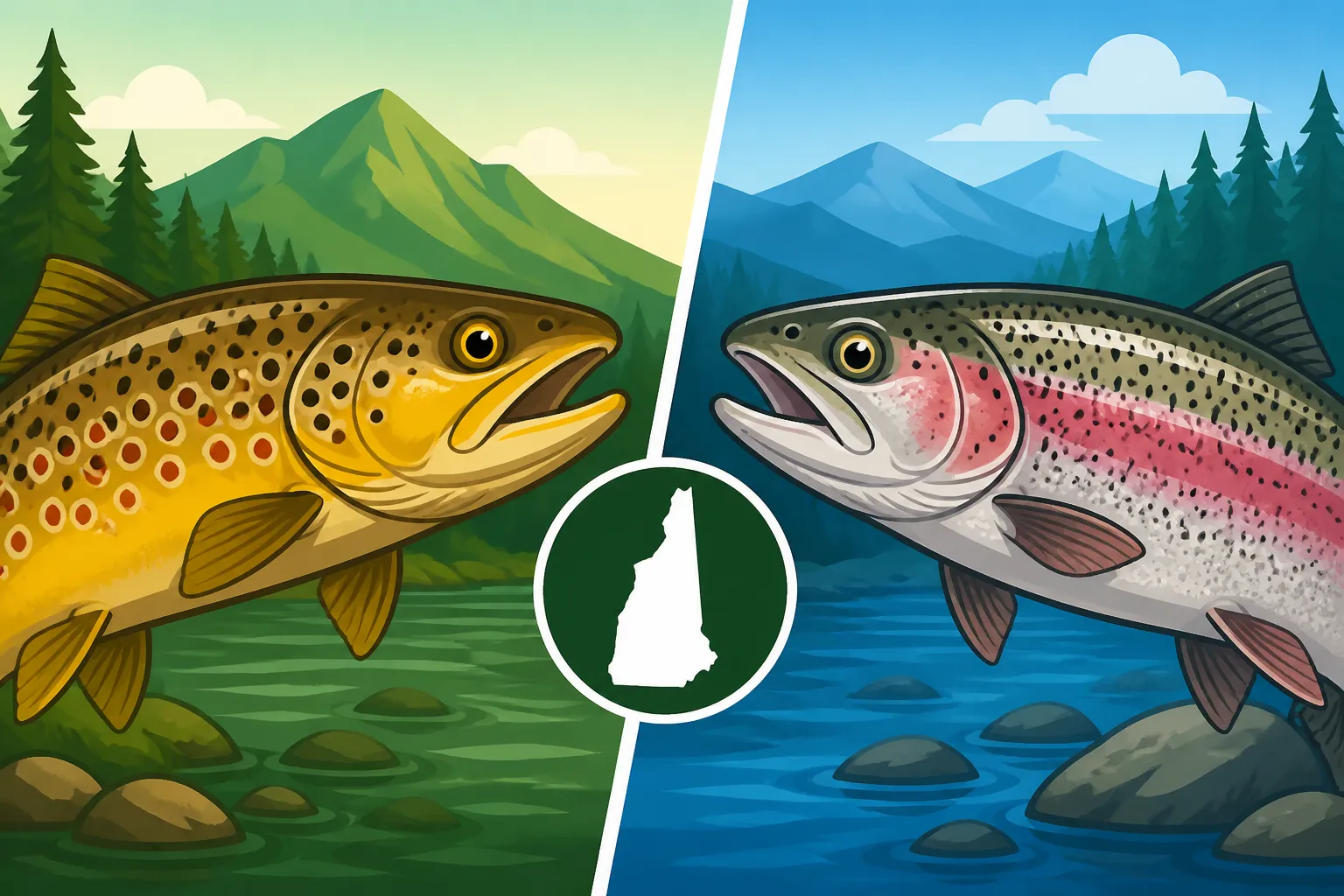
This is often the first place anglers look, and for good reason, as the spot patterns are usually a strong indicator. Brown trout, or Salmo trutta, are typically adorned with dark spots, often ringed with a lighter halo, giving them an "oil slick" or "bullseye" appearance. These spots are usually prominent on their sides, back, and dorsal fin, and often extend onto their head. You might also notice some red or orange spots mixed in, particularly on their sides, which are often encircled with a pale blue halo. Imagine a sprinkling of pepper mixed with a few colorful candies. The spots tend to be more irregular in shape and distribution, sometimes forming wavy lines along their back.
Rainbow trout, or Oncorhynchus mykiss, on the other hand, usually have smaller, more numerous, and uniformly black spots. These spots are often like fine freckles, densely covering their entire body, from their head to their tail, including their dorsal fin and, crucially, their caudal (tail) fin. It's like someone took a fine-tipped marker and dotted them all over. The tail fin is a really key area to check: if it's heavily spotted, it's almost certainly a rainbow. While browns might have some spots on their tail, they are usually much sparser, larger, and less uniform than a rainbow's. This dense, almost peppered look, extending to the tail, is a classic rainbow characteristic.
Coloration and Body Shape – Beyond the Spots
Beyond the spots, the overall color palette and body structure also offer significant clues. Brown trout tend to live up to their name with a more yellowish-brown, golden-brown, or even olive-brown base color. Their bellies are often cream or yellow. This earthy tone helps them blend in with the rocky, silty, or weedy bottoms of many rivers and lakes. Their body shape can be a bit more robust and torpedo-like, especially larger individuals, with a relatively shorter, squarer tail fin. The mouth of a brown trout is also quite telling; it's typically larger, extending well past the eye, giving them a more predatory appearance. They often have a slightly more aggressive jawline.
Rainbow trout, true to a part of their name, often display a prominent, iridescent pink or red stripe running horizontally along their lateral line, from their gill plate to their tail. This stripe can be incredibly vibrant, especially during spawning season or in males, or it might be quite faint in other individuals or environments. Their base color typically ranges from a silvery-green to a darker olive on their back, fading to silvery sides and a white belly. Their body is generally more streamlined and sleeker than a brown trout's, often appearing more "athletic." Their tail fin is typically broader and more deeply forked, and you'll consistently find those small black spots covering it. The mouth of a rainbow trout is usually smaller than a brown's, generally not extending past the back of the eye. If you're looking for a good field guide to keep these differences straight, you can find many comprehensive ones on Amazon that can be a lifesaver when you're out on the water.
Habitat and Behavior Clues – Where and How They Live
While visual identification is your primary tool, understanding the typical habitats and behaviors of brown and rainbow trout in New Hampshire can provide extra context and solidify your identification. Different species often have preferred environments and hunting styles, which can subtly influence where you encounter them and how they look.
Preferred Waters – Not All Trout Like the Same Address
Brown trout are renowned for their hardiness and adaptability. They can tolerate slightly warmer water temperatures than native brook trout and often thrive in a wider range of conditions, from clear, cold mountain streams to larger, slower rivers, and even lakes. In New Hampshire, you'll find them in many streams and rivers, particularly those with good cover like undercut banks, fallen logs, and rocky structures. They are often less bothered by human presence and can be found in more developed areas. They're also known for being a bit more nocturnal, especially the larger, more wary specimens, often feeding heavily during low light conditions or at night. Their ability to survive in slightly less pristine conditions has made them a staple in many New Hampshire fisheries.
Rainbow trout, while also widely stocked and adaptable, generally prefer cooler, well-oxygenated water, often associated with pristine streams, rivers, and deep, cold lakes. They are frequently stocked in many of New Hampshire's popular fishing spots. They tend to be more active during daylight hours and are often found in faster-moving currents, riffles, and runs, where they can ambush insects drifting downstream. In lakes, they'll often cruise open waters or congregate near cool spring inlets. While hardy, they typically favor environments with a consistent supply of cold, clean water. Knowing the specific characteristics of the water you're fishing in can sometimes give you a hint about which species you're more likely to encounter. Check out resources like New Hampshire Trout Stocking Report and Map to see what's being put into local waters.
Feeding Habits and Attitude – What's on the Menu?
When it comes to dinner, both species are opportunistic, but they do have some tendencies. Brown trout are famous (or infamous, depending on your perspective!) for their predatory nature, especially as they grow larger. While juveniles will feed heavily on insects, larger browns become aggressive hunters, readily consuming smaller fish, crayfish, and even small rodents or amphibians that fall into the water. They are often more territorial and can be quite aggressive towards lures and flies that mimic their prey, especially large streamers or crankbaits. Their larger mouth is certainly built for it. They tend to hold tight to cover and dart out to ambush prey.
Rainbow trout, while also predatory, tend to lean more towards an insectivorous diet throughout their lives. They are often seen rising to take dry flies on the surface, especially during prolific hatches, and will readily feed on nymphs, emergers, and small baitfish. They are often considered more "sporty" by fly anglers due to their strong runs and aerial acrobatics once hooked. They can be a bit more nomadic, cruising larger areas in search of food. Their behavior can be quite different from a brown's, often making them more visible and active targets during the day. Understanding these slight differences can sometimes help you target one over the other, especially when thinking about Best Baits for Smallmouth Bass on Winnipesaukee (even though this is bass, the principle of tailoring bait applies) or other specific trout fishing techniques.
When Both are Present: Decoding the Mixed Bag
Many of New Hampshire's most beloved fishing waters, from the tranquil streams to the larger lakes, are home to both brown and rainbow trout. This is where identification can get tricky, especially since stocking practices and natural reproduction contribute to diverse populations.
Stocked vs. Wild Fish – A Matter of Upbringing
One major factor influencing appearance is whether a fish is wild-born or hatchery-reared. Stocked fish, whether brown or rainbow, often exhibit certain characteristics that can make them easier to identify as stocked, if not always definitive of the species immediately. They might have worn fins (especially the dorsal and caudal fins) from rubbing against concrete raceways, a more uniform size for their age, or even slightly duller coloration compared to their wild counterparts. A fresh stocking of rainbows, for instance, might have very bright silver sides and a pronounced pink stripe, but their fins might tell a story of their hatchery upbringing.
Wild brown trout, on the other hand, especially those that have lived in a stream for years, tend to be incredibly vibrant with deep, rich colors and perfectly formed fins. Their spots are often sharper and their overall pattern more intricate. Similarly, wild rainbow trout can develop incredibly intense coloring, with their red stripe almost glowing, and their bodies becoming very muscular and sleek from fighting currents and foraging naturally. The subtle differences between Difference between wild and stocked trout in New Hampshire are fascinating and can often be observed in both species. Sometimes, anglers report "holdover" trout, which are stocked fish that have survived for a year or more in the wild, often taking on more wild-like characteristics and making identification even more challenging.
Hybridization and Anomalies – When Nature Gets Creative
While less common, it's worth noting that in some instances, nature can throw a curveball. While brown trout (a European import) and rainbow trout (native to the Pacific Northwest) are distinct species, there have been very rare reports of hybridization, particularly with closely related species or in highly manipulated environments. More commonly, you might encounter what are colloquially called "tiger trout," which are a sterile hybrid of a brown trout and a brook trout. These fish have a distinctive vermiculated pattern (worm-like markings) similar to a brook trout, but with a more brown trout-like coloration.
Beyond hybrids, individual fish can sometimes display unusual coloration or spot patterns due to genetic variation, diet, water chemistry, or injuries. For example, a brown trout that lives in very dark, tannin-stained water might appear much darker than one from a bright, clear stream. Or, a rainbow trout might have a very faint lateral stripe if it's stressed or in poor condition. These anomalies are part of the beauty and mystery of fishing, but they can certainly add to the identification challenge. Always rely on a combination of features rather than just one when trying to make a positive ID. It can be like solving a small puzzle right there on the water!
Beyond the Eye Test: Other Differentiating Factors
Sometimes, even after careful visual inspection, you might still be on the fence. There are a few more subtle anatomical features and practical tips that can help you make a confident identification.
Fin Markings and Mouth Structure – Closer Inspection
Take a moment to look closely at the fins, especially the adipose fin and the tail. The adipose fin, that small fleshy fin on the back between the dorsal fin and the tail, is often a similar color to the back of the fish in both species, but sometimes subtle differences can be noted. For rainbows, remember that the black spots almost always extend onto the caudal (tail) fin, often in distinct rows. For browns, while there may be some spots, they are usually much less defined and numerous on the tail.
The mouth is another crucial area. As mentioned earlier, the brown trout typically has a larger mouth, with the maxillary (upper jawbone) extending noticeably beyond the back of the eye. This larger gape is perfectly suited for its more piscivorous (fish-eating) diet as it grows. The rainbow trout's mouth is generally smaller, with the maxillary typically not extending past the middle or back of the eye. If you're struggling, a quick check of the mouth size relative to the eye can be a decisive factor. Also, while both have teeth, a large brown trout's teeth can feel a bit more robust and numerous.
Practical Tips for Anglers – Making the Call on the Water
Here's a quick rundown of practical tips to help you in the field:
- Observe the Tail Fin First: If you see clear, numerous black spots covering the tail fin, you're almost certainly looking at a rainbow trout. If the tail is mostly unspotted or has only a few faint, larger spots, consider a brown.
- Look for the Lateral Stripe: The iridescent pink or red stripe on the side is a strong rainbow characteristic. While it can be faint, its presence usually means rainbow. Brown trout do not have this stripe.
- Check Spot Colors and Halos: Brown trout often have those dark spots with lighter halos, and sometimes red/orange spots with blue halos. Rainbow spots are almost always uniformly black, without halos.
- Consider the Environment: While not foolproof, if you're in a clear, fast-flowing, very cold mountain stream, you might lean towards rainbow or even Brook Trout: New Hampshire's Native Trout. If it's a larger, slower river with good cover, brown trout are very likely.
- Use a Reference: Keep a small, waterproof fish identification card or a dedicated app on your phone. Even better, bring a printed copy of a Trout Species Identification Guide for New Hampshire. You can even find great laminated fish ID cards specifically for trout on Amazon. This way, you have a visual aid right there with you.
- Catch and Release Gently: While identifying, always handle the fish with wet hands, support its weight, and minimize its time out of water, especially if you plan to release it. Knowing the species can also be important for understanding New Hampshire Fishing Regulations Explained as bag and length limits can differ.
By combining these observations, you'll soon develop an eye for the subtle nuances that differentiate these two fantastic New Hampshire game fish. Happy angling!
Disclaimer
This article is for general informational purposes only and does not constitute professional advice. Laws, prices and regulations vary by location and change over time. Consult a qualified professional for guidance on your specific situation.