Largemouth Bass vs Smallmouth Bass Identification
It's incredibly common to pull a bass out of a New Hampshire lake or river and find yourself staring at it, wondering, "Is this a largemouth or a smallmouth?" They share a family name, but these two popular game fish have distinct characteristics that can make all the difference in understanding where to find them, what lures to use, and even what regulations apply. This guide is here to help you confidently identify the differences between largemouth and smallmouth bass, so you can make informed decisions on the water and perhaps even impress your fishing buddies.
Why Distinguish Between Largemouth and Smallmouth?
Knowing whether you've hooked a largemouth or a smallmouth isn't just about showing off your fish ID skills, though that's certainly a bonus! It has practical implications for how you approach fishing in New Hampshire and ensures you're following local rules. Different species often mean different strategies, different habitats, and sometimes, different regulations.
Habitat and Behavior Differences
Largemouth and smallmouth bass, while both formidable predators, tend to prefer different aquatic environments, especially in New Hampshire's diverse waters. Largemouth bass are often found lurking in warmer, shallower, and weedier areas. Think of those lily pad fields, submerged timber, or thick stands of reeds in a slow-moving river or a pond like Pawtuckaway Lake. They are ambush predators, content to hide and strike at unsuspecting prey passing by. Their body shape and coloration are perfectly adapted for these environments, allowing them to blend seamlessly into dense cover.
Smallmouth bass, on the other hand, are the kings and queens of cooler, clearer, and rockier waters. You'll typically find them cruising around rocky points, ledges, submerged humps, or current breaks in larger lakes like Winnipesaukee or rivers such as the Connecticut River. They're more open-water predators, often schooling up and actively chasing down baitfish. Their streamlined bodies and bronze coloration are ideal for camouflaging against rocky bottoms and navigating swift currents. Understanding these fundamental habitat preferences can save you a lot of time and help you decide where to focus your efforts. If you're fishing a weedy cove, you're almost certainly targeting largemouth. If you're drifting over a deep, rocky shoal, it's smallmouth territory.
Fishing Regulations and Limits
This is where identifying your catch correctly becomes really important. New Hampshire Fish and Game Department regulations can sometimes vary between species, especially concerning minimum length limits, daily creel limits, and specific seasonal rules. For instance, while both species might fall under general bass regulations for certain waters, there might be unique size restrictions or slot limits in specific lakes or rivers designed to manage one population over the other.
Imagine you're out fishing on Lake Winnipesaukee, and you've had a fantastic day, catching several bass. If you're not sure whether they're largemouth or smallmouth, you could inadvertently keep a fish that's undersized for its species or exceed a daily limit. This isn't just a minor oversight; it could lead to penalties, and nobody wants that. Always refer to the most current New Hampshire Bass Limits and Slot Rules or the Reading the New Hampshire Freshwater Fishing Digest to be absolutely sure. Knowing which bass you've landed ensures you're a responsible and compliant angler, helping to conserve these fantastic fisheries for everyone.
Key Visual Indicators: The Mouth and Jawline
The most definitive way to tell a largemouth from a smallmouth bass often comes down to their mouths. It's right there in their names! This is the first thing I look at when I'm holding a bass in my hands, especially if I'm on the fence about its identity.
Largemouth Bass Mouth Anatomy
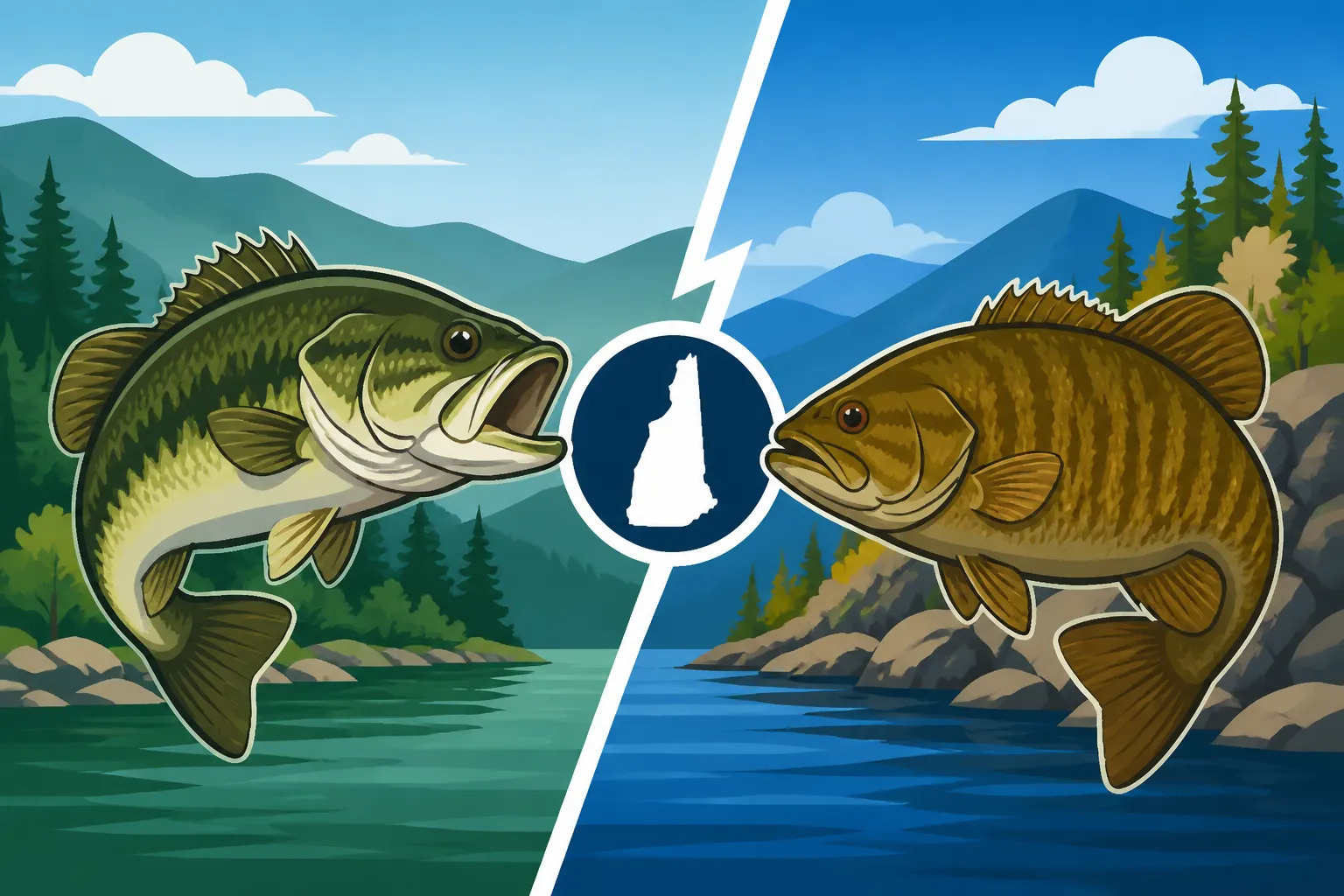
True to their name, largemouth bass have a noticeably larger mouth. The key feature to observe is how far back the corner of their jaw extends. If you draw an imaginary vertical line from the back of the eye straight down, the corner of a largemouth's mouth will extend past that line. It's a significant visual cue. When you open a largemouth's mouth, it often looks like it could swallow something much larger than itself – which, frankly, they often try to do!
This large maw is perfectly designed for their ambush hunting style, allowing them to engulf prey quickly from cover. Think about a largemouth hiding in the weeds. When a frog or a baitfish swims by, that wide gape allows them to open their mouth, create a strong vacuum, and inhale their meal in a split second. It's an adaptation that makes them incredibly efficient predators in their preferred, often thick, environments. This distinct jawline is usually the quickest way to confirm you've got a largemouth on the line.
Smallmouth Bass Mouth Anatomy
In contrast, smallmouth bass have a more proportionate, "smaller" mouth. Again, using that imaginary vertical line from the back of the eye, the corner of a smallmouth's mouth will typically not extend past that line. Instead, it usually aligns with or stops just short of the center of the eye. It's a subtle but consistent difference that, once you see it a few times, becomes second nature to spot.
Their mouth, while still sizable for a fish, is more streamlined. This allows them to effectively chase down baitfish and prey in open water or along rocky structures. They are built for agility and pursuit, and their mouth reflects that. They still have impressive suction capabilities, but their primary hunting method isn't usually the same sudden engulfing ambush that a largemouth employs. For anglers, this difference in mouth size can also influence your lure selection. While both will strike a variety of baits, a smallmouth might prefer slightly smaller or more streamlined offerings compared to a largemouth's willingness to attack bulkier presentations. If you're comparing two fish of similar overall length, the smallmouth will always have that less pronounced jawline.
Body Shape, Coloration, and Markings
Beyond the mouth, the overall body shape and the subtle nuances of color and pattern offer excellent clues for identification. These features often reflect the environments each species inhabits, acting as their natural camouflage.
Largemouth Bass Body and Color
Largemouth bass typically have a more elongated, somewhat thicker body shape. They can appear robust and "pot-bellied," especially when well-fed. Their coloration tends to be a darker green, sometimes almost blackish-green on the back, fading to lighter green or yellowish-white on their belly. The most prominent marking is usually a distinct, dark, horizontal stripe or series of blotches running along their lateral line, from the gill plate to the tail. On some fish, especially those from very clear water or certain strains, this stripe can be broken or less pronounced, but it's almost always present in some form.
Think about the places you'd find a largemouth in New Hampshire – dense weed beds, submerged logs, or shaded undercut banks. Their dark green and blotchy pattern helps them disappear into these complex backgrounds. They often have a somewhat camouflaged, almost mottled appearance, which is perfect for an ambush predator waiting for its meal. The texture of their scales can also feel a bit rougher, but that's a less reliable indicator than the visual patterns. When you're fishing a pond full of lily pads, like those found in Bear Brook State Park, the bass you pull out will almost certainly be one of these verdant, stripe-laden beauties.
Smallmouth Bass Body and Color
Smallmouth bass, on the other hand, possess a more compact, torpedo-shaped body. They tend to be leaner and more muscular, built for speed and fighting current. Their coloration is usually a beautiful bronze, golden-brown, or even yellowish-brown on their back and sides, lightening to a cream or white belly. Instead of a horizontal stripe, smallmouth bass typically feature vertical bars or blotches along their sides, which can vary in intensity depending on the water clarity, light conditions, and the individual fish's stress level. Sometimes these bars can be quite faded, appearing as subtle, wavy vertical bands.
Their bronze hue and vertical bars are ideal for blending in with rocky bottoms, gravel, and submerged ledges – the classic smallmouth habitat found in places like Newfound Lake or the rocky sections of the Pemigewasset River. When you catch a smallmouth, especially a vibrant one from clear, cool water, you'll often notice a stunning iridescence in its scales. They just look like they belong in cold, clean water. Holding one up, you'll often appreciate its powerful, streamlined build, a testament to its life navigating currents and chasing down energetic prey like crawfish and smelt.
Here's a quick comparison table to help visualize these key differences:
| Feature | Largemouth Bass | Smallmouth Bass |
|---|---|---|
| Mouth Size | Jaw extends past the back of the eye | Jaw ends before or directly under the center of the eye |
| Body Shape | More elongated, thicker, "pot-bellied" | More compact, streamlined, torpedo-shaped |
| Primary Color | Dark green, olive green, blackish-green | Bronze, golden-brown, yellowish-brown |
| Side Markings | Distinct dark horizontal stripe or blotches | Vertical bars or blotches (can be faded) |
| Dorsal Fin | Deep notch, appears almost two separate fins | Shallow notch, appears as one continuous fin |
| Eye Color | Often yellowish to reddish | Often reddish-orange to brown |
| Habitat | Weedy, warm, shallow water, submerged timber | Rocky, cool, clear water, current |
Dorsal Fin and Other Subtle Clues
Once you've checked the mouth and the body markings, there are a few other subtle, but reliable, indicators that can help confirm your identification. The dorsal fin, in particular, offers a very telling characteristic.
The Divided Dorsal Fin
Both largemouth and smallmouth bass have two dorsal fins, but how they connect is a key differentiator. The largemouth bass has a very deep, almost complete, division between its spiny front dorsal fin and its soft-rayed rear dorsal fin. If you run your finger along the top of their back, you'll feel a distinct, almost separate gap where the two fins meet. This deep notch makes it appear, at first glance, as if the largemouth has two entirely separate dorsal fins.
This characteristic is a consistent anatomical feature. It's not something that changes with age, water conditions, or diet. So, if you're holding a fish and still a bit unsure after checking the mouth and coloration, feeling or seeing that pronounced separation in the dorsal fin is an excellent confirmatory sign that you're dealing with a largemouth. It’s one of those "once you see it, you can't unsee it" details.
Eye Color and Pectoral Fin Positioning
Beyond the dorsal fin, some other nuanced features can help, though they might be slightly less obvious or more variable. The eye color, for instance, often differs. Largemouth bass typically have eyes that range from a yellowish to a reddish hue, often with a darker pupil that stands out against the lighter iris. Smallmouth bass, in contrast, frequently have eyes that appear more reddish-orange to brown, sometimes with a slightly more mottled or complex iris pattern. This isn't a hard-and-fast rule as lighting conditions and individual fish can vary, but it can be a helpful supporting detail.
Another subtle cue can be the positioning of their pectoral fins. On a smallmouth bass, the pectoral fin (the one just behind the gills on the side) tends to be positioned slightly lower on the body, closer to the midline. For a largemouth bass, this fin often sits a bit higher on the body. This subtle difference contributes to their overall streamlined versus bulkier appearance. Again, this isn't the primary identifier, but if you're trying to make a definitive call on a particularly ambiguous fish, these small details can sometimes tip the scales. When comparing several photos on a site like Amazon that sells various fish identification guides, you'll see these subtle details highlighted.
Habitat Preferences: Where You'll Find Them
As mentioned earlier, the environment plays a huge role in where you're likely to encounter each bass species. Understanding their preferred digs in New Hampshire can drastically improve your fishing success by putting you in the right place at the right time.
Largemouth's Preferred Environments
Largemouth bass are typically warm-water fish, thriving in temperatures ranging from the mid-60s to mid-70s Fahrenheit. In New Hampshire, this means they'll be found in shallower lakes, ponds, slow-moving rivers, and backwaters that feature abundant aquatic vegetation, submerged timber, docks, or other forms of cover. They love places where they can hide and ambush their prey. Think of areas like the coves of Pawtuckaway Lake, the numerous smaller ponds scattered throughout southern New Hampshire, or slow, weedy stretches of the Merrimack River. These are classic largemouth territories.
During the warmer months, you'll often find them tucked right into the densest weeds, under lily pads, or alongside fallen trees. In the spring and fall, they might be found on slightly deeper edges of these covers as they move to and from spawning or feeding grounds. They are incredibly opportunistic feeders, preying on everything from baitfish like shiners, to frogs, crayfish, and even small birds or mammals that fall into the water. If you're targeting areas rich in green growth and structure, you're almost certainly going after largemouth. Anglers often use topwater lures, jigs, or soft plastics designed to be worked through heavy cover when pursuing these fish. How to Catch Largemouth Bass in New Hampshire covers more specific techniques.
Smallmouth's Preferred Environments
Smallmouth bass, conversely, are cool-water enthusiasts, preferring water temperatures in the upper 50s to low 70s Fahrenheit. In New Hampshire, this translates to large, deep, clear lakes and rivers with rocky bottoms, gravel bars, ledges, and strong current. They are less dependent on dense vegetation and more on structural elements like boulders, humps, and drop-offs. Iconic smallmouth destinations include the vast expanse of Lake Winnipesaukee, the clear waters of Sunapee Lake, or the fast-flowing sections of the Connecticut River.
Smallmouth are active hunters, often schooling up and chasing down their prey. You'll find them roaming open water or hugging structures where they can ambush baitfish like smelt and alewives, or forage for crayfish. In summer, they might move to deeper, cooler waters, while in spring and fall, they can be found shallower around spawning beds or actively feeding on baitfish pushed against rocky points. Their powerful, streamlined bodies are perfectly adapted for these environments, allowing them to navigate strong currents and chase down prey with agility. For gear, anglers often use crankbaits, jerkbaits, or soft plastics fished on drop shots or tubes to mimic their natural forage. You can learn more about specific tactics in How to Catch Smallmouth Bass in New Hampshire Lakes.
Fishing Techniques Tailored to Each Species
Understanding the differences in appearance and habitat isn't just academic; it directly influences the fishing techniques you'll employ to catch each species. A successful day often hinges on matching your approach to the bass you're targeting.
Largemouth Fishing Strategies
Since largemouth bass prefer dense cover and are ambush predators, fishing techniques often involve getting your lure directly into their hiding spots. Heavy cover requires gear that can handle snags and powerful fish. You'll often find anglers using stout baitcasting gear with braided line, designed to yank a fish out of thick weeds or wood.
- Jigging and Flipping/Pitching: These techniques are paramount for largemouth. Using a weedless jig or a soft plastic creature bait, you "flip" or "pitch" your lure into tight spots around lily pads, docks, or submerged brush. The idea is to trigger a reaction strike from a bass waiting in ambush.
- Topwater Lures: When largemouth are active, especially during low light conditions or around heavy cover, topwater baits like frogs, poppers, or buzzbaits are incredibly effective. The explosive strikes on topwater are truly exhilarating!
- Spinnerbaits and Bladed Jigs: These lures are excellent for covering water, especially along weed lines or through scattered cover. Their flash and vibration can draw fish out of hiding.
- Worm Rigs: Texas-rigged or Carolina-rigged plastic worms are classic largemouth baits, highly effective when fished slowly around structure.
Remember, the goal with largemouth is often to entice them from their protective cover. Patience and precise lure placement are key. If you're fishing a weedy New Hampshire pond, these are the tactics that will likely put fish in your boat or on the bank.
Smallmouth Fishing Strategies
Smallmouth bass, with their preference for rocky, open water, and their propensity for chasing prey, require a different set of techniques. Their fight is legendary, often involving acrobatic jumps and powerful runs, and your gear needs to be up to the task.
- Trolling and Casting Crankbaits/Jerkbaits: For covering vast expanses of water in large lakes like Winnipesaukee, trolling deep-diving crankbaits can be highly effective for smallmouth, especially when they're deeper in summer. Casting jerkbaits and medium-diving crankbaits around rocky points and humps is also very productive, mimicking the baitfish they chase.
- Soft Plastics (Drop Shot, Tube Jigs): Finesse techniques using soft plastics are killer for smallmouth. A drop shot rig allows you to present a bait at a specific depth above structure, while tube jigs perfectly imitate crayfish, a primary food source for smallmouth. Work these slowly along rocky bottoms.
- Spinnerbaits and Blade Baits: While different from largemouth use, smaller, more compact spinnerbaits or blade baits can be effective for smallmouth in rivers or when they are actively chasing baitfish in open water.
- Jigging Spoons: When smallmouth are schooled up on deep structure, vertical jigging spoons can trigger strikes by imitating a dying baitfish.
Smallmouth fishing often involves more active searching and a focus on structure rather than dense cover. Lighter line, sensitive rods, and lures that can be worked precisely along contours are often favored. How to Catch Smallmouth Bass in New Hampshire Lakes provides more advanced tips and tricks for targeting these bronze beauties. Both species offer incredible angling opportunities in New Hampshire, and knowing how to tell them apart, and then tailor your approach, will only deepen your enjoyment of the sport.
Disclaimer
This article is for general informational purposes only and does not constitute professional advice. Laws, prices and regulations vary by location and change over time. Consult a qualified professional for guidance on your specific situation.