How deep lake trout go in summer
One of the most perplexing challenges for anglers in New Hampshire is when the summer heat settles in, and those hard-fighting lake trout seem to vanish without a trace. You spend hours casting in familiar spots, only to come up empty-handed, leaving you wondering if they've packed up and left the lake entirely. This guide is here to demystify exactly how deep lake trout go in summer, helping you understand their seasonal movements and equip you with the knowledge to find and catch them even on the warmest days.
Understanding Lake Trout Behavior in Summer
Lake trout are cold-water creatures, plain and simple. As the New Hampshire summer progresses and surface waters heat up, these fish don't just hang out in shallower areas hoping for a breeze. They actively seek out their preferred temperatures and oxygen levels, which means relocating to deeper, cooler parts of the lake. It's not a matter of choice; it's a matter of survival, and understanding this fundamental need is the first step to successful summer lake trout fishing.
Thermal Stratification and Cold Water Comfort
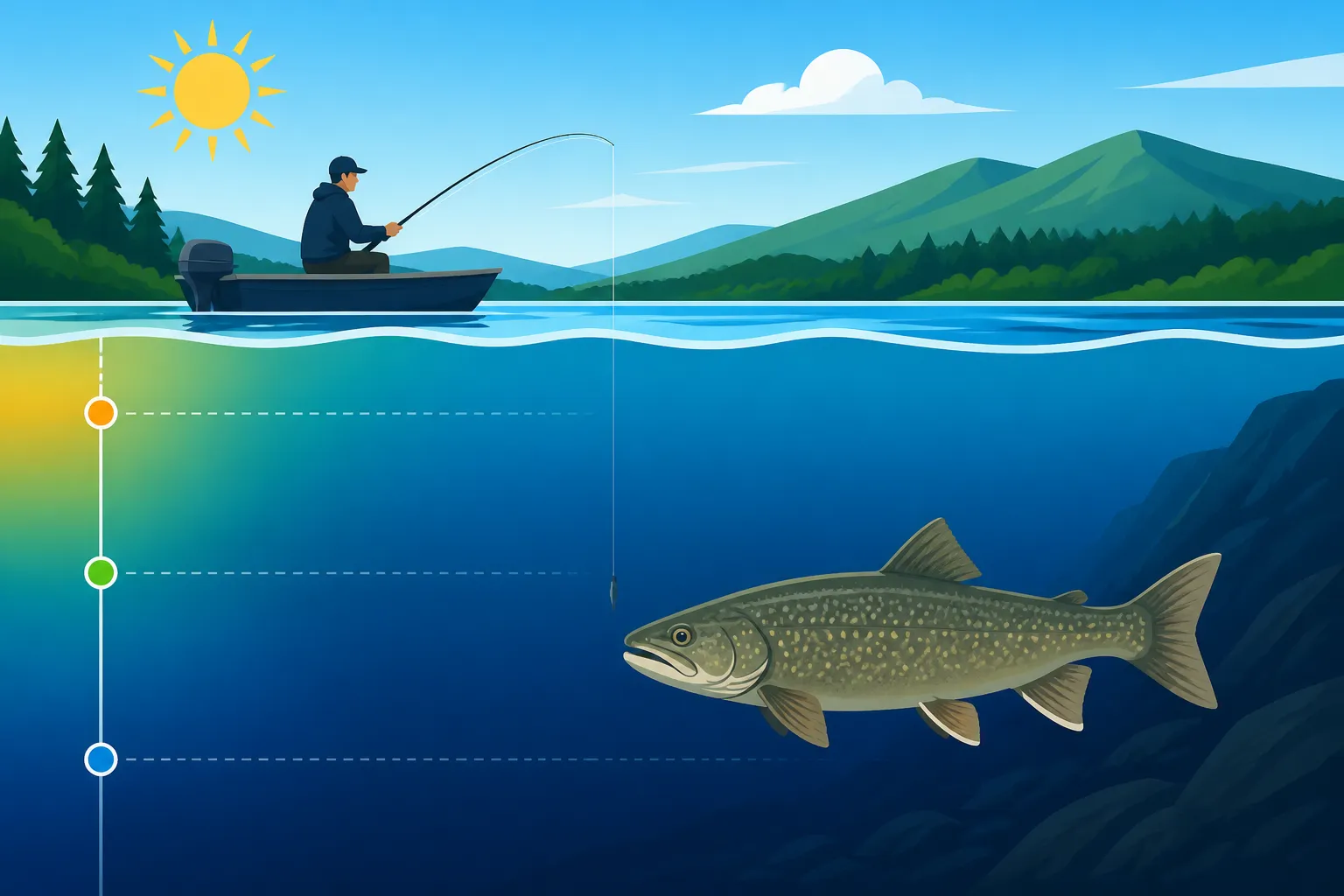
The science behind it is called thermal stratification. As a lake warms in the summer, it forms distinct layers. The top layer, called the epilimnion, is warm and exposed to the sun. Below that is the thermocline, a transition zone where the temperature drops rapidly. Finally, at the bottom, is the hypolimnion, a cold, dense layer that remains consistently cool throughout the summer. Lake trout are almost exclusively found in the hypolimnion or along the very bottom edge of the thermocline.
Their ideal water temperature generally falls within a narrow band, often between 45 and 55 degrees Fahrenheit (7 to 13 degrees Celsius). When the surface water climbs into the 60s and 70s, it's simply too warm for them to thrive, let alone actively feed. So, they descend, sometimes to incredible depths, to find that sweet spot where they are comfortable and can conserve energy. Think of it as their natural air conditioning system – they’re just moving to where the thermostat is set perfectly for them.
Oxygen Levels: A Deeper Dive
While cold water is paramount, oxygen levels are equally critical. Deep, cold water can sometimes become depleted of oxygen, especially in lakes with significant organic matter at the bottom or poor circulation. This phenomenon is known as hypoxia or anoxia. If the very deepest parts of the hypolimnion become anoxic, lake trout will be forced to move shallower, but only as far as the thermocline allows, always seeking that delicate balance of cold water and sufficient oxygen.
This means that while they want to be deep for the cold, they need enough oxygen to breathe. Anglers often refer to this as finding the "oxygenated deep water." It's not always a straight shot to the bottom; sometimes the most productive depth might be where a cold, oxygen-rich current enters the lake or near certain submerged structures that promote water circulation. Paying attention to historical data or asking local bait shops about oxygen levels in specific lakes can give you a significant advantage.
Factors Influencing Lake Trout Depth
It would be too easy if lake trout simply moved to a fixed depth in every lake during the summer. Unfortunately, a variety of factors influence their specific vertical location, making each lake a unique puzzle to solve. Understanding these variables helps you narrow down your search and more effectively target these elusive fish.
Lake-Specific Thermoclines
The depth and thickness of the thermocline, and therefore the depth of the cold water, can vary significantly from one New Hampshire lake to another. Larger, deeper, and clearer lakes like Lake Winnipesaukee or Newfound Lake will typically have a well-defined thermocline that forms deeper and holds more cold, oxygenated water throughout the summer. In these types of lakes, lake trout might comfortably reside in depths ranging from 60 to over 100 feet. You can find more specific tips for these waters in our guide on Lake Winnipesaukee Lake Trout Fishing.
Conversely, shallower lakes, or those with less clear water, might have a shallower, less stable thermocline. In such cases, the deepest available cold, oxygenated water might be more in the 30-50 foot range. It's crucial not to assume a universal depth across all bodies of water. Your best bet is to research the specific lake you're fishing, look at bathymetric (depth) maps, and ideally, use your sonar to identify the thermocline in real-time.
The Forage Connection: Where the Food Is
Lake trout are predators, and like all predators, they follow their food. In many New Hampshire lakes, their primary forage is rainbow smelt, which are also cold-water species. Smelt tend to school up in the same cold, deep water that lake trout inhabit. So, while lake trout are seeking comfort, they are also on the hunt. Finding dense schools of baitfish on your sonar is often a strong indicator that lake trout are nearby, even if you don't mark the trout directly.
If the smelt are holding at 70 feet, chances are the lake trout will be cruising slightly below, through, or just above those schools. Their feeding patterns often involve attacking from below. This dynamic relationship means that understanding baitfish behavior is almost as important as understanding the lake trout themselves. Sometimes, baitfish might move up into the thermocline for short periods, and the lake trout will follow them, so don't be afraid to adjust your depth accordingly.
Reading the Environment: Signs Above and Below
While much of deepwater fishing relies on technology, a keen eye for environmental clues can still be helpful. Strong winds that churn the surface can sometimes temporarily mix surface waters, pushing warm water deeper or creating upwellings of cold water in certain areas. Observing consistent wind patterns on a lake can help you predict where cooler water might be pushed or where baitfish might concentrate.
Below the surface, understanding structure is paramount. Lake trout, even when deep, will relate to underwater features like humps, points, ledges, and submerged islands. These structures can break up currents, provide ambush points, and aggregate baitfish. Studying your lake maps for deepwater structure before you even launch your boat can significantly reduce your search time. Our guide on How to fish deep structure for summer lake trout can give you even more insights into this critical aspect.
Gear Up for Depth: Tools and Techniques
Successfully targeting lake trout in the summer months requires specialized gear and techniques designed to get your lures down to where these fish are holding. You can't just cast a spoon from shore and expect results when they're 70 feet down. This is where modern angling technology and proven methods really shine, making what once seemed impossible, entirely achievable.
Sonar is Your Best Friend
A quality fish finder with good down-imaging and side-imaging capabilities is arguably the most critical piece of equipment for summer deepwater lake trout fishing. You need to be able to see the thermocline, mark baitfish schools, and identify lake trout holding near structure. Without it, you're essentially fishing blind in a vast underwater world. Brands like Humminbird and Garmin offer excellent units, and many highly-rated models are readily available through online retailers like Amazon.
Learn to interpret your sonar screen:
- Thermocline: It often appears as a distinct band on your screen where the density of the water changes, showing up as a horizontal line or fuzzy area. This tells you the upper limit of the cold water.
- Baitfish: Look for dense clouds or schools of small marks, usually suspended at a specific depth.
- Lake Trout: They will appear as larger, distinct arches or marks, often associated with baitfish or holding tight to structure. Sometimes they look like long, thin lines if they're directly under the transducer.
Trolling with Precision: Downriggers and Leadcore
Once you've identified the depth where lake trout are holding, you need a way to consistently present your lure at that exact depth. This is where trolling techniques like using downriggers or leadcore line come into play. Downriggers allow you to precisely control the depth of your lure using a heavy cannonball weight and a release clip. Your lure runs freely behind the boat, but at the exact depth the downrigger is set. This is incredibly effective for keeping your offering right in the strike zone. You can explore options and find detailed setup guides for these invaluable tools in Best Downriggers for Lake Trout Trolling.
Leadcore line, while less precise than a downrigger, is another excellent method for getting lures deep. This line has a lead core encased in a braided sheath, causing it to sink. The amount of line you let out, combined with your boat speed and lure type, dictates how deep your lure runs. Each color segment (often 10 yards) of leadcore line sinks a certain amount, typically around 5-7 feet, depending on speed and lure. Combining leadcore with a long fluorocarbon leader is a popular approach, allowing the lure to swim naturally. You can find robust options for Best line for lake trout deep trolling on Amazon.
Vertical Jigging: When Trolling Isn't Possible
While trolling covers a lot of water, sometimes lake trout are concentrated over a specific piece of deep structure, like a submerged hump or a deep rocky point. In these situations, vertical jigging can be incredibly effective. Once you've marked fish or structure on your sonar, you can position your boat directly over them and drop a heavy jig or spoon straight down. The key is to use enough weight to get your lure to the desired depth quickly and effectively.
Common lures for deep jigging include heavy jigging spoons, blade baits, or even large soft plastic swimbaits rigged on heavy jig heads. The action of your jig is crucial; experiment with aggressive rips, subtle lifts, and pauses to entice strikes. This technique is more about precision than covering water and can be especially rewarding when you've pinpointed a tight school of fish. Don't forget to check out our suggestions for Best Spoons for Lake Trout Trolling which can often double as effective jigging lures.
Putting It All Together: A Summer Strategy
Finding and catching deepwater lake trout in the summer isn't just about one trick; it's a combination of preparation, observation, and adaptability. By integrating all these elements into a cohesive strategy, you can significantly increase your chances of success and turn those frustrating summer days into memorable fishing adventures.
Scouting and Planning Your Trip
Before you even leave your driveway, spend some time scouting. Consult bathymetric maps of the lake you plan to fish. Identify major deepwater structures, channels, and areas where tributaries might flow in, potentially bringing cooler, oxygenated water. Look for prominent points that drop off quickly into deep water or isolated humps that could hold baitfish. Many fishing apps and online resources provide detailed contour maps that are invaluable for this type of pre-trip planning.
Consider the time of day. While lake trout are deep, early morning and late evening can sometimes be more productive, as light penetration is reduced, and baitfish might move slightly higher in the water column. However, deepwater lake trout fishing can be a productive all-day affair once you've located them, as their preferred conditions don't change much throughout the 24-hour cycle at depth.
Experimentation is Key
No matter how much planning you do, conditions on the water can change daily, even hourly. What worked yesterday might not work today. Be prepared to experiment with depths, trolling speeds, and lure colors. Start by targeting the depth you've identified on your sonar as having baitfish or the thermocline, but if you're not getting bites, don't be afraid to adjust. Try moving up or down 5-10 feet at a time. Trolling Techniques for New Hampshire Lake Trout often emphasize the importance of speed and depth variations.
Vary your trolling speed. Sometimes a slow, methodical crawl is best, while other times a slightly faster pace can trigger a reactionary strike. Use different lure types and colors until you find what the fish are keying in on. Keep notes, either mentally or in a logbook, about what worked where and when. This data can be invaluable for future trips. A well-stocked tackle box, perhaps one you've curated from quality options found on Amazon, will give you the versatility you need.
Safety First on Big Water
Fishing for lake trout often means venturing onto larger, deeper New Hampshire lakes, sometimes far from shore. It’s imperative to prioritize safety. Always check the weather forecast before heading out, as conditions can change rapidly on big bodies of water, turning a calm morning into a choppy, dangerous afternoon. Ensure your boat is in good working order, with all required safety equipment, including life jackets for everyone on board. If you're using a small craft, understand its limitations.
Even in summer, deep water can be surprisingly cold. If you or a fishing partner were to fall overboard, hypothermia can become a concern more quickly than you might think. Always let someone know your float plan – where you're going and when you expect to return. Being prepared ensures that your focus can remain on the thrilling pursuit of those elusive summer lake trout, making the experience enjoyable and safe for everyone.
| Lake Type/Season | Typical Lake Trout Depth Range (Summer) | Key Factors Influencing Depth | Recommended Gear |
|---|---|---|---|
| Deep, Clear Lakes | 60-120+ feet | Well-defined thermocline, abundant smelt, deep structure | Downriggers, heavy spoons/jigs, sensitive sonar |
| Medium-Depth Lakes | 30-70 feet | Variable thermocline, forage movement, oxygen levels | Leadcore line, deep-diving crankbaits, good sonar |
| Early Summer | Can be shallower (20-50 feet) | Warming trend beginning, fish transitioning to deeper water | Versatile trolling, some jigging over structure |
| Peak Summer Heat | Deepest consistent depths (60-100+ feet) | Strong stratification, low surface oxygen, maximum thermal refuge | Downriggers, dedicated deepwater techniques |
Disclaimer
This article is for general informational purposes only and does not constitute professional advice. Laws, prices and regulations vary by location and change over time. Consult a qualified professional for guidance on your specific situation.