Trout Species Identification Guide for New Hampshire
It's happened to every angler in New Hampshire: you're out on the water, you feel that telltale tug, and after a fantastic fight, you pull in a beautiful, shimmering fish. But then the moment of truth arrives, and you find yourself squinting, trying to figure out exactly what kind of trout you've just caught. Is it a brook trout? A rainbow? Maybe a brown? The subtle differences can be tricky, especially with vibrant coloration variations. This guide is here to cut through that confusion, helping you confidently identify the common trout species swimming in New Hampshire's pristine waters so you can appreciate your catch and follow regulations without a hitch.
Identifying Common Trout Species in New Hampshire
New Hampshire is a paradise for trout anglers, boasting several distinct species that offer unique challenges and rewards. While they all fall under the "trout" umbrella, each has its own set of characteristics that, once you know what to look for, make identification much easier. Let's dive into the specifics of each major player you're likely to encounter.
Brook Trout: New Hampshire's Native Gem
Ah, the brook trout. Often considered the most iconic and beloved trout in New Hampshire, this species isn't actually a true trout but a char, though for angling purposes, we lump them in. They are native to our cold, clear waters and finding a wild brook trout, especially in a remote mountain stream, feels like uncovering a hidden treasure. These fish are absolute stunners, and their vibrant colors are truly a sight to behold.
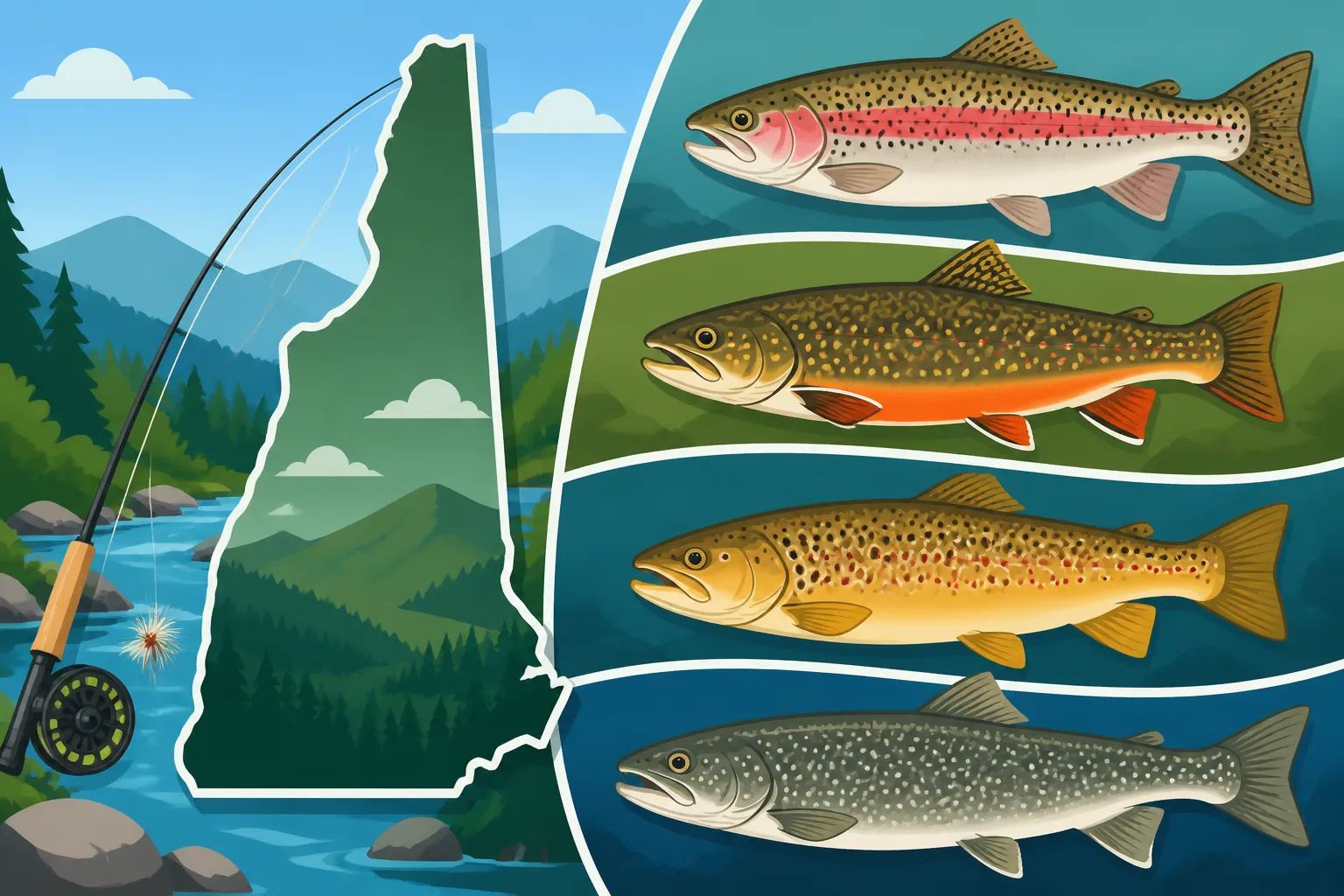
When you pull in a brook trout, you'll immediately notice its worm-like (vermiculated) patterns across its dark olive green back and head. This isn't just a scattering of spots; it's an intricate maze of markings that truly sets them apart. Along their sides, you'll see scattered light spots, often yellow or cream-colored, interspersed with striking red spots that are usually encircled by a blue halo. Their lower fins – the pectoral, pelvic, and anal fins – are a dead giveaway. They have distinctive white leading edges, often backed by black, followed by a vivid orange or reddish hue. This tri-color fin is almost like a signature. Their tail fin is typically square or slightly forked. They tend to be smaller than other trout species you'll find in New Hampshire, but what they lack in size, they make up for in beauty and fight. Many anglers pursue them specifically for their wild nature and stunning appearance, often seeking them in the smaller, colder streams that tumble down from the White Mountains. For more on these beauties, check out Brook Trout: New Hampshire's Native Trout.
Rainbow Trout: The Popular Stocker
Rainbow trout are perhaps the most widely recognized trout species, especially among those who fish stocked waters. They're not native to New Hampshire but have been extensively introduced and are a staple of the state's stocking program, providing fantastic opportunities for anglers, particularly in ponds and rivers that might not sustain wild trout populations. If you've ever fished a popular trout pond after the spring stocking, chances are you've encountered plenty of rainbows.
The defining characteristic of a rainbow trout is, as its name suggests, a prominent, iridescent pink or red stripe that runs horizontally along its side, from its gill plate back to its tail. This stripe can vary in intensity, sometimes appearing vibrant and bold, other times more subtle, depending on the fish's diet, habitat, and even its mood. Their bodies are typically silver to olive green, heavily speckled with small, distinct black spots on their back, sides, and caudal (tail) fin. These spots often extend onto the dorsal and adipose fins as well. Unlike brook trout, rainbow trout have a more deeply forked tail, which gives them incredible power and speed in the water – making for exhilarating fights when hooked. Their fins generally lack the dramatic white leading edges seen on brook trout, though they can have some lighter coloration. They often grow larger than brook trout in stocked environments, and catching a robust rainbow can be quite an experience. To understand more about where these fish come from, read up on Rainbow Trout Stocking in New Hampshire.
Brown Trout: The Elusive European
Brown trout are another non-native species, originally hailing from Europe, but they have established strong, self-sustaining populations in many of New Hampshire's rivers and lakes. They're known for their wariness and often impressive size, making them a prized catch for many seasoned anglers. If you're looking for a challenging adversary, the brown trout is often it.
Visually, brown trout can be a bit more variable in their coloration than rainbows or brook trout, which can sometimes lead to identification challenges. Their bodies typically range from golden brown to olive, fading to a creamy white or yellowish belly. They are characterized by numerous dark spots on their back and sides, which often have a pale halo around them. Crucially, many brown trout also have scattered red or orange spots, some of which may also be haloed, particularly along their lateral line. What helps distinguish them from brook trout is the absence of the vermiculated pattern on the back and the lack of those distinct white leading edges on their lower fins. Their tail is usually square or only slightly forked, and it often has very few or no spots, which can be a key identifier. Brown trout can grow quite large in New Hampshire, especially in fertile rivers and lakes, and they are known for being voracious predators. For insights into their behavior, check out Brown Trout Habits in New Hampshire Streams.
Lake Trout: The Deep Water Predator
Lake trout are a fascinating species, and like brook trout, they are technically a char, not a true trout. They are native to some of New Hampshire's deepest, coldest lakes and are revered for their large size and deep-water fighting prowess. If you're targeting truly big fish, lake trout are often the answer, but you'll need specialized gear and techniques to reach them.
Identifying a lake trout is usually fairly straightforward due to their distinctive body shape and coloration. They typically have a long, slender body with a large head and a deeply forked tail, much more pronounced than any other trout species in New Hampshire. Their coloration tends to be darker, often a dark green, grey, or brownish hue on their back, fading to a lighter belly. Their entire body, including their dorsal, adipose, and tail fins, is covered in numerous irregular, light-colored spots that are typically smaller than the spots on a brown trout and lack the distinct halos. These spots are a key feature – they look like small, scattered specks across a darker canvas. Lake trout also have a much larger mouth than brook or rainbow trout, often extending past the eye, which is indicative of their predatory nature. These fish are true coldwater dwellers, seeking out the deepest parts of lakes, especially in warmer months. Catching a lake trout, especially a large one, is an unforgettable experience, and learning the specific techniques can greatly enhance your success. You can dive deeper into this topic with Lake Trout Fishing in New Hampshire.
Key Distinguishing Features for Trout Identification
While the general descriptions above are helpful, sometimes it comes down to a few critical details when you have a fish in hand. Think of it like a detective looking for clues; each spot, fin, and curve tells a story. Knowing these key features will solidify your identification skills and make you a more informed angler.
Spot Patterns and Coloration
This is often the first thing people notice, and for good reason! The arrangement, color, and shape of spots are paramount in trout identification.
Brook trout, as we discussed, are all about the vermiculations – those wavy, worm-like markings on their back and dorsal fin. They also have colorful red spots with blue halos on their sides. If you see wormy patterns and blue halos, you've likely got a brook trout. Rainbow trout, on the other hand, are characterized by a distinct pink or red lateral stripe and uniform black spots covering their body and tail fin. These spots are usually solid black and lack any halos. Think "rainbow stripe" and "peppered with black." Brown trout present a mix, with dark spots often surrounded by a pale halo, and some red or orange spots, also with or without halos, but importantly, no vermiculations on their back. Their tail is often spotless or has very few spots, which contrasts sharply with a rainbow's spotted tail. Lake trout are covered in numerous small, irregular light-colored spots over a darker background, including their deeply forked tail. It's more of a speckled appearance than distinct, round spots. Remember, colors can vary, but the pattern of spots is usually consistent.
Fin Characteristics and Shape
Don't overlook the fins! They provide incredibly reliable clues, especially the tail fin and the lower fins.
The tail fin is a major differentiator. Brook trout usually have a square or slightly forked tail. Rainbow trout typically have a more moderately forked tail, and it's often covered in spots. Brown trout usually have a square or slightly emarginate (shallowly notched) tail that is often unspotted or has very few spots. Lake trout are the champions of the deeply forked tail – this is perhaps their most defining fin characteristic, almost like a V-shape.
Now, look at the lower fins (pectoral, pelvic, and anal). Brook trout have those incredible white leading edges, often followed by a black stripe and then an orange-red color. This three-color pattern is unique to them. Rainbow and brown trout typically have less distinctive lower fins, lacking these prominent white edges, though they can be lighter in color. Paying attention to these fin details can save you from misidentification, especially if the body coloration is ambiguous.
Body Shape and Mouth Structure
While not as immediately obvious as spots, the overall body profile and the mouth can offer supporting evidence for your identification.
Brook trout tend to have a more robust, torpedo-shaped body when healthy, and a relatively small mouth that doesn't extend much past the eye. Rainbow trout are often sleek and streamlined, built for speed, with a mouth that typically ends around the back of the eye. Brown trout can have a more stocky, powerful build, especially larger specimens, and their mouth often extends slightly beyond the back of the eye, indicating their predatory nature. Lake trout, true to their predatory habits, have the most elongated body and a very large mouth, which typically extends well beyond the eye. Their deeply forked tail also contributes to their overall streamlined, deep-water profile. Observing these characteristics can help confirm what you suspect based on spots and fins. Don't be afraid to gently examine the fish (always with wet hands!) to get a good look at these features before releasing it. A good waterproof field guide, perhaps one you picked up on Amazon, can be an invaluable tool to keep in your tackle box for quick reference.
Where to Find Each Trout Species in New Hampshire
Knowing what trout species look like is one thing, but knowing where they generally hang out in New Hampshire's diverse aquatic environments is another. Each species has its preferred habitat, dictated by factors like water temperature, oxygen levels, and available forage. Understanding these preferences can greatly improve your chances of targeting specific species.
Brook Trout Habitats
Brook trout are the quintessential residents of New Hampshire's colder, higher-elevation waters. They thrive in small, clear, cold headwater streams, mountain brooks, and spring-fed ponds. These pristine environments offer the high oxygen levels and stable cold temperatures they absolutely need to survive and reproduce. You're less likely to find robust wild brook trout populations in large, warm rivers or lakes, although they might persist in the cold tributaries feeding into them.
They prefer streams with plenty of cover: undercut banks, submerged logs, boulders, and overhanging vegetation that provide refuge from predators and strong currents. Anglers often hike into more remote areas, sometimes bushwhacking through dense forest, to find these wild populations. The reward is often catching brightly colored, feisty brook trout in some of the state's most scenic and untouched natural settings. In many parts of the White Mountains, almost any small, cold stream you encounter could hold brook trout. You can learn more about where these fish thrive by looking at Where brook trout still live wild in New Hampshire.
Rainbow Trout Stocked Waters
Because rainbow trout are so adaptable and grow relatively quickly, they are the backbone of New Hampshire's put-and-take fisheries. You'll find them predominantly in stocked lakes, ponds, and rivers throughout the state. These are often waters that are easily accessible to the public, designed to provide consistent angling opportunities. After the initial spring stocking, they disperse, but many linger in areas where food is plentiful and water conditions are favorable.
While they prefer cooler water, they can tolerate a wider range of temperatures than brook trout, making them suitable for a broader array of New Hampshire's waterways. They are a popular target for family outings and beginner anglers due to their willingness to bite and the sheer number introduced into these waters. Look for them in areas like Long Pond, Webster Lake, or sections of the Pemigewasset River that receive stockings. Checking the New Hampshire Fish and Game stocking reports is your best bet for finding recently stocked rainbow trout. For a complete picture of where these fish are released, consult the New Hampshire Trout Stocking Report and Map.
Brown Trout in Rivers and Lakes
Brown trout are a bit more versatile than brook trout when it comes to habitat, often thriving in medium to large rivers and larger, cooler lakes. They are particularly well-suited to waters that have a good mix of riffles, runs, and deep pools, as well as plenty of structure like boulders, submerged logs, and undercut banks for ambush points. While they appreciate cold water, they can tolerate slightly warmer conditions than brook trout, which allows them to colonize a wider range of New Hampshire's river systems.
You'll often find them alongside rainbows in some of the larger, slower sections of rivers like the Merrimack or the Connecticut, where they can grow to impressive sizes by preying on smaller fish and insects. In lakes, they'll often hold in deeper sections, especially during warmer months, but will move shallower during dawn, dusk, or overcast days to feed. They're known for being opportunistic feeders, and large brown trout often become piscivorous, meaning they eat other fish. This quest for larger meals means they often patrol different parts of the water column than smaller trout.
Lake Trout's Coldwater Domain
If you're targeting lake trout, you need to think deep and cold. These fish are true specialists, inhabiting the deep, cold, well-oxygenated waters of New Hampshire's largest and deepest lakes. Lakes like Winnipesaukee, Squam Lake, and Sunapee Lake are prime lake trout territory. They require specific thermal refuges during the summer months when surface waters warm up, often retreating to depths of 50 feet or more where temperatures remain consistently low.
In these deepwater environments, lake trout are apex predators, preying on other fish like rainbow smelt. This dependence on cold, oxygen-rich water means they are confined to a relatively small number of glacial lakes in the state. Anglers targeting lake trout often use specialized techniques like downrigging or deep jigging to reach these fish at their preferred depths. During spring and fall, especially after ice-out or before ice-up, they may move shallower as the entire water column cools down, making them more accessible to shore or shallower boat fishing. Understanding the specific regulations for these unique fish is paramount, so always check the local guide. You can find more information about these deepwater inhabitants in Lake Trout Fishing in New Hampshire.
Why Accurate Identification Matters
Beyond the simple satisfaction of knowing what you've caught, accurate trout identification is incredibly important for several practical and ethical reasons. It's not just about bragging rights; it's about being a responsible and effective angler.
Adhering to Regulations
This is perhaps the most critical reason for correct identification. New Hampshire Fish and Game has specific regulations for different trout species, which can include varying:
- Daily bag limits: How many fish of a particular species you can keep in a single day.
- Possession limits: How many fish of a particular species you can have in your possession at any given time.
- Minimum or maximum length limits: Some species may have a slot limit, where fish between certain sizes must be released, or a minimum size for harvest.
- Season dates: When it's legal to fish for and keep certain species.
Misidentifying a fish could lead to inadvertently violating these regulations. For example, if you mistake a small wild brook trout for a stocked rainbow, you might keep a fish that is under a specific length limit or from a special regulation stream where brook trout are catch-and-release only. This isn't just a minor oversight; it can result in fines and other penalties. Imagine catching a prized fish only to realize later that you weren't allowed to keep it because you misidentified it – it's a frustrating scenario that's easily avoided with a little knowledge. Always consult the most current New Hampshire Freshwater Fishing Digest, available from the NH Fish and Game Department or online. You can learn more about specific rules in New Hampshire Bag and Possession Limits by Species.
Understanding Fish Behavior and Habitat
Accurate identification allows you to build a deeper understanding of the fishery you're engaging with. Each trout species has unique behaviors, dietary preferences, and habitat requirements.
- If you consistently catch brook trout in a particular stream, it tells you that the water is likely very cold, clean, and well-oxygenated, indicative of a healthy, pristine environment. You'd then know that using smaller, more natural baits or flies might be effective, as these fish often feed on native insects.
- Conversely, if you're pulling in mostly rainbow trout, you might be fishing a recently stocked pond, where techniques like PowerBait or lures that imitate hatchery pellets could be more effective.
- If you find large brown trout, it suggests a more robust food chain, possibly including smaller baitfish, and you might switch to larger lures or streamers.
Knowing what you're catching helps you learn about the ecosystem and refine your fishing strategies for future success. This deeper understanding enhances the entire angling experience.
Conservation Efforts and Data Collection
Every angler can contribute to conservation efforts, and accurate fish identification plays a small but significant role. When you report your catches (if required for specific programs or studies) or simply share your observations with fellow anglers or local conservation groups, that information is more valuable if it's precise.
Fish and Game biologists rely on accurate data to manage populations effectively, decide where to stock, and identify potential problems. If anglers are consistently misidentifying species, it skews the data, making it harder to track population trends or evaluate stocking success. For example, if anglers mistake a rare, naturally reproducing native trout for a more common stocked species, it could lead to misallocations of resources or missed opportunities for protection. Even if you're just releasing fish, knowing what you've caught allows you to properly log it in your mental fishing journal, contributing to your own understanding of fish distribution and health across New Hampshire's waters. It's about being part of the bigger picture of sustainable fishing.
Tips for On-the-Water Identification
When you've got a lively fish in your hands, sometimes all the book knowledge can go right out the window! But with a few simple tricks and resources, you can quickly and confidently identify your catch right there on the stream bank or boat.
A Quick Checklist for Anglers
Having a mental (or even physical) checklist can be super helpful when that fish is flopping around. Here’s a streamlined process:
- Observe the Tail: Is it deeply forked (likely lake trout), moderately forked and spotted (rainbow), square/slightly forked and spotless (brown), or square/slightly forked (brook trout)? This is often the fastest indicator.
- Check the Back/Head Pattern: Are there distinct worm-like markings (vermiculations)? If yes, it’s a brook trout. If no, move on.
- Look for a Lateral Stripe: Is there a prominent pink/red stripe down the side? That’s your rainbow.
- Examine Spotting: Are the spots dark with light halos (brown)? Are they small, light, and irregular all over the body, including the tail (lake trout)? Are they red with blue halos (brook)? Or are they purely black and widespread (rainbow)?
- Fin Edges: Do the lower fins have distinct white leading edges? If so, brook trout.
- Mouth Size: Does the mouth extend well past the eye (lake trout) or just to the eye (rainbow, brook, brown)?
Running through these steps quickly can narrow down the possibilities significantly. Take a moment, even if it’s exciting, to really observe before you decide to keep or release. A second look can prevent a costly mistake.
Using Resources and Tools
You don't have to rely solely on your memory. There are fantastic tools available to aid in on-the-water identification.
- Waterproof Field Guides: This is a no-brainer. Purchase a compact, waterproof field guide specifically for freshwater fish of the Northeast or New Hampshire. Keep it in your tackle box or fishing vest. When in doubt, quickly flip to the trout section and compare your catch to the illustrations and descriptions. Many anglers find these indispensable, and you can find a great selection of them on Amazon.
- Smartphone Apps: There are numerous fish identification apps available that can help. While not always 100% accurate, they can provide a good starting point, sometimes even using image recognition (though be careful with these and always double-check).
- The New Hampshire Freshwater Fishing Digest: Always have a copy, either physical or digital, of the current fishing regulations. It often contains illustrations and descriptions of common species, along with all the legal requirements. Reading the New Hampshire Freshwater Fishing Digest is crucial before you head out.
- Camera: Take a clear photo of your catch before release. If you're still unsure after consulting your guide, you can review the photo later or share it with an experienced angler or the NH Fish and Game Department for confirmation. Just be sure to handle the fish gently and return it to the water quickly, especially if it's catch-and-release. A good quality, lightweight net can help keep the fish calm and contained while you snap a picture or consult your guide. Many excellent nets are available, and you might even find one that clips to your pack easily on Amazon.
By combining careful observation with readily available resources, you'll soon become a pro at identifying New Hampshire's diverse and beautiful trout species, enhancing your fishing experience and ensuring you're a responsible steward of our waters.
| Feature | Brook Trout | Rainbow Trout | Brown Trout | Lake Trout |
|---|---|---|---|---|
| Back/Head | Dark, worm-like (vermiculated) patterns | Olive/silver, black spots | Golden/olive, dark spots | Dark green/grey, light spots |
| Side Spotting | Yellow/cream spots, red spots with blue halos | Numerous black spots, pink/red lateral stripe | Dark spots with pale halos, some red/orange spots | Numerous small, irregular light spots |
| Lower Fins | White leading edge, then black, then orange/red | Generally plain | Generally plain | Generally plain |
| Tail Fin | Square or slightly forked | Moderately forked, spotted | Square or slightly emarginate, often unspotted | Deeply forked, light spots |
| Mouth Size | Small, usually to eye | Medium, usually to back of eye | Medium/large, slightly past eye | Large, well past eye |
| Typical Habitat | Cold, clear headwater streams, spring-fed ponds | Stocked lakes, ponds, rivers | Larger, cooler rivers and lakes | Deep, cold, oxygenated lakes |
Disclaimer
This article is for general informational purposes only and does not constitute professional advice. Laws, prices and regulations vary by location and change over time. Consult a qualified professional for guidance on your specific situation.