New Hampshire required boat safety equipment checklist
Navigating New Hampshire's beautiful lakes and rivers is a quintessential part of the angling experience, but the joy of a peaceful morning on the water can quickly turn stressful if you're not prepared. Many anglers feel overwhelmed by the sheer volume of rules and regulations, especially when it comes to boat safety equipment. It’s frustrating to try and piece together what you truly need versus what’s just a good idea, not to mention the worry of facing a fine. This comprehensive guide is here to untangle the complexities, providing a clear, item-by-item checklist of the essential safety gear required by New Hampshire law, ensuring your next outing is both compliant and stress-free.
Understanding New Hampshire's Boating Safety Mandates
When you head out onto New Hampshire's sparkling waters, whether it’s the vast expanse of Lake Winnipesaukee or a quiet pond tucked away in the White Mountains, you’re not just responsible for your fishing gear and a good time; you're also responsible for the safety of everyone on board and around you. New Hampshire boating laws are designed to align closely with federal U.S. Coast Guard (USCG) regulations, which means many of the requirements are standard across the country. However, there are nuances and specific items you absolutely must have on board, depending on the type and size of your vessel. Failing to carry the correct safety equipment isn't just a minor oversight; it can lead to hefty fines and, more importantly, put lives at risk in an emergency. It's about being prepared, not just compliant.
The New Hampshire Fish and Game Department is the primary agency responsible for enforcing these regulations. Their conservation officers regularly patrol the state’s waterways, ensuring that boaters are adhering to the safety standards. Ignorance of the law is never an excuse, so understanding these requirements before you even launch your boat is paramount. This foundational knowledge is crucial for every angler, from the seasoned veteran to someone just starting out, making sure that your focus can remain on the bite rather than stressing about what's missing from your boat.
Personal Flotation Devices (PFDs)
Perhaps the most critical piece of safety equipment, Personal Flotation Devices, or PFDs, commonly known as life jackets, are non-negotiable in New Hampshire. The law is quite clear: you must have at least one properly sized, USCG-approved wearable PFD for every person on board your vessel, including yourself. This isn't just for passengers; the operator needs one too.
There are different types of PFDs, categorized by their intended use and flotation capability. Type I (Off-Shore) PFDs offer the most buoyancy and are designed for rough, open water where rescue might be delayed. Type II (Near-Shore) PFDs are good for calm, inland waters. Type III (Flotation Aid) PFDs are comfortable for continuous wear and are popular for fishing and watersports, provided you're on calm waters and rescue is likely to be prompt. Then there are Type V PFDs, which are special-use devices, like those built into fishing vests or deck suits, but they must be approved for the activity and worn to count as a PFD. Inflatable PFDs, often favored for their low profile and comfort, are typically Type V and must be worn to be considered readily accessible. For anyone under the age of 13, the rules are even stricter: they are required to wear a USCG-approved PFD at all times while underway on any vessel, unless they are in an enclosed cabin. This particular rule is a vital one to remember, as explained in more detail in our guide on Life Jacket Requirements for New Hampshire Boaters. Always check that your PFDs are in good, serviceable condition, free from rips, tears, or excessive sun damage, as a compromised PFD is no PFD at all. You can find a wide range of USCG-approved PFDs for various activities and sizes on platforms like Amazon.
Throwable Flotation Devices
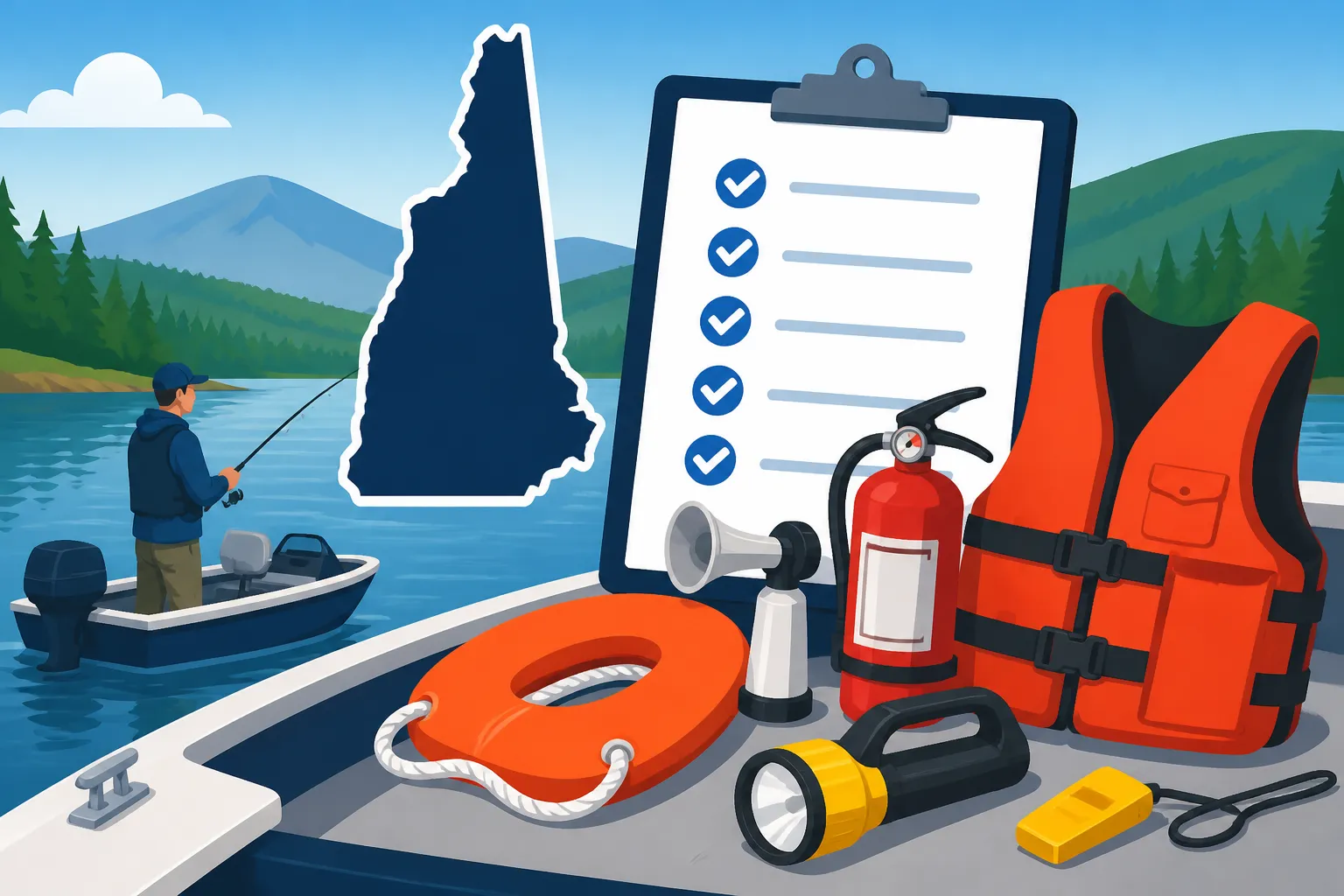
In addition to wearable PFDs, any vessel 16 feet or longer (excluding canoes and kayaks) is required to have at least one USCG-approved throwable flotation device on board. This usually means a ring buoy, a seat cushion, or a horseshoe buoy. The key here is "throwable" – it's meant to be tossed to someone in the water, not worn.
The purpose of a throwable device is to provide immediate assistance to someone who has fallen overboard, giving them something to hold onto while you maneuver your boat for rescue. It's a critical piece of equipment that buys precious time. This device must be immediately accessible, meaning it can't be stowed away in a locker under a pile of gear. Imagine the urgency if someone goes overboard; you need to be able to grab that cushion and throw it in seconds. Make sure it's kept in good condition, just like your wearable PFDs, so it doesn't fall apart when you need it most.
Sound-Producing Devices
Every vessel operating on New Hampshire waters must carry a sound-producing device. For boats under 39.4 feet (12 meters), this can be as simple as a horn, whistle, or bell, provided it can produce an efficient sound signal audible for at least one-half nautical mile. For larger vessels, a whistle and a bell are specifically required.
These devices are crucial for signaling intentions, warning other boaters, or alerting others to an emergency, especially in low visibility conditions like fog or heavy rain, or when approaching blind turns on a river. Understanding the proper whistle signals – like one short blast for "passing port to port" or five short blasts for "danger" – is part of responsible boating. Even a small kayak should have a marine whistle clipped to its PFD for quick access. It’s not just about meeting a requirement; it’s about having a vital communication tool that can prevent collisions and call for help.
Visual Distress Signals (VDS)
For vessels operating on coastal waters or the Great Lakes (which New Hampshire does not have, but does have tidal waters like Great Bay), visual distress signals (VDS) are required. Since most New Hampshire recreational boating happens on inland freshwater lakes and rivers, the requirement for VDS is generally limited to those operating on federally controlled waters such as tidal rivers and coastal areas. If you're fishing the Piscataqua River or exploring Great Bay, you absolutely need these.
USCG-approved VDS come in various forms, including pyrotechnic (flares) and non-pyrotechnic (flags, electric lights). Pyrotechnic VDS are effective day or night but have expiration dates and must be replaced regularly. Non-pyrotechnic VDS, like an orange signal flag for daytime use or an electric distress light for nighttime, are non-expiring alternatives. Ensure whatever VDS you carry is USCG-approved, in serviceable condition, and easily accessible. Again, this isn't about arbitrary rules; it's about making sure that if you find yourself in trouble, you can be seen and rescued, particularly vital in the context of Great Bay Striped Bass Fishing Rules.
Fire Extinguishers
Fire is a terrifying prospect on any boat, especially one loaded with fuel and electrical systems. That's why fire extinguishers are a mandatory safety item for many vessels in New Hampshire. The requirement hinges on the type and size of your boat and whether it has certain features. Generally, a fire extinguisher is required if your boat is equipped with any of the following:
- Inboard engines: Any vessel with an enclosed engine compartment.
- Closed compartments: Spaces where flammable or explosive vapors can accumulate, such as under permanent decks or closed storage areas.
- Double bottoms: Spaces not sealed to the hull or that are not completely filled with flotation materials.
- Closed living spaces: Cabins or sleeping berths.
- Fixed fuel tanks: Any permanent fuel tanks.
If your vessel meets any of these criteria, you'll need at least one USCG-approved B-I type fire extinguisher. Larger vessels may require multiple or larger extinguishers. For example, a 26-foot boat with an inboard engine would need at least one B-I type. Always ensure your extinguisher is fully charged, easily accessible, and within its expiration date. A quick check of the gauge on your extinguisher before each outing could literally save your boat and your life. Many marine-grade fire extinguishers can be found on Amazon.
Ventilation and Backfire Flame Arrestors
These are often overlooked but critically important safety components, primarily for boats with inboard gasoline engines. Proper ventilation in engine compartments is essential to prevent the accumulation of explosive gasoline fumes. Boats built after 1980 with gasoline engines are required to have a powered ventilation system (a blower) that purges fumes before starting the engine, in addition to natural ventilation. Older boats might have different requirements, but the principle remains: keep those fumes out.
A backfire flame arrestor is another vital safety device found on gasoline engines that are not entirely enclosed. It's designed to prevent flames from a backfiring engine from igniting fuel vapors in the engine compartment. This small, often metallic screen device fits over the carburetor or air intake. It must be USCG-approved and kept clean and in good working order. These are typically factory-installed components, but if you're buying a used boat or performing engine maintenance, it’s critical to ensure they are present and functional. Neglecting these safety features is like playing with fire, quite literally.
Vessel-Specific Safety Gear Requirements
While the general safety items apply broadly, certain types and sizes of vessels have additional, specific requirements in New Hampshire. It's not a one-size-fits-all approach, and understanding these distinctions is key to full compliance and, more importantly, enhanced safety.
Small Watercraft: Kayaks, Canoes, and Paddleboards
For those who prefer human-powered vessels like kayaks, canoes, and stand-up paddleboards, the safety requirements are generally simpler but no less crucial. You still need one USCG-approved wearable PFD for each person on board, and children under 13 must wear theirs.
Additionally, if you're operating these small craft after sunset or before sunrise, or in conditions of restricted visibility, you are required to display a white light visible 360 degrees around. This can be a handheld flashlight or lantern, or a mounted all-around white light. The idea is to make sure you're visible to larger vessels that might not see a small, dark object on the water. While a sound-producing device isn't always explicitly mandated for these smallest vessels, it’s highly recommended to carry a whistle. Imagine trying to warn a speeding motorboat about your presence without one! These simple additions significantly increase your safety margin on the water.
Motorboats 16 Feet to 26 Feet
This category covers a vast number of recreational fishing boats in New Hampshire, from modest aluminum skiffs to larger center consoles. Beyond the general requirements already discussed, these boats will almost certainly need a throwable flotation device and a fire extinguisher.
The specifics of the fire extinguisher depend on whether the boat has a fixed fire extinguishing system in the engine compartment. If it does, you might only need one B-I type portable extinguisher. If not, you might need two B-I types or one B-II type. It's a nuance worth checking directly with the New Hampshire Fish and Game regulations or your local marine dealer. Visibility lights are also essential. If you're operating between sunset and sunrise, or during periods of restricted visibility, your boat must display specific navigation lights: a white all-around stern light, and separate or combined red and green sidelights at the bow. These lights help other vessels understand your direction of travel and avoid collisions. Properly working navigation lights are non-negotiable for night fishing or early morning launches.
Boats Over 26 Feet
As vessels get larger, the safety equipment requirements become more extensive, reflecting the increased complexity and potential for more serious incidents. For boats over 26 feet, the fire extinguisher requirements typically increase, potentially demanding more B-I types or larger B-II extinguishers.
Sound-producing devices also become more specific, often requiring both a whistle and a bell. While not explicitly mandated for all recreational boats, larger vessels might also consider carrying additional communications equipment, like a VHF marine radio, especially if venturing into parts of Lake Winnipesaukee or other large bodies of water where cell service can be spotty. The navigation light requirements are also more stringent, often involving masthead lights in addition to sidelights and stern lights, ensuring maximum visibility for other traffic. Additionally, larger vessels often carry marine sanitation devices (MSDs), and these must comply with specific waste discharge regulations, an important consideration for environmental protection.
Here’s a quick summary table of common requirements:
| Item | <16 ft (e.g., Kayak, Canoe) | 16 ft to <26 ft (e.g., Bass Boat) | 26 ft to <40 ft (e.g., Cruiser) | Notes |
|---|---|---|---|---|
| Wearable PFDs | 1 per person | 1 per person | 1 per person | Children <13 must wear PFD while underway. USCG-approved. |
| Throwable PFD | Not required | 1 | 1 | Immediately accessible. USCG-approved. |
| Sound Device | Whistle/horn (rec.) | Whistle/horn | Whistle and Bell | Must be audible for ½ nm. |
| Visual Distress S. (VDS) | Not required (Inland) | Required (Coastal/Tidal) | Required (Coastal/Tidal) | Pyrotechnic (flares) or non-pyrotechnic (flag/light). Check expiration dates for flares. |
| Fire Extinguisher | Not required | 1 B-I or 2 B-I/1 B-II* | 1 B-II or 2 B-I/1 B-III* | *Depends on boat features (inboard engine, closed compartments, etc.). USCG-approved. |
| Navigation Lights | White light (if night) | Red/Green sidelights, White stern | Red/Green, Masthead, White stern | Required from sunset to sunrise and in restricted visibility. |
| Ventilation | Not applicable | Required (gasoline engines) | Required (gasoline engines) | For enclosed gasoline engine compartments. |
| Backfire Arrestor | Not applicable | Required (gasoline engines) | Required (gasoline engines) | For non-enclosed gasoline engines. |
Note: Fire extinguisher requirements vary based on vessel size and presence of fixed fire extinguishing systems. Always consult the latest NH Fish and Game regulations for precise details.
Beyond the Checklist: Smart Boating Practices in New Hampshire
While adhering to the mandatory equipment list is essential for legal compliance and basic safety, true preparedness goes beyond simply checking boxes. Responsible anglers understand that the unpredictable nature of New Hampshire's weather and waterways often calls for extra precautions and additional gear.
Communications and Navigation Aids
Even on familiar waters like Lake Winnipesaukee, having a reliable way to communicate in an emergency is critical. While a cell phone is often your first thought, service can be spotty in many remote areas or deep coves. A waterproof, fully charged cell phone is a good start, but consider a VHF marine radio for boats large enough to carry one, especially if you venture far from shore or into the tidal waters of the coast. These radios provide direct communication with other vessels and emergency services. For navigation, always carry physical charts of the waters you're fishing, even if you rely heavily on electronic GPS on your fish finder. Batteries die, and electronics fail, but a paper chart never does. Knowing how to read it is a skill every boater should possess. You might also find a compass helpful as a backup.
Emergency Gear and Tools
Think about what you'd need if something went wrong: a small toolkit with basic items like screwdrivers, pliers, duct tape, and spare parts (like fuses) can fix minor issues that might otherwise strand you. A first-aid kit, well-stocked with bandages, antiseptic wipes, pain relievers, and any personal medications, is a non-negotiable item for any outing. It's not just about cuts and scrapes; you might need it for a severe allergic reaction or sudden illness.
Beyond that, consider a spare anchor, particularly if you're in an area with strong currents or high winds. A reliable flashlight or headlamp (with extra batteries) is indispensable if you're on the water after dark or have to troubleshoot an issue in a dark compartment. A small bilge pump (manual or electric) can save you if you start taking on water, and extra dock lines or mooring lines are always handy. For those enjoying Ice Fishing in New Hampshire, different safety gear like ice picks, throw ropes, and a spud bar are paramount.
Weather Preparedness and Float Plans
New Hampshire weather can change rapidly, especially in the mountains or on large lakes. Always check the forecast before you head out, and continue to monitor weather apps or marine radio updates while you're on the water. Carry extra layers of clothing, even on a sunny day, as temperatures can drop quickly, and getting wet can lead to hypothermia. A waterproof bag for your electronics and dry clothes is a smart investment.
Finally, and perhaps most importantly, tell someone where you're going and when you expect to return. This is called a "float plan." It doesn't have to be official; a simple text to a friend or family member outlining your launch point, intended fishing spots, and estimated return time is enough. If you don't check in by your agreed-upon time, they know who to call and where to send help. This simple act is one of the most effective safety measures you can take, ensuring that if you encounter an unforeseen problem, someone will know you're missing and can initiate a search.
Remember, responsible boating isn't just about avoiding a ticket; it's about making sure every trip ends safely and enjoyably. Equipping your boat properly is the first step, but a proactive mindset towards safety is what truly protects you and your loved ones on the beautiful waters of the Granite State.
Disclaimer
The information provided in this guide is intended for informational purposes only and serves as a general overview of New Hampshire boating safety equipment requirements. Regulations can change, and specific circumstances for your vessel may dictate additional or different requirements. It is always the boater's responsibility to consult the most current New Hampshire Fish and Game Department regulations, as well as federal U.S. Coast Guard regulations, before operating any vessel. Failure to comply with these laws can result in fines and legal penalties. This guide does not constitute legal advice.