Sunapee Lake best trolling spots for salmon
Fishing for landlocked salmon on Sunapee Lake can feel like searching for a needle in a colossal, deep haystack. This majestic body of water holds some truly magnificent fish, but their elusive nature and the sheer size of the lake can be incredibly daunting for even experienced anglers. If you've spent hours fruitlessly trolling, staring at a blank sonar screen, or just wishing you knew where to start, you're not alone. This comprehensive guide is here to unravel the mysteries of Sunapee's landlocked salmon, focusing specifically on the best trolling spots and techniques to help you put more of these silver beauties in your net.
Understanding Landlocked Salmon Behavior on Sunapee Lake
Before we dive into specific locations, it's absolutely crucial to understand the very nature of landlocked salmon, especially how they behave in a large, deep, oligotrophic lake like Sunapee. These aren't your typical pond fish; they are apex predators, constantly on the move, and their existence revolves almost entirely around two things: cold water and their primary food source, the rainbow smelt. Without grasping these fundamentals, even the best spot in the world might not yield results.
Seasonal Movements and Forage
Landlocked salmon are inherently nomadic, driven by the changing seasons and the migration patterns of their prey. In the spring, shortly after ice-out, they'll often be found cruising closer to the surface and along the shorelines as the entire lake is cold and rich with oxygen. This is when smelt, too, are often shallower, sometimes even moving into tributary mouths to spawn. As summer progresses and the surface waters warm, the salmon retreat to the cooler, deeper parts of the lake, specifically seeking out the thermocline—that distinct layer where warm surface water meets cold, deep water. This thermal refuge is also where the smelt tend to congregate, creating a perfect hunting ground for salmon.
Come fall, as the lake's surface temperatures cool again and the water "turns over," salmon can once more be found in a wider range of depths. This is a particularly exciting time as they become very active, feeding heavily in preparation for winter and their own spawning rituals. Understanding this annual dance with the thermocline and the smelt is your first and most important tool for locating them. If you’re not sure about the exact timing of these movements, consulting resources like the New Hampshire Fish and Game Department's annual reports or even a local guide through platforms like FishingBooker can provide invaluable real-time insights.
Preferred Depths and Water Temperatures
As mentioned, salmon are cold-water fish. They thrive in water temperatures generally ranging from the low 40s to the low 60s Fahrenheit, with their optimal feeding zone often being right around 50-55°F. On Sunapee, this means they're heavily influenced by the thermocline during the warmer months. Your sonar isn't just for showing you fish; it's also a powerful tool for finding the thermocline, which will appear as a distinct band of fluctuating temperature or even a fuzzy layer on your screen due to dense plankton or baitfish.
In spring, you might find salmon anywhere from the surface down to 20-30 feet. As summer peaks, they could be holding anywhere from 30 to 80 feet, often suspending over even deeper water. They rarely stick right to the bottom unless it’s a deep structure with adjacent cold water. Instead, they'll patrol the mid-water column, where oxygen levels are good and baitfish are plentiful. This is why knowing how to properly set your trolling depth is crucial, whether you're using lead core line or advanced downrigger systems. Checking the New Hampshire fishing season dates and closures can also help you understand when certain fishing patterns might be more prevalent for landlocked salmon.
Prime Trolling Locations on Sunapee Lake for Salmon
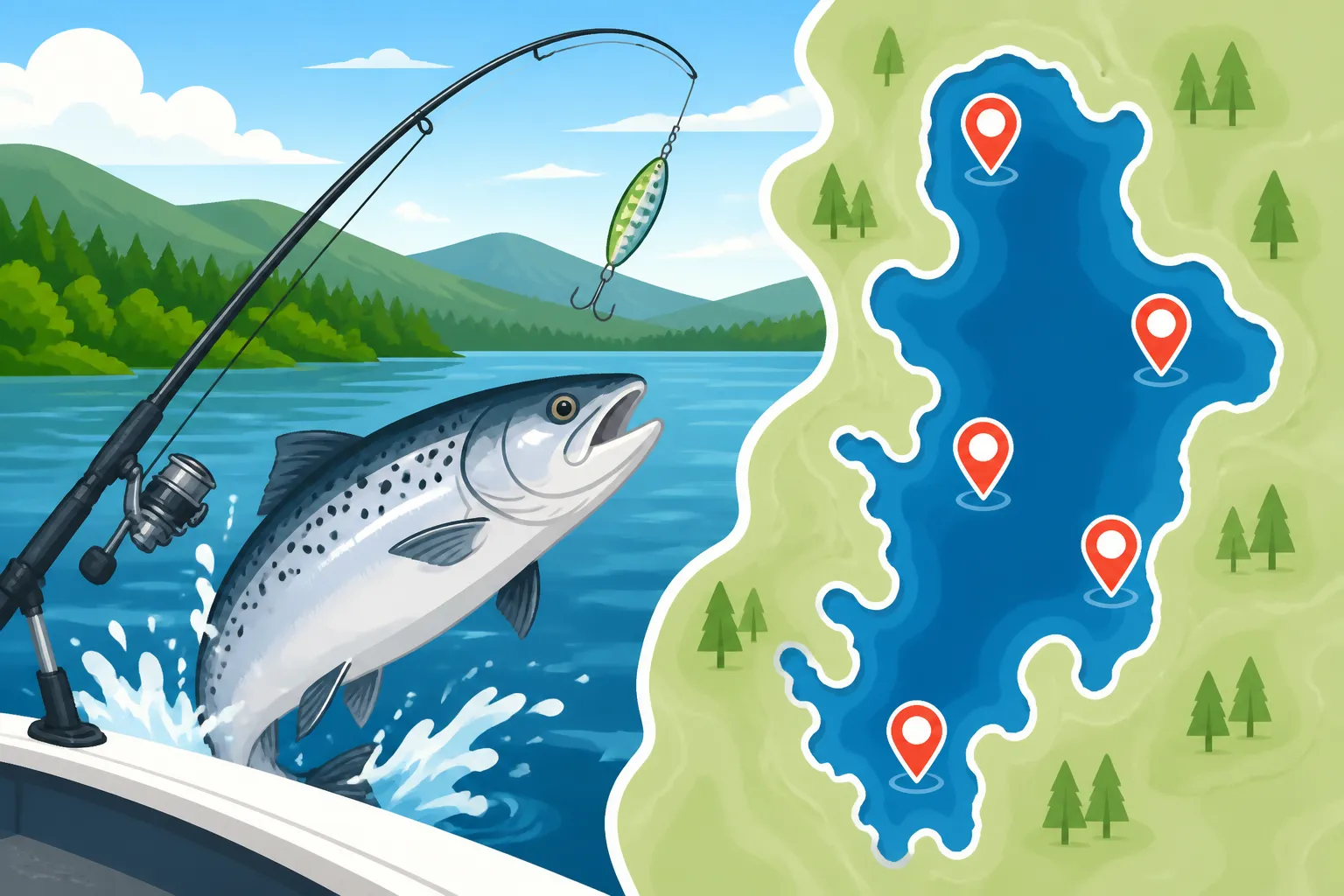
Sunapee Lake is a vast, 4,100-acre glacial lake, carved deep with numerous coves, islands, and pronounced underwater structures. Identifying "the best" trolling spots isn't about finding a single honey hole, but rather understanding the types of areas where salmon are most likely to be found throughout the season. You're looking for convergences of cold water, baitfish, and structure that offer ambush points or travel corridors for these predators.
Southern Basin and Deeper Channels
The southern end of Sunapee Lake, particularly around the towns of Sunapee and Newbury, boasts some of the lake's deepest sections. This area includes expansive basins that drop to over 100 feet in many places. These deep zones are absolutely critical for salmon, especially during the summer, as they provide the cold water refuge these fish need. Trolling here isn't about hugging the shore; it's about covering vast amounts of open water, paying close attention to your sonar for baitfish schools and temperature breaks.
Key areas to focus on include the deeper channels leading out from Newbury Harbor and the wide-open expanse towards Burkehaven. Salmon will often "stack up" or cruise along the edges of these deep basins, particularly where submerged points or humps rise up from the bottom, attracting smelt. Imagine them patrolling the underwater cliffs or suspended over the abyss, waiting for a school of bait to swim by. This open water trolling can be tedious, but it's often where the biggest fish are found, requiring patience and a good understanding of what your electronics are telling you.
The Northern End and Inlet Areas
While the southern end is famous for its depth, the northern end of Sunapee, near Georges Mills and Sunapee Harbor (the actual harbor itself is typically too shallow, but the approaches are key), offers different advantages, especially during cooler water periods. This area can be a hotspot in spring and fall due to its proximity to feeder streams and slightly shallower depths that warm or cool more quickly.
For instance, the waters leading into Georges Mills from the main lake can concentrate baitfish, making them attractive to salmon. Additionally, areas around the mouth of the Sugar River, while not directly accessible for trolling in all parts, influence the baitfish movements in the surrounding lake. Look for subtle underwater contours, points, and even old river channels that might funnel baitfish. In early spring, you might find salmon cruising surprisingly close to the surface in these areas, making them prime targets for flat-lining or using planer boards. Don't be afraid to experiment with your trolling speed for landlocked salmon in these shallower, more dynamic zones.
Mid-Lake Structure and Islands
Sunapee Lake is dotted with islands and features numerous submerged humps, ledges, and rocky points that act as magnets for baitfish and, consequently, salmon. These mid-lake structures provide critical ambush points and areas for salmon to rest and feed. Great Island, Little Island, and the numerous smaller, unnamed humps are all worth exploring.
Trolling around these structures requires precision. You're not just moving in a straight line; you're often tracing the contours, looking for sudden depth changes, rock piles, or shelves where baitfish might be holding. The areas immediately surrounding these islands, especially on their deep-water sides, can be particularly productive. For example, the drop-offs on the east side of Great Island can hold significant numbers of salmon during the summer months. If you’re utilizing a boat with a good fish finder, such as those discussed in guides like Best Fish Finders for New Hampshire Lakes, you’ll be able to identify these structures and the fish holding to them much more effectively.
Here's a quick overview of some prime trolling areas and their seasonal relevance:
| Location / Feature | Prime Season | Typical Trolling Depth (Feet) | Key Considerations |
|---|---|---|---|
| Newbury Harbor Approaches | Summer, Fall | 40-80 | Deep basin, thermocline, baitfish concentrations |
| Georges Mills Entrance | Spring, Fall | 15-40 | Proximity to inlet, cooler surface temps, baitfish |
| Great Island Drop-offs | All Season | 30-70 | Submerged structure, current, ambush points |
| The Ledges (South Basin) | Summer | 50-90 | Very deep water, suspending fish, schooling smelt |
| Sunapee Harbor Approaches | Spring | 20-50 | Early season activity, warming waters |
| Mid-Lake Humps/Bumps | All Season | 30-80 | Specific submerged structure, current breaks |
Essential Trolling Techniques for Sunapee Salmon
Finding the fish is only half the battle; the other half is presenting your lure effectively to entice a strike. Trolling for landlocked salmon on Sunapee Lake is a nuanced art that combines the right gear, understanding your electronics, and a touch of intuition. It’s not simply dragging a lure behind the boat; it’s about carefully controlling depth, speed, and action to mimic the smelt they feed on.
Gear Setup and Lure Selection
When it comes to gear for Sunapee salmon, versatility is key. You'll want medium-light to medium-action rods that can handle the powerful runs of a salmon, paired with reels spooled with quality monofilament or fluorocarbon lines, or a braided line with a fluorocarbon leader for stealth. For reaching those specific depths, downriggers are incredibly effective, allowing you to precisely target the thermocline or specific depths where you're marking fish or bait. Alternatively, lead core line or weighted trolling setups can also get your lures down, though with less pinpoint accuracy. You can learn more about suitable setups in a guide to Best Trolling Gear for New Hampshire Lake Trout, much of which applies to salmon as well.
Lure selection is paramount, and the golden rule for Sunapee salmon is "match the hatch," meaning, imitate the rainbow smelt. Small, slender spoons are perennial favorites. Brands like Mooselook Thinfish, Sutton Spoons, or something similar in silver, blue, green, or even gold patterns, are excellent choices. Smelt-imitating stickbaits like Rapala or Bomber Long A's can also be very effective, especially when trolled on the surface or just below in spring and fall. Don't overlook small flutter spoons or even flies designed to mimic smelt, which can be fished behind a dodger or flasher for added attraction. Experiment with different colors and sizes until you find what the salmon are keying in on that particular day. For more on what these fish eat, check out our guide on What lures imitate the smelt landlocked salmon eat.
Reading Sonar and Interpreting Structure
Your fish finder is your best friend on Sunapee. It's not just a fancy display; it's a window into the underwater world. Learning to interpret what your sonar is showing you will dramatically increase your success rate. Look for arches that indicate individual fish, but also pay close attention to bait balls—dense clouds on your screen that signify schools of smelt. Where there's bait, there's usually salmon not far behind.
Also, use your sonar to identify underwater structure like humps, ledges, and steep drop-offs. Salmon often patrol these areas, using them as ambush points. The thermocline, as mentioned earlier, is another crucial feature your sonar can help you locate. Once you've identified the thermocline, aim to troll your lures just above, within, or just below it, as this is where salmon are most likely to be actively feeding. Don't forget to mark waypoints on your GPS when you get a strike or see significant bait—these spots are often productive repeatedly. Sometimes, understanding the nuances of how deep to troll for salmon at Winnipesaukee can give you a solid baseline for Sunapee as well.
Maximizing Your Success on Sunapee's Waters
Catching landlocked salmon on Sunapee Lake isn't just about showing up with a boat and some lures. It involves strategic thinking, constant adjustment, and a healthy respect for the environment and the regulations. These final tips will help you put all the pieces together for a more fruitful day on the water.
Weather and Time of Day Considerations
Like all fish, salmon are influenced by weather and time of day. Overcast days or periods of low light (dawn and dusk) are often the most productive, as salmon feel less exposed and are more likely to feed actively. On bright, sunny days, they tend to drop deeper and become more cautious, requiring more subtle presentations. Keep an eye on barometric pressure; stable or slowly falling pressure often indicates good fishing, while rapidly changing pressure can shut down the bite.
Wind can also play a significant role. A light chop on the water surface can help break up your boat's silhouette, making it harder for salmon to spot you, while also creating currents that concentrate baitfish. However, too much wind can make boat control and precise trolling difficult. Plan your trips to align with favorable weather patterns and remember that some of the best fishing often happens when you're willing to brave the less "comfortable" conditions. More detailed insights on this can be found in our guide on the Best Time of Day to Catch Landlocked Salmon.
Safety and Regulations Reminder
Sunapee Lake is a large body of water, and conditions can change rapidly. Always prioritize safety. Ensure your boat is properly equipped with all required safety gear, including life jackets for everyone on board, as detailed in New Hampshire Boating Laws for Anglers. Let someone know your float plan, and keep an eye on weather forecasts. It's always better to cut a trip short than to risk getting caught in dangerous conditions.
Furthermore, always be aware of and adhere to the latest New Hampshire landlocked salmon regulations. This includes daily limits, length limits, and any specific gear restrictions that might be in place. Regulations are designed to protect the fishery and ensure healthy populations for future generations of anglers. Ignorance of the rules is not an excuse, and penalties for violations can be steep. A quick review of the New Hampshire Freshwater Fishing Digest can keep you current on all the specifics. Respect other boaters and anglers, practice responsible catch and release, and leave no trace behind. If you're looking for an alternative way to get on the water and learn the ropes, booking a trip with a local guide through FishingBooker can offer a safe and informative experience.
Disclaimer
The information provided in this guide is for general informational purposes only and should not be considered legal advice or a substitute for consulting official New Hampshire Fish and Game Department regulations. Fishing conditions, regulations, and fish behavior can change, so always ensure you check the most current rules and local advisories before heading out on the water.